| IELTS listening The Morrow Museum Tour listening practice test has 10 questions belongs to the History & Museum Studies subject.. |
You will hear the curator of the Morrow Museum talking about the museum’s attractions. Hello, and welcome to the Morrow Museum. As you can see, this is our reception, and there’s also a small shop where you can buy some books on the artist and his times, as well as postcards and other reproductions of some of his best-known paintings.
To your right is a study room for scholars to examine the many diaries, letters and other documents relevant to the artist’s life. While to the left is a small theatre in which you can view a short TV documentary that was made a few years ago.
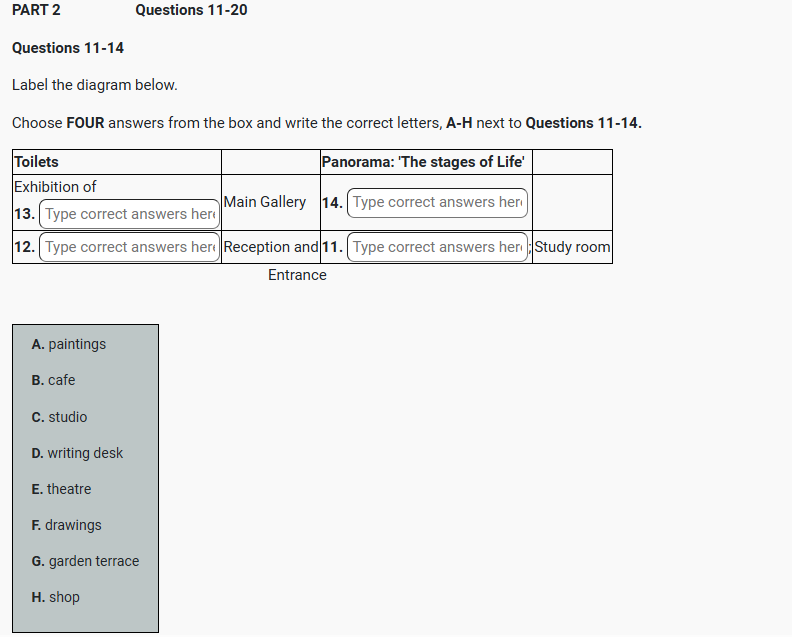
Behind me is the main gallery, which not only contains some of Moreau’s better-known oil paintings, but also some artefacts from his life, including his writing desk with photos of his much-loved wife and family.
Go through to the left and there’s a small exhibition of Morrow’s drawings, and beyond that is a small cafe with a small garden terrace and some toilets. Going back to the main gallery and continuing to the right, you’ll find a reproduction of Morrow’s studio and what it may have looked like in the 1870s, at the time he was painting his famous The Stages of Life panorama.
If you go through this, you come to the museum’s star attraction, the panorama, the stages of life. Before you go into the museum, perhaps it’s worth giving you a little information on the artist. Anthony Moreau, that’s M-O-R-R-O-W, is often confused with his French contemporary, Gustave Moreau, M-O-R-E-A-U.
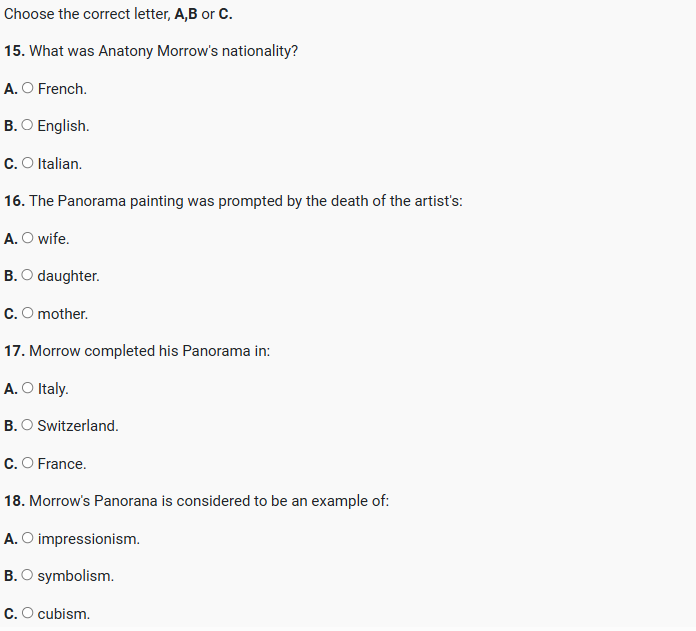
And though he worked for many years in France and was well known to his French contemporaries, he was actually born here in England to an English father and Italian mother. His life was full of joy and tragedy.
He had a loving wife, who he adored, and five children, leading a happy married life. However, the death of his eldest child, a girl, came as a great blow to him, and this was followed the next year by the passing of his beloved mother. However, it was the death of his wife, while giving birth to their youngest child, that had the most profound effect on Morrow, and was the ultimate inspiration for his stages of life panorama.
Following his wife’s passing, Moreau found he was no longer able to work in the family home, which contained so many memories. So he left his children in the care of his loving sister and travelled throughout Europe. He first went to Italy and stayed for a while with his mother’s family in Naples.
It was in Italy that he first had the idea for the panorama and made some preliminary drawings, which can be seen in our drawing gallery. However, still plagued by grief, he then moved on to France and, as a result of a bout of illness, went on to Switzerland to recuperate. He then returned to France, and it was in Marseille, where he lived for many years before, that he painted his panorama.
Though the painting has some affinity with the Impressionists in the handling of paint and the range of colours, his work is generally accepted as an example of symbolism, though some have likened it to the post-Impressionist works of Cézanne and others, while some historians have seen elements of Cubism, though this is not a view held by many.
However, when it was exhibited in 1876 it was not received well by the critics. However, it was bought by a wealthy Parisian industrialist and placed in his private chapel.
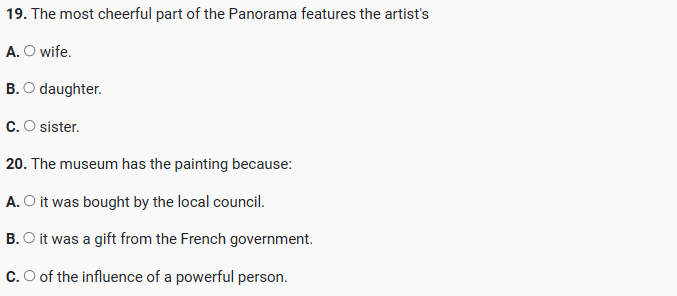
The panorama charts life from birth to death. The artist produced it as a semi-circular panorama. As he said, life surrounds us and consumes us all. When you look at the painting, you may recognize some of Moreau’s family members from the photos in the main gallery. His youngest daughter, Charlotte, can be seen in the early stages of life’s saga in somewhat nostalgic, melancholic scenes.
His sister also appears in the middle section in perhaps the least mournful passage of the painting, while his wife, perhaps not surprisingly, takes centre stage at the end. You may wonder how the painting ended up here in a small English seaside town.
The building, which now houses the museum, was once Moreau’s childhood home and was bought by the local council when it was threatened with demolition in the 1970s. The Panorama had been in the country since the end of the Second World War, when it was given to the nation by the French government as a token of appreciation for our hosting the Free French Forces.
However, it was the intervention of Clementine Churchill, Winston Churchill’s widow, that saw it being permanently housed here. It is a sad, yet at the time an uplifting painting, from one of our least known, but perhaps most romantic painters. I hope you enjoy your visit.
Learn From Experienced Teacher.
Best IELTS Coaching Dehradun.

7055710004
IELTS Simulation 323 GMS Road, Near Ballupur Chowk, Dehradun, India

email: info at ieltsband7.com