| IELTS listening Conservation of Reptiles listening practice test has 10 questions belongs to the Environment & Wildlife Conservation subject.. |
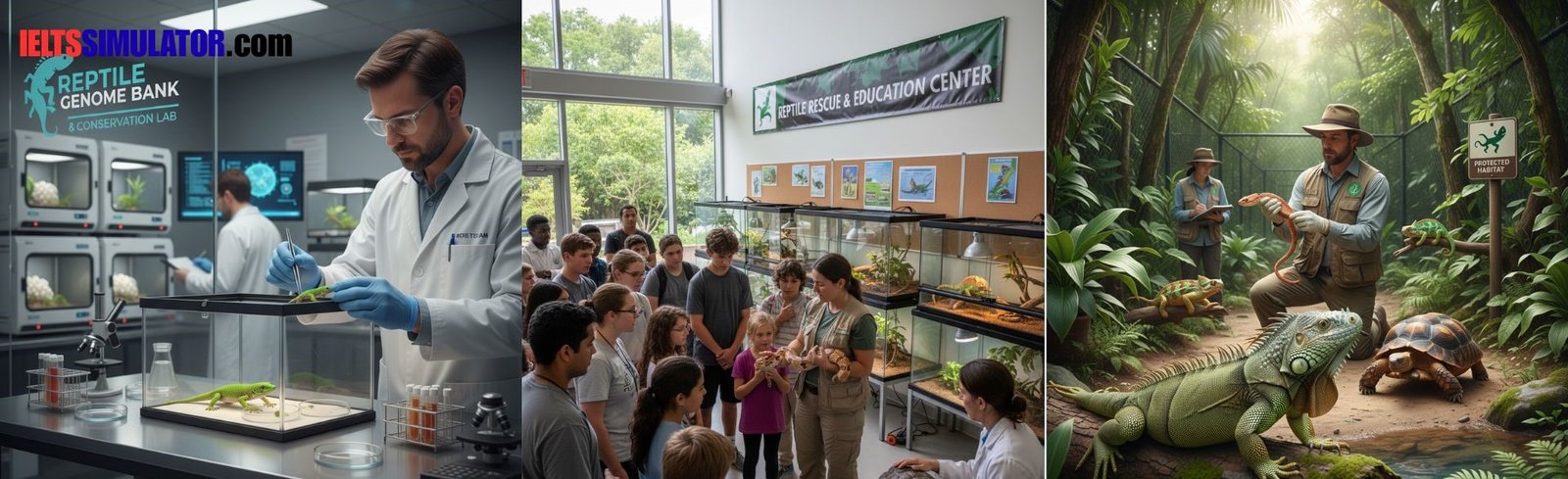
You will hear a lecture on the conservation of reptiles. I’d like to welcome everyone to the last lecture in our series on conservation. This time, we’ll be talking about reptiles. You might not have thought much about conservation in terms of reptiles, which includes lizards, snakes, crocodiles, and turtles, and there’s a good reason for that. Reptiles are, generally speaking, not well represented in conservation strategies.
Few people are aware that around 100 species of snake are threatened with extinction, for example. As well as the illegal pet trade, lizards are most at risk from rising temperatures globally, as it affects their ability to hunt. So, what are reptiles and where do they live? Reptiles are cold-blooded, which means their body temperature varies with the outside environment, unlike us mammals, whose temperature remains constant. Reptiles can be found in diverse habitats.
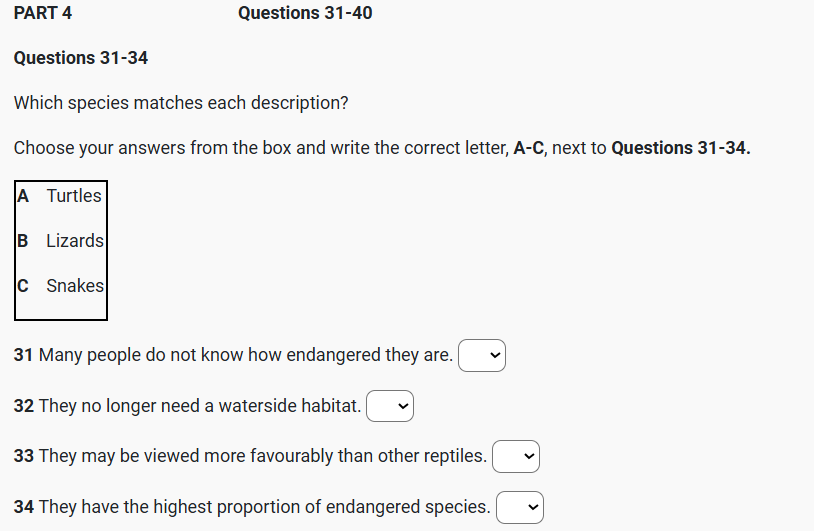
Although they prefer environments which offer both land and water, many, such as lizards, have adapted to live away from the water. they live in the tropics, as well as freshwater and oceanic habitats. People often assume that there are fewer conservation efforts concerning reptiles because they lack the cute and cuddly appeal of species with fur or feathers. This isn’t necessarily true of turtles, though, who lack the scary perception of most reptiles. That may be one of the reasons that conservationists also lack data on reptile species, meaning their conservation needs are less well understood. We do, however, know that between 18 and 33% of reptile species are in danger of extinction. When it comes to turtles, this rises to 59% of the species. To put this into context, 15% of bird species are threatened with extinction, much fewer than reptiles.

Like many other species, reptiles are at risk of habitat loss due to urban expansion and the rise of animal agriculture, pollution and climate change. The biggest threat faced by reptiles, however, is from hunting, due to their value in fashion and traditional medicine. There are many reasons why we need to put more effort into the conservation of reptiles. They play a crucial role in maintaining the balance of the natural world. Many of them are top predators, controlling the population of insects and small animals that could otherwise cause havoc in the ecosystem. Reptiles also play an important role as pollinators. This means they spread the seeds of plants which sustain countless other species. One particular reason to conserve reptiles is that they represent billions of years of evolutionary history, including the ability to adapt to diverse environments.
You may have heard that, in spite of there being few initiatives focusing on the conservation of reptiles, many reptile species benefit from conservation efforts that target other species, especially mammals and birds. This is true in that reptiles are most threatened in areas where other species are also threatened. However, some reptile species with small ranges, meaning they spend their entire lives within a limited area, require special interventions to survive. So what can be done specifically to help reptiles that are at risk of extinction? As with most other species, education is certainly more crucial than all the others. It can be hard to change people’s perception of species they have always hunted, but we have seen many examples of conservation programmes around the world that have turned lifelong hunters into protectors of endangered species. Linked to education is the need for legislation.

Where species are at risk, it is crucial for governments to take action to protect them via the law, imposing harsh penalties on those who continue to kill them. I’d now like to focus on a few examples of reptiles in danger. First of all, one of the largest living reptiles and the largest predator in the Americas, the Orinoco crocodile, which is only found in the basin of the Orinoco River in Venezuela and Colombia. The species came very close to extinction in the mid-20th century as it was hunted for its skin. The Orinoco crocodile was given protected status in the 1970s, but has still not recovered, and there are only an estimated 250 to 500 individuals left in the wild. While the Colombians have introduced captive breeding programs and released baby crocs into the wild, the programs cannot be considered a complete success due to lack of funds and other issues.
The second reptile species I’d like to talk about is the Madagascar big-headed turtle, which is a top priority of conservationists. As the name would suggest, this species lives only in the freshwater habitats of Madagascar, off the coast of Africa. The reason for the endangerment of this species is the huge appetite for its meat in Asia, and in spite of a ban on their export, this trade continues. The Turtle Conservation Fund is focused on protecting this important species through education programmes, captive breeding and reintroduction. The final reptile I want to discuss is one of the rarest snakes in the world, the ornate ground snake. There are thought to be less than 20 individuals left on a single island called Maria Major in Saint Lucia. The reason for the endangerment of this species is the introduction of invasive species, such as mongoose, to the other islands.
The species was actually declared extinct in 1936, but rediscovered in 1973, and a captive breeding programme is now underway to save this critically endangered species.
Experienced Teacher Best Training By CELTA Trainer.
Small Batch Size, Flexible Time.

7055710004
IELTS Simulation 323 GMS Road, Near Ballupur Chowk, Dehradun, India

email: info at ieltsband7.com