IELTS READING – Children with auditory problems S46AT1

| IELTS Reading Children with auditory problems reading practice test has 10 questions belongs to Health & Education subject.. |
A. Hearing impairment or other auditory function deficit in young children can have a major impact on their development of speech and communication, resulting in a detrimental effect on their ability to learn at school. This is likely to have major consequences for the individual and the population as a whole. Q6 The New Zealand Ministry of Health has found from research carried out over Q7 two decades that 6-10% of children in that country are affected by hearing loss.
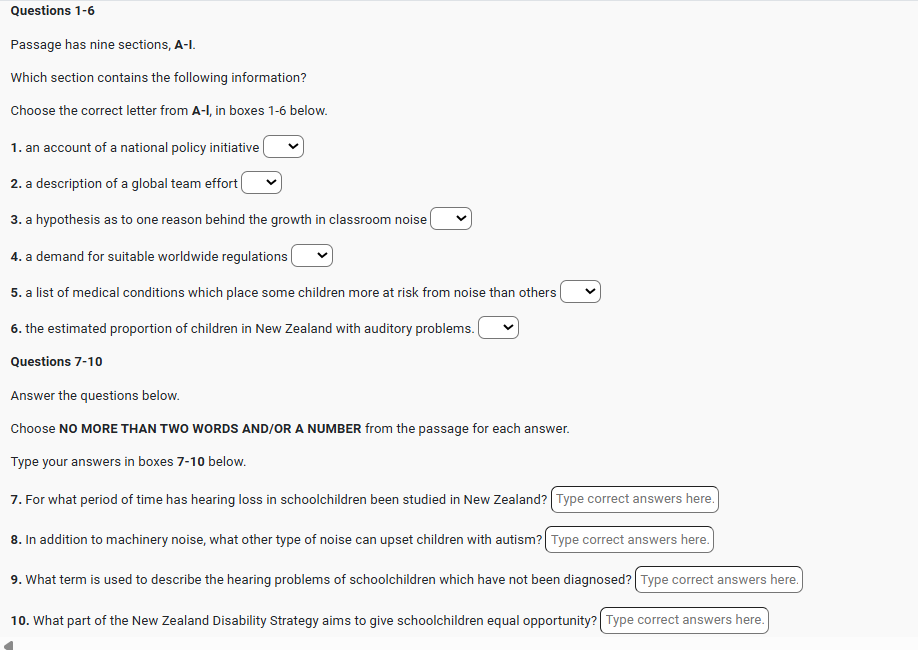
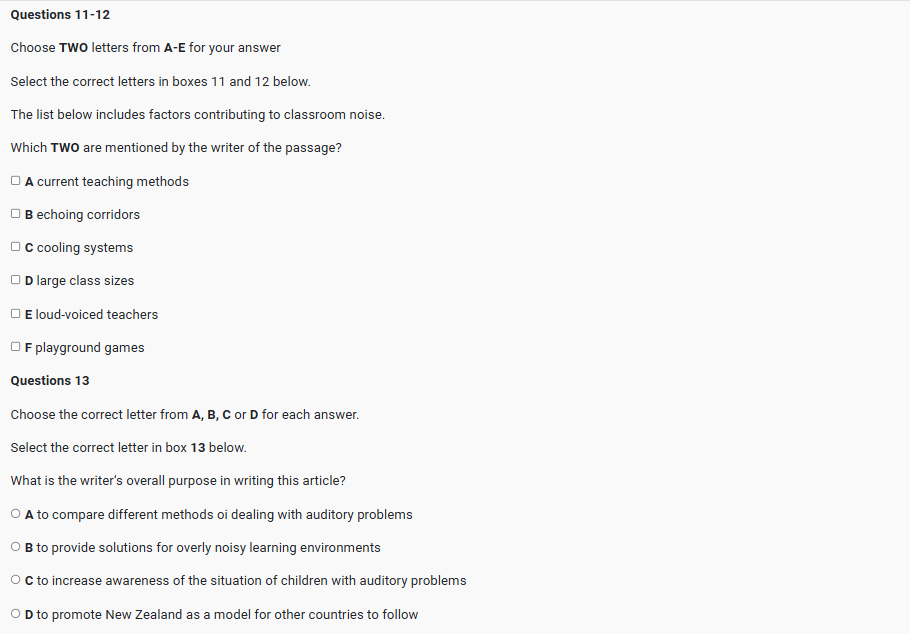
B. A preliminary study in New Zealand has shown that classroom noise presents a major concern for teachers and pupils. Q11 Modern teaching practices, the organization of desks in the classroom, poor classroom acoustics, and mechanical means of ventilation such as Q12 air-conditioning units all contribute to the number of children unable to comprehend the teachers voice. Q3 Education researchers Nelson and Soli have also suggested that recent trends in learning often involve collaborative interactions of multiple minds and tools as much as individual possession of information. This all amounts to heightened activity and noise levels, which have the potential to be particularly serious for children experiencing auditory function deficit. Noise in classrooms can only exacerbate their difficulty in comprehending and processing verbal communication with other children and instructions from the teacher.
C. Children with auditory function deficit are potentially failing to learn to their maximum potential because of noise levels generated in classrooms. The effects of noise on the ability of children to team effectively in typical classroom environments are now the subject of increasing concern. Q2 The International Institute of Noise Control Engineering(I-INCE), on the advice of the World Health Organization, has established an international working party, which includes New Zealand, to evaluate noise and reverberation control for school rooms.
D. While the detrimental effects of noise in classroom situations are not limited to children experiencing disability, those with a disability that affects their processing of speech and verbal communication could be extremely vulnerable. Q5 The auditory function deficits in question include hearing impairment, autistic spectrum disorders (ASD) and attention deficit disorders ADD/ADHD).
E. Autism is considered a neurological and genetic life-long disorder that causes discrepancies in the way information is processed. This disorder is characterized by interlinking problems with social imaginations, social communication, and social interaction. According to Janzen, this affects the ability to understand and relate in typical ways to people, understand events and objects in the environment, and understand or respond to sensory stimuli. Autism does not allow learning or thinking in the same ways as in children who are developing normally.
Autistic spectrum disorders often result in major difficulties in comprehending verbal information and speech processing. Those experiencing these disorders often find sounds such as Q8 crowd noise and the noise generated by machinery painful and distressing. This is difficult to scientifically quantify as such extra-sensory stimuli vary greatly from one autistic individual to another. But a child who finds any type of noise in their classroom or learning space intrusive is likely to be adversely affected in their ability to process information.
F. The attention deficit disorders are indicative of neurological and genetic disorders and are characterized by difficulties with sustaining attention, effort and persistence, organization skills, and disinhibition. Children experiencing these disorders find it difficult to screen out unimportant information, and focus on everything in the environment rather than attending to a single activity. Background noise in the classroom becomes a major distraction, which can affect their ability to concentrate.
G. Children experiencing an auditory function deficit can often End speech and communication very difficult to isolate and process when set against high levels of background noise. These levels come from outside activities that penetrate the classroom structure, from teaching activities, and other noise generated inside, which can be exacerbated by room reverberation. Strategies are needed to obtain the optimum classroom construction and perhaps a change in classroom culture and methods of teaching. In particular, the effects of noisy classrooms and activities on those experiencing disabilities in the form of auditory function deficit need thorough investigation. It is probable that many undiagnosed children exist in the education system with Q9 invisible disabilities. Their needs are less likely to be met than those of children with known disabilities
H. Q1 The New Zealand Government has developed a New Zealand Disability Strategy and has embarked on a wide-ranging consultation process. The strategy recognizes that people experiencing disability face significant barriers in achieving a full quality of life in areas such as attitude, education, employment, and access to services. Q10 Objective 3 of the New Zealand Disability Strategy is to ‘Provide the Best Education for Disabled People’ by improving education so that all children, youth learners, and adult learners will have equal opportunities to learn and develop within their already existing local school. For a successful education, the learning environment is vitally significant, so any effort to improve this is likely to be of great benefit to all children, but especially to those with auditory function disabilities.
I. A number of countries are already in the process of formulating their own standards for the control and reduction of classroom noise. New Zealand will probably follow their example. The literature to date on noise in school rooms appears to focus on the effects on schoolchildren in general, their teachers, and the hearing impaired. Only limited attention appears to have been given to those students experiencing the other disabilities involving auditory function deficit. Q4 It is imperative that the needs of these children are taken into account in the setting of appropriate international standards to be promulgated in future.
Prepare for IELTS IELTS Test International Experienced Teacher Best Training By CELTA Trainer. Best Results Easily Get Required Score IELTS Exam Dates Available, Small Batch Size with Flexible Time, Professional.

8439000086
8439000087
7055710003
7055710004
IELTS Simulation 323 GMS Road, Near Ballupur Chowk, Dehradun, India

email: info at ieltsband7.com
Boost Your Score: Practice IELTS Online with IELTS Simulator Prepare for IELTS Effectively Using IELTS Simulator Ace the IELTS: Try Realistic Practice on IELTS Simulator IELTS Simulator: Online Practice to Improve Your IELTS Score Rocky Bay field trip listening practice test has 10 questions belongs to the Leisure & Entertainment subject. Prepare for IELTS IELTS Test International Experienced Teacher Best Training By CELTA Trainer. Best Results Easily Get Required Score IELTS Exam Dates Available, Small Batch Size with Flexible Time, Professional. Easily Get Required Score I am interested in IELTS Pass with Confidence, Dehradun Small Batch Size with Flexible Time, professional faculty. Learn From Experienced Teacher Best IELTS Coaching Dehradun Best IELTS in Dehradun Uttarakhand GMS Road BEST coaching in Dehradun Apply for Class Courses Today Good Results. Small Batch Size, Flexible Time and Professional IELTS Teacher Best IELTS coaching classes IDP certified British Council trained and CELTA certified experienced trainer. Easily Get Required Score Tel:8439000086 Tel:8439000087 Tel:7055710003 Tel:7055710004 Tel:7055710009