IELTS READING – The True Cost of Food S38AT2

 IELTS Reading The True Cost of Food reading practice test has 10 questions belongs to Economics & Agriculture subject..

A. For more than forty years the cost of food has been rising. It has now reached a point where a growing number of people believe that it is far too high and that bringing it down will be one of the great challenges of the twenty-first century. That cost, however, is not in immediate cash. In the West at least, most food is now far cheaper to buy in relative terms than it was in 1960. The cost is in the collateral damage of the very methods of food production that have made the food cheaper: in the pollution of water, the enervation of soil, the destruction of wildlife, the harm to animal welfare, and the threat to human health caused by modern industrial agriculture.

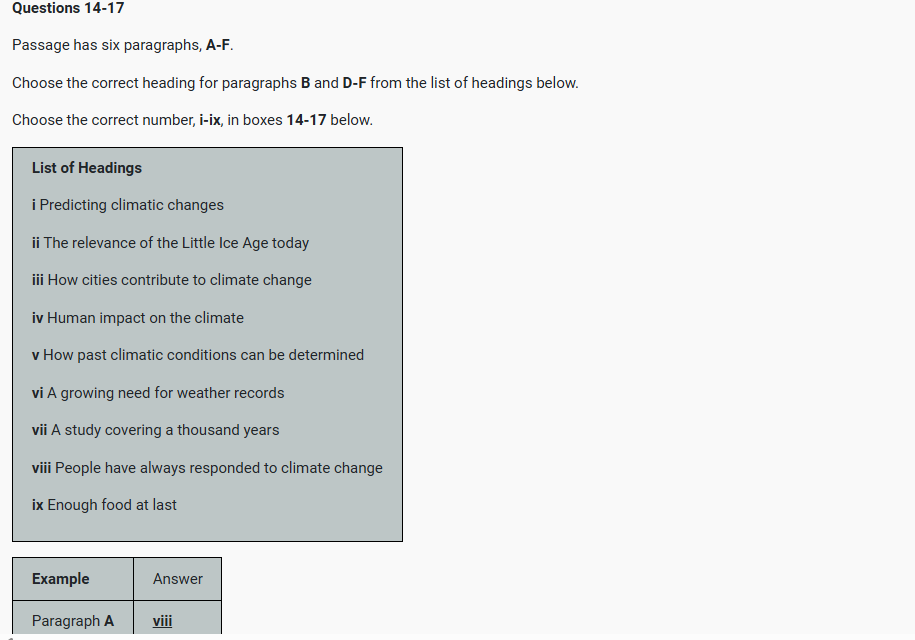
B. Q15 First mechanisation, then mass use of chemical fertilisers and pesticides, then monocultures, then battery rearing of livestock, and now genetic engineering– the onward march of intensive farming has seemed unstoppable in the last half-century, as the yields of produce have soared. Q18 But the damage it has caused has been colossal. In Britain, for example, many of our best-loved farmland birds, such as the skylark, the grey partridge, the lapwing, and the corn bunting, have vanished from huge stretches of countryside, as have even more wild-flowers and insects. This is a direct result of the way we have produced our food in the last four decades. Thousands of miles of hedgerows, thousands of ponds have disappeared from the landscape. The faecal filth of salmon farming has driven wild salmon from many of the sea lochs and rivers of Scotland. Q17 Natural soil fertility is dropping in many areas because of continuous industrial fertiliser and pesticide use, while the growth of algae is increasing in lakes because of the fertiliser run-off.

C. Put it all together and it looks like a battlefield, but consumers rarely make the connection at the dinner table. Q16 That is mainly because the costs of all this damage are what economists refer to as externalities: they are outside the main transaction, which is for example producing and selling a field of wheat, and are borne directly by neither producers nor consumers. Q20 To many, the costs may not even appear to be financial at all, but merely aesthetic -a terrible shame, but nothing to do with money. And anyway they, as consumers of food, certainly aren’t paying for it, are they?

D. But the costs to society can actually be quantified and, when added up, can amount to staggering sums. A remarkable exercise in doing this has been carried out by one of the world’s leading thinkers on the future of agriculture, Professor Jules Pretty, Director of the Centre for Environment and Society at the University of Essex. Professor Pretty and his colleagues calculated the externalities of British agriculture for one particular year. They added up the costs of repairing the damage it caused and came up with a total figure of £2,343m. This is equivalent to £208 for every hectare of arable land and permanent pasture, almost as much again as the total government and EU spends on British farming in that year. And according to Professor Pretty, it was a conservative estimate.

E. The costs included: £120m for removal of pesticides; £16m for removal of nitrates; £55m for removal of phosphates and soil; Q14 £23m for the removal of the bug cryptosporidium from drinking water by water companies; £125m for damage to wildlife habitats, hedgerows and dry stone walls; £1,113m from emissions of gases likely to contribute to climate change; £106m from soil erosion and organic carbon losses; Q21 £169m from food poisoning; and £607m from cattle disease. Professor Pretty draws a simple but memorable conclusion from all this: our Q22 food bills are actually threefold. We are paying for our supposedly cheaper food in three separate ways: once over the counter, secondly through our taxes, which provide the enormous subsidies propping up modern intensive farming, and thirdly to clean up the mess that modern farming leaves behind.

F. So can the true cost of food be brought down? Breaking away from industrial agriculture as the solution to hunger may be very hard for some countries, but in Britain, where the immediate need to supply food is less urgent, and the costs and the damage of Q23 intensive farming have been clearly seen, it may be more feasible. The government needs to create sustainable, competitive, and diverse farming and food sectors, which will contribute to a thriving and sustainable rural economy, and advance environmental, economic, health, and animal welfare goals.

G. But if industrial agriculture is to be replaced, what is a viable alternative? Professor Pretty feels that Q24 organic farming would be too big a jump in thinking and in practices for many farmers. Furthermore, the price premium would put the product out of reach of many poorer consumers. He is recommending the immediate introduction of a ‘Q25 Greener Food Standard’, which would push the market towards more sustainable environmental practices than the current norm, while not requiring the full commitment to organic production. Such a standard would comprise agreed practices for different kinds of farming, covering agrochemical use, soil health, land management, water and energy use, food safety, and animal health. It could go a long way, he says, to shifting Q26 consumers as well as Q26 farmers towards a more sustainable system of agriculture.


Boost Your Score: Practice IELTS Online with IELTS Simulator.

phone icon
8439000086
8439000087
7055710003
7055710004
IELTS Simulation 323 GMS Road, Near Ballupur Chowk, Dehradun, India

Chat on WhatsApp
email: info at ieltsband7.com

IELTS READING – Why pagodas don’t fall down S38AT1

 IELTS Reading Why pagodas don’t fall down reading practice test has 10 questions belongs to 🏯 Architecture & Engineering subject..

In a land swept by typhoons and shaken by earthquakes, how have Japan’s tallest and seemingly flimsiest old buildings – 500 or so wooden pagodas – remained standing for centuries? Q1 Records show that only two have collapsed during the past 1400 years. Those that have disappeared were destroyed by fire as a result of lightning or civil war. Q2 The disastrous Hanshin earthquake in 1995 killed 6,400 people, toppled elevated highways, flattened office blocks and devastated the port area of Kobe. Yet it left the magnificent five-storey pagoda at the Toji temple in nearby Kyoto unscathed, though it levelled a number of buildings in the neighbourhood.

Japanese scholars have been mystified for ages about why these tall, slender buildings are so stable. It was only thirty years ago that the building industry felt confident enough to erect office blocks of steel and reinforced concrete that had more than a dozen floors. With its special shock absorbers to dampen the effect of sudden sideways movements from an earthquake, the thirty-six-storey Kasumigaseki building in central Tokyo – Japan’s first skyscraper – was considered a masterpiece of modern engineering when it was built in 1968.

Yet in 826, with only pegs and wedges to keep his wooden structure upright, the master builder Kobodaishi had no hesitation in sending his majestic Toji pagoda soaring fifty-five metres into the sky – nearly half as high as the Kasumigaseki skyscraper built some eleven centuries later. Clearly, Japanese carpenters of the day knew a few tricks about allowing a building to sway and settle itself rather than fight nature’s forces. But what sort of tricks?

Q9 The multi-storey pagoda came to Japan from China in the sixth century. As in China, they were first introduced with Buddhism and were attached to important temples. Q7 The Chinese built their pagodas in brick or stone, with inner staircases, and used them in later centuries mainly as watchtowers. Q4&Q5 When the pagoda reached Japan, however, its architecture was freely adapted to local conditions – they were built less high, typically five rather than nine storeys, made mainly of wood and the staircase was dispensed with because the Japanese pagoda did not have any practical use but became more of an art object. Because of the typhoons that batter Japan in the summer, Japanese builders learned to extend the eaves of buildings further beyond the walls. This prevents rainwater gushing down the walls. Pagodas in China and Korea have nothing like the overhang that is found on pagodas in Japan.

Q8 The roof of a Japanese temple building can be made to overhang the sides of the structure by fifty per cent or more of the building’s overall width. Q6 For the same reason, the builders of Japanese pagodas seem to have further increased their weight by choosing to cover these extended eaves not with the porcelain tiles of many Chinese pagodas but with much heavier earthenware tiles.

But this does not totally explain the great resilience of Japanese pagodas. Q11 Is the answer that, like a tall pine tree, the Japanese pagoda – with its massive trunk-like central pillar known as shinbashira – simply flexes and sways during a typhoon or earthquake? For centuries, many thought so. But the answer is not so simple because the startling thing is that the shinbashira actually carries no load at all. In fact, in some pagoda designs, it does not even rest on the ground, but is suspended from the top of the pagoda – hanging loosely down through the middle of the building. The weight of the building is supported entirely by twelve outer and four inner columns.

And what is the role of the shinbashira, the central pillar? The best way to understand the shinbashira’s role is to watch a video made by Shuzo Ishida, a structural engineer at Kyoto Institute of Technology. Q12 Mr Ishida, known to his students as ‘Professor Pagoda’ because of his passion to understand the pagoda, has built a series of models and tested them on a ‘shake-table’ in his laboratory. In short, the shinbashira was acting like an enormous stationary pendulum. Q12 The ancient craftsmen, apparently without the assistance of very advanced mathematics, seemed to grasp the principles that were, more than a thousand years later, applied in the construction of Japan’s first skyscraper. Q10&13 What those early craftsmen had found by trial and error was that under pressure a pagoda’s loose stack of floors could be made to slither to and fro independent of one another. Viewed from the side, the pagoda seemed to be doing a snake dance – with each consecutive floor moving in the opposite direction to its neighbours above and below. The shinbashira, running up through a hole in the centre of the building, constrained individual storeys from moving too far because, after moving a certain distance, they banged into it, transmitting energy away along the column.

Another strange feature of the Japanese pagoda is that, because the building tapers, with each successive floor plan being smaller than the one below, none of the vertical pillars that carry the weight of the building is connected to its corresponding pillar above. In other words, a five-storey pagoda contains not even one pillar that travels right up through the building to carry the structural loads from the top to the bottom. More surprising is the fact that the individual storeys of a Japanese pagoda, unlike their counterparts elsewhere, are not actually connected to each other. They are simply stacked one on top of another like a pile of hats. Interestingly, such a design would not be permitted under current Japanese building regulations.

And the extra-wide eaves? Think of them as a tightrope walker’s balancing pole. The bigger the mass at each end of the pole, the easier it is for the tightrope walker to maintain his or her balance. The same holds true for a pagoda. ‘With the eaves extending out on all sides like balancing poles,’ says Mr Ishida, ‘the building responds to even the most powerful jolt of an earthquake with a graceful swaying, never an abrupt shaking.’ Here again, Japanese master builders of a thousand years ago anticipated concepts of modern structural engineering.


Prepare for IELTS Test International Experienced Teacher Best Training By CELTA Trainer. Best Results Easily Get Required Score IELTS Exam Dates Available, Small Batch Size with Flexible Time, Professional.

phone icon
8439000086
8439000087
7055710003
7055710004
IELTS Simulation 323 GMS Road, Near Ballupur Chowk, Dehradun, India
Chat on WhatsApp
email: info at ieltsband7.com

IELTS READING – Educating Psyche S37AT3

IELTS Reading Educating Psyche reading practice test has 10 questions belongs to 🧠 Psychology & Education subject..

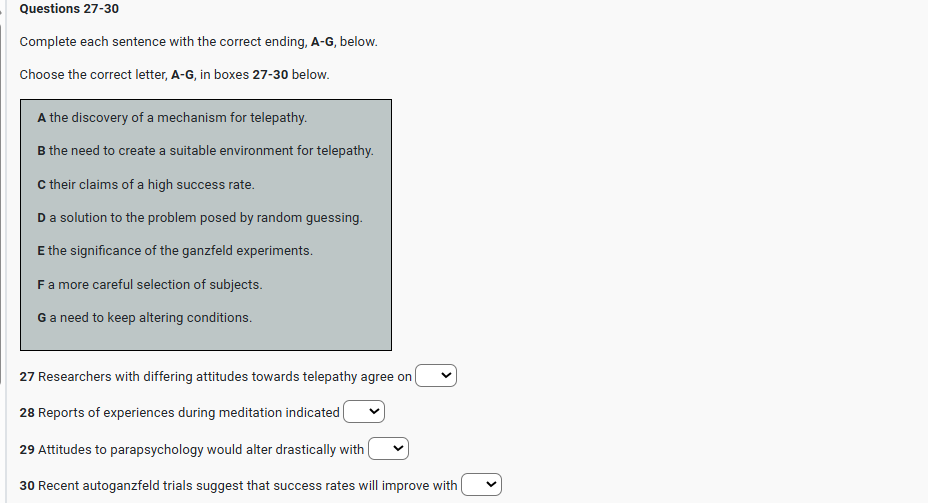
Q27 Educating Psyche by Bernie Neville is a book which looks at radical new approaches to learning, describing the effects of emotion, imagination, and the unconscious on learning. One theory discussed in the book is that proposed by George Lozanov, which focuses on the power of suggestion.

Q28 Lozanov’s instructional technique is based on the evidence that the connections made in the brain through unconscious processing (which he calls non-specific mental reactivity) are more durable than those made through conscious processing. Besides the laboratory evidence for this, Q28 we know from our experience that we often remember what we have perceived peripherally, long after we have forgotten what we set out to learn. Q29 If we think of a book we studied months or years ago, we will find it easier to recall peripheral details – the colour, the binding, the typeface, the table at the library where we sat while studying it – than the content on which we were concentrating. If we think of a lecture we listened to with great concentration, we will recall the lecturer’s appearance and mannerisms, our place in the auditorium, the failure of the air-conditioning, much more easily than the ideas we went to learn. Even if these peripheral details are a bit elusive, they come back readily in hypnosis or when we relive the event imaginatively, as in psychodrama. The details of the content of the lecture, on the other hand, seem to have gone forever.

This phenomenon can be partly attributed to the common counterproductive approach to study (making extreme efforts to memorise, tensing muscles, inducing fatigue), but it also simply reflects the way the brain functions. Q30 Lozanov therefore made indirect instruction (suggestion) central to his teaching system. Q27 In suggestopedia, as he called his method, consciousness is shifted away from the curriculum to focus on something peripheral. The curriculum then becomes peripheral and is dealt with by the reserve capacity of the brain.

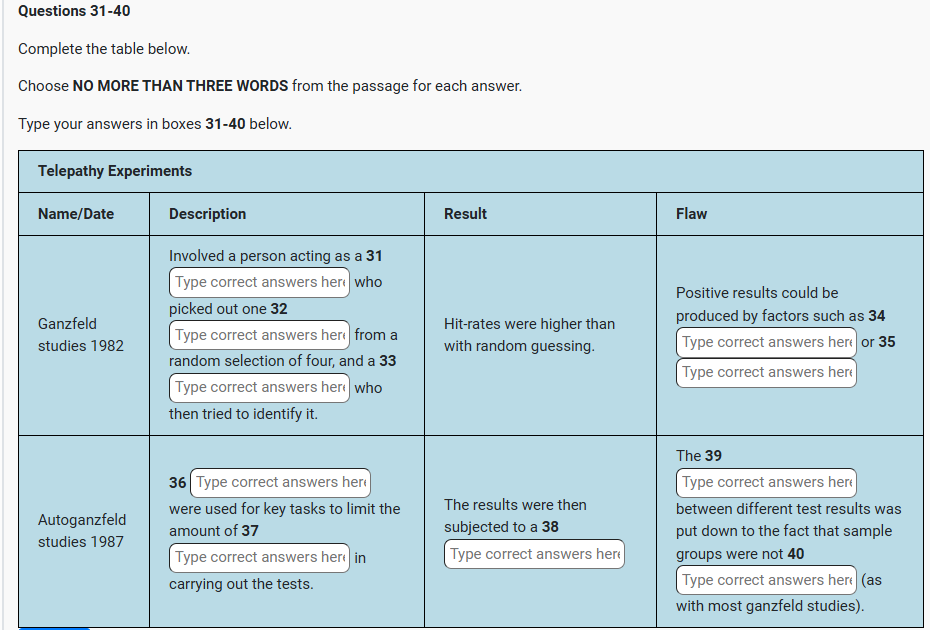
The suggestopedic approach to foreign language learning provides a good illustration. In its most recent variant (1980), it consists of the reading of vocabulary and text while the class is listening to music. The first session is in two parts. Q31 In the first part, the music is classical (Mozart, Beethoven, Brahms) and the teacher reads the text slowly and solemnly, with attention to the dynamics of the music. The students Q31 follow the text in their books. This is followed by several minutes of silence. In the second part, they listen to baroque music (Bach, Corelli, Handel) while the teacher reads the text in a normal speaking voice. During this time Q31 they have their books closed. During the whole of this session, their attention is passive; they listen to the music but make no attempt to learn the material.

Q32 Beforehand, the students have been carefully prepared for the language learning experience. Through meeting with the staff and satisfied students they develop the expectation that learning will be easy and pleasant and that they will successfully learn several hundred words of the foreign language during the class. In a preliminary talk, the teacher introduces them to the material to be covered, but does not ‘teach’ it. Likewise, the students are instructed not to try to learn it during this introduction.

Some hours after the two-part session, Q33 there is a follow-up class at which the students are stimulated to recall the material presented. Once again the approach is indirect. The students do not focus their attention on trying to remember the vocabulary, but focus on using the language to communicate (e.g. through games or improvised dramatisations). Such methods are not unusual in language teaching. What is distinctive in the suggestopedic method is that they are devoted entirely to assisting recall. The ‘learning’ of the material is assumed to be automatic and effortless, accomplished while listening to music. The teacher’s task is to assist the students to apply what they have learned paraconsciously, and in doing so to make it easily accessible to consciousness. Q36 Another difference from conventional teaching is the evidence that students can regularly learn 1000 new words of a foreign language during a suggestopedic session, as well as grammar and idiom.

Lozanov experimented with teaching by direct suggestion during sleep, hypnosis, and trance states, but found such procedures unnecessary. Hypnosis, yoga, Silva mind-control, religious ceremonies, and faith healing are all associated with Q39 successful suggestion, but none of their techniques seem to be essential to it. Such rituals may be seen as placebos. Lozanov acknowledges that the Q37 ritual surrounding suggestion in his own system is also a Q38 placebo, but maintains that without such a placebo people are unable or afraid to tap the reserve capacity of their brains. Like any placebo, it must be dispensed with authority to be effective. Just as a doctor calls on the full power of autocratic suggestion by insisting that the patient take precisely this white capsule precisely three times a day before meals, Lozanov is categoric in insisting that the suggestopedic session be conducted exactly in the manner designated, by trained and accredited suggestopedic teachers.

While suggestopedia has gained some notoriety through success in the teaching of modern languages, few teachers are able to emulate the Q40 spectacular results of Lozanov and his associates. We can, perhaps, attribute mediocre results to an inadequate placebo effect. The students have not developed the appropriate mindset. They are often not motivated to learn through this method. They do not have enough ‘faith’. They do not see it as ‘real teaching’, especially as it does not seem to involve the ‘work’ they have learned to believe is essential to learning.


Easily Get Required Score I am interested in IELTS Pass with Confidence, Dehradun Small Batch Size with Flexible Time, professional faculty.

phone icon
8439000086
8439000087
7055710003
7055710004
IELTS Simulation 323 GMS Road, Near Ballupur Chowk, Dehradun, India
Chat on WhatsApp
email: info at ieltsband7.com

MAKING EVERY DROP COUNT – S37AT2

IELTS Reading MAKING EVERY DROP COUNT reading practice test has 10 questions belongs to 💧 Environment & Resource Management subject..

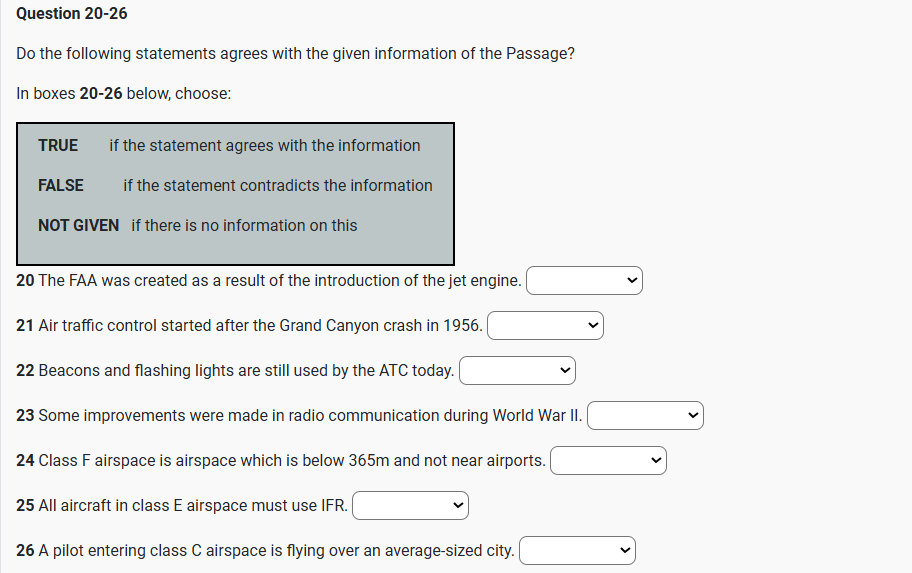
A. Q14 The history of human civilization is entwined with the history of ways we have learned to manipulate water resources. As towns gradually expanded, water was brought from increasingly remote sources, leading to sophisticated engineering efforts such as dams and aqueducts. Q14 At the height of the Roman Empire, nine major systems, with an innovative layout of pipes and well-built sewers, Q21 supplied the occupants of Rome with as much water per person as is provided in many parts of the industrial world today.

B. During the industrial revolution and population explosion of the 19th and 20th centuries, the demand for water rose dramatically. Unprecedented construction of tens of thousands of monumental engineering projects designed to control floods, protect clean water supplies, and provide water for irrigation and hydropower brought great benefits to hundreds of millions of people. Q22 Food production has kept pace with soaring populations mainly because of the expansion of artificial irrigation system that makes possible the growth of 40% of the world’s food. Nearly one-fifth of all the electricity generated worldwide is produced by turbines spun by the power of falling water.

C. Yet there is a dark side to this picture: despite our progress, half of the world’s population till suffers, with water services inferior to those available to the ancient Greeks and Romans. As the United Nations report on access to water reiterated in November 2001, Q15 more than one billion people lack access to clean drinking water: some two and half billion do not have adequate sanitation services. Preventable water-related diseases kill an estimated 10,000 to 20,000 children every day, and the latest evidence suggests that we are falling behind in efforts to solve their problems.

D. The consequences of our water policies extend beyond jeopardizing human health. Tens of millions of people have been forced to move from their homes – often with little warning or compensation – to make way for the reservoirs behind dams. Q16 More than 20% of all freshwater fish species are now threatened or endangered because dams and water withdrawals have destroyed the free-flowing river ecosystems where they thrive. Certain irrigation practices degrade soil quality and reduce agricultural productivity. Groundwater aquifers* are being pumped down faster than they are naturally replenished in part of India, China, the USA, and elsewhere. And disputes over shared water resources have led to violence and continue to raise local, national, and even international tensions.

E. At the outset of the new millennium, Q17 however, the way resource planners think about water is beginning to change. The focus is slowly shifting back to the provision of basic human and environmental needs as a top priority – ensuring ‘some for all,’ instead of ‘more for some’. Q17&26 Some water experts are now demanding that existing infrastructure be used in smarter ways rather than building new facilities, which is increasingly considered the option of last, not first, resort. This shift in philosophy has not been universally accepted, and it comes with strong opposition from some established water organizations. Nevertheless, it may be the only way to address successfully the pressing problems of providing everyone with clean water to drink, adequate water to grow food, and a life free from preventable water-related illness.

F. Q18 Fortunately – and unexpectedly – the demand for water is not rising as rapidly as some predicted. As a result, the pressure to build now water infrastructures has diminished over the past two decades. Q18&24 Although population, industrial output, and economic productivity have continued to soar in developed nations, the rate at which people withdraw water from aquifers, rivers, and lacks has slowed. And in a few parts of the world, demand has actually fallen.

G. Q19 What explains this remarkable turn of events? Two factors: people have figured out how to use water more efficiently, and communities are rethinking their priorities for water use. Throughout the first three-quarters of the 20th century, the quantity of freshwater consumed per person doubled on average; in the USA, water withdrawals increased tenfold while the population quadrupled. Q25 But since 1980, the amount of water consumed per person has actually decreased, thanks to a range of new technologies that help to conserve water in homes and industry. In 1965, for instance, Japan used approximately 13 million gallons* of water to produce $1 million of commercial output; by 1989 this had dropped to 3.5 million gallons (even accounting for inflation) – almost a quadrupling of water productivity. In the USA, water withdrawals have fallen by more than 20% from their peak in 1980.

H. Q20 On the other hand, Q26 dams, aqueducts, and other kinds of infrastructure will still have to be built, particularly in developing countries where basic human needs have not been met. But such projects must be built to higher specifications and with more accountability to local people and their environment than in the past. And even in regions where new projects seem warranted, we must find ways to meet demands with fewer resources, respecting ecological criteria and to smaller budget.


 Best Results Easily Get Required Score IELTS Exam Dates Available, Small Batch Size with Flexible Time, Professional.

phone icon
8439000086
8439000087
7055710003
7055710004
IELTS Simulation 323 GMS Road, Near Ballupur Chowk, Dehradun, India
Chat on WhatsApp
email: info at ieltsband7.com