IELTS READING – Back to the future of skyscraper design S19AT2


IELTS SIMULATOR FREE ACADEMIC ONLINE READING – Back to the future of skyscraper design S19AT2 FREE COMPUTER DELIVERED ONLINE TEST IELTS SIMULATION

IELTS READING Back to the future of skyscraper design reading practice test has 10 questions belongs to Environmental Design & Engineering subject..

Answers to the problem of excessive electricity use by skyscrapers and large public buildings can be found in ingenious but forgotten architectural designs of the 19th and early 20th centuries

A. The Recovery of Natural Environments in Architecture by Professor Alan Short is the culmination of 30 years of research and award-

winning green building design by Short and colleagues in Architecture, Engineering, Applied Maths and Earth Sciences at the University of Cambridge. The crisis in building design is already here,’ said Short. ‘Policy makers think you can solve energy and building problems with gadgets. You can’t. As global temperatures continue to rise, we are going to continue to squander more and more energy on keeping our buildings mechanically cool until we have run out of capacity.’

B. Short is calling for a sweeping reinvention of how skyscrapers and major public buildings are designed – to end the reliance on sealed buildings which exist solely via the ‘life support’ system of vast air conditioning units. Instead, he shows it is entirely possible to accommodate natural ventilation and cooling in large buildings by looking into the past, Q18 before the widespread introduction of air conditioning systems, which were ‘relentlessly and aggressively marketed’ by their inventors.

C. Short points out that to make most contemporary buildings habitable, they have to be sealed and air-conditioned. The energy use and carbon emissions this generates is spectacular and largely unnecessary. Buildings in the West account for 40-50% of electricity usage, generating substantial carbon emissions, and the rest of the world is catching up at a frightening rate. Q15 Short regards glass, steel and air-conditioned skyscrapers as symbols of status, rather than practical ways of meeting our requirements.

D. Short’s book highlights a developing and sophisticated art and science of ventilating buildings through the 19th and earlier-20th centuries, including the design of ingeniously ventilated hospitals. Of particular interest were those built to the Q19 designs of John Shaw Billings, including the first Johns Hopkins Hospital in the US city of Baltimore (1873-1889). Q17We spent three years digitally modelling Billings’ final designs,’ says Short. ‘We put Q20 pathogens in the airstreams, modelled for someone with Q21 tuberculosis (TB) coughing in the wards and we found the ventilation systems in the room would have kept other patients safe from harm.

E. Q16 ’We discovered that 19th-century hospital Q22 wards could generate up to 24 air changes an hour – that’s similar to the performance of a modern-day, computer-controlled operating theatre. We believe you could build wards based on these principles now. Single rooms are not appropriate for all patients. Q23 Communal wards appropriate for certain patients – older people with dementia, for example – would work just as well in today’s hospitals, at a fraction of the energy cost.’ Professor Short contends the mindset and skill-sets behind these designs have been completely lost, lamenting the disappearance of expertly designed theatres, opera houses, and other buildings where up to half the volume of the building was given over to ensuring everyone got fresh air.
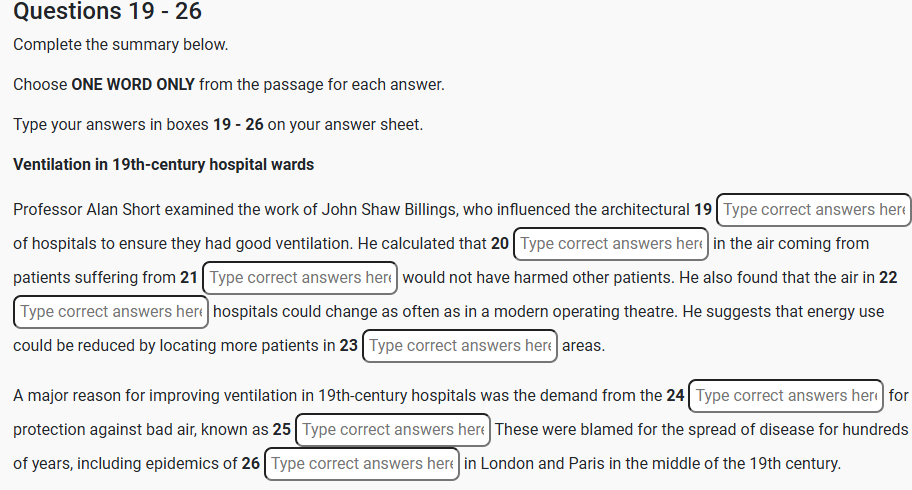
F. Q14 Much of the ingenuity present in 19th-century hospital and building design was driven by a panicked Q24 public clamouring for buildings that could protect against what was thought to be the lethal threat of Q25 miasmas – toxic air that spread disease. Miasmas were feared as the principal agents of disease and epidemics for centuries, and were used to explain the spread of infection from the Middle Ages right through to the Q26 cholera outbreaks in London and Paris during the 1850s. Foul air, rather than germs, was believed to be the main driver of ‘hospital fever’, leading to disease and frequent death. The prosperous steered clear of hospitals. While miasma theory has been long since disproved, Short has for the last 30 years advocated a return to some of the building design principles produced in its wake.

G. Today, huge amounts of a building’s space and construction cost are given over to air conditioning. ‘But I have designed and built a series of buildings over the past three decades which have tried to reinvent some of these ideas and then measure what happens. To go forward into our new low-energy, low-carbon future, we would be well advised to look back at design before our high-energy, high-carbon present appeared. What is surprising is what a rich legacy we have abandoned.’

H. Successful examples of Short’s approach include the Queen’s Building at De Montfort University in Leicester. Containing as many as 2,000 staff and students, the entire building is naturally ventilated, passively cooled and naturally lit, including the two largest auditoria, each seating more than 150 people. The award-winning building uses a fraction of the electricity of comparable buildings in the UK. Short contends that glass skyscrapers in London and around the world will become a liability over the next 20 or 30 years if climate modelling predictions and energy price rises come to pass as expected.

I. He is convinced that sufficiently cooled skyscrapers using the natural environment can be produced in almost any climate. He and his team have worked on hybrid buildings in the harsh climates of Beijing and Chicago – built with natural ventilation assisted by back-up air conditioning – which, surprisingly perhaps, can be switched off more than half the time on milder days and during the spring and autumn. Short looks at how we might reimagine the cities, offices and homes of the future. Maybe it’s time we changed our outlook.


Best Results Easily Get Required Score IELTS Exam Dates Available, Small Batch Size with Flexible Time, Professional.

phone icon
8439000086
8439000087
7055710003
7055710004
IELTS Simulation 323 GMS Road, Near Ballupur Chowk, Dehradun, India

Chat on WhatsApp
email: info at ieltsband7.com

IELTS READING – The power of play S20AT3

IELTS SIMULATOR FREE ACADEMIC ONLINE READING – The power of play S20AT3 FREE COMPUTER DELIVERED ONLINE TEST IELTS SIMULATION
IELTS Reading The power of play reading practice test has 10 questions belongs to 🧠 Education & Child Psychology subject..

Q32 Virtually every child, the world over, plays. The drive to play is so intense that children will do so in any circumstances, for instance when they have no real toys, or when parents do not actively encourage the behavior. In the eyes of a young child, running, pretending, and building is fun.

Researchers and educators know that these playful activities benefit the development of the whole child across social, cognitive, physical, and emotional domains. Indeed, play is such an instrumental component to healthy child development that the United Nations High Commission on Human Rights (1989) recognized play as a fundamental right of every child.

Yet, while experts continue to expound a powerful argument for the importance of play in children’s lives, the actual time children spend playing continues to decrease. Today, children play eight hours less each week than their counterparts did two decades ago (Elkind 2008). Under pressure of rising academic standards, play is being replaced by test preparation in kindergartens and grade schools, and parents who aim to give their preschoolers a leg up are led to believe that flashcards and educational ‘toys’ are the path to success. Q33 Our society has created a false dichotomy between play and learning.

Through play, children learn to regulate their behavior, lay the foundations for later learning in science and mathematics, figure out the complex negotiations of social relationships, build a repertoire of creative problem-solving skills, and so much more. There is also an important role for adults in guiding children through playful learning opportunities.

Q35 Full consensus on a formal definition of play continues to elude the researchers and theorists who study itQ34 Q27 Definitions range from discrete descriptions of various types of play such as physical, construction, language, or symbolic play (Miller & Almon 2009), to lists of broad criteria, based on observations and attitudes, that are meant to capture the essence of all play behaviors (e.g. Rubin  1983).

A majority of the contemporary definitions of play focus on several key criteria. The founder of the National Institute for Play, Stuart Brown, has described play as ‘anything that spontaneously is done for its own sake’. More specifically, he says it ‘appears purposeless, produces pleasure and joy, [and] leads one to the next stage of mastery’ (as quoted in Tippett 2008). Similarly, Miller and Almon (2009) say that play includes ‘activities that are freely chosen and directed by children and arise from intrinsic motivation’. Q31 Often, play is defined along a continuum as more or less playful using the following set of behavioral and dispositional criteria (e.g. Rubin et al. 1983):

Play is pleasurable: Children must enjoy the activity or it is not play. It is intrinsically motivated: Children engage in play simply for the satisfaction the behavior itself brings. It has no extrinsically motivated function or goal. Play is process oriented: When children play, the means are more important than the ends. It is freely chosen, spontaneous and voluntary. If a child is pressured, they will likely not think of the activity as play. Play is actively engaged: Players must be physically and/or mentally involved in the activity. Play is non-literal. It involves make-believe.

According to this view, children’s playful behaviors can range in degree from 0% to 100% playful. Q30 Rubin and colleagues did not assign greater weight to any one dimension in determining playfulness; however, other researchers have suggested that process orientation and a lack of obvious functional purpose may be the most important aspects of play (e.g. Pellegrini 2009).

From the perspective of a continuum, play can thus blend with other motives and attitudes that are less playful, such as work. Q36 Unlike play, work is typically not viewed as enjoyable and it is extrinsically motivated (i.e. it is goal-oriented). Q29 Researcher Joan Goodman (1994) suggested that hybrid forms of work and play are not a detriment to learning; rather, they can provide optimal contexts for learning. For example, a child may be engaged in a difficult, goal-directed activity set up by their teacher, but they may still be actively engaged and intrinsically motivated. At this mid-point between play and work, the child’s motivation, coupled with guidance from an adult, can create robust opportunities for playful learning.

Critically, recent research supports the idea that adults can facilitate children’s learning while maintaining a playful approach in interactions known as ‘guided play’ (Fisher et al. 2011). Q28 The adult’s role in play varies as a function of their educational goals and the child’s developmental level (Hirsch-Pasek et al. 2009).

Guided play takes two forms. At a very basic level, adults can enrich the child’s environment by providing objects or experiences that promote aspects of a curriculum. In the more direct form of guided play, parents or other adults can support children’s play by joining in the fun as a co-player, raising thoughtful questions, commenting on children’s discoveries, or Q37 encouraging further exploration or new facets to the child’s activity. Although playful learning can be somewhat structured, it must also be child-centered (Nicolopolou et al. 2006). Play should stem from the child’s own Q38 desire.

Both free and guided play are essential elements in a child-centered approach to playful learning. Intrinsically motivated free play provides the child with true Q39 autonomy, while guided play is an avenue through which parents and educators can provide more Q40 targeted learning experiences. In either case, play should be actively engaged, it should be predominantly child-directed, and it must be fun.


Easily Get Required Score I am interested in IELTS Pass with Confidence, Dehradun Small Batch Size with Flexible Time, professional faculty.

phone icon
8439000086
8439000087
7055710003
7055710004
IELTS Simulation 323 GMS Road, Near Ballupur Chowk, Dehradun, India
Chat on WhatsApp
email: info at ieltsband7.com

IELTS READING – Saving bugs to find new drugs S20AT2


IELTS SIMULATOR FREE ACADEMIC READING – Saving bugs to find new drugs S20AT2 FREE COMPUTER DELIVERED ONLINE TEST IELTS SIMULATION

IELTS Reading Saving bugs to find new drugs reading practice test has 10 questions belongs to Health & Environment subject..

Zoologist Ross Piper looks at the potential of insects in pharmaceutical research

A. More drugs than you might think are derived from, or inspired by, compounds found in living things. Looking to nature for the soothing and curing of our ailments is nothing new – we have been doing it for tens of thousands of years. You only have to look at other primates

– such as the Q16 capuchin monkeys who rub themselves with toxin-oozing millipedes to deter mosquitoes, or the chimpanzees who use noxious forest plants to rid themselves of intestinal parasites – to realise that our ancient ancestors too probably had a basic grasp of medicine.

B. Pharmaceutical science and chemistry built on these ancient foundations and perfected the extraction, characterisation, modification, and testing of these natural products. Q19 Then, for a while, modern pharmaceutical science moved its focus away from nature and into the laboratory, designing chemical compounds from scratch. The main cause of this shift is that although there are plenty of promising chemical compounds in nature, finding them is far from easy. Securing sufficient numbers of the organism in question, isolating and characterising the compounds of interest, and producing large quantities of these compounds are all significant hurdles.

C. Laboratory-based drug discovery has achieved varying levels of success, something which has now prompted the development of new approaches focusing once again on natural products. With the ability to mine genomes for useful compounds, it is now evident that we have barely scratched the surface of nature’s molecular diversity. Q14 This realisation, together with several looming health crises, such as antibiotic resistance, has put bioprospecting – the search for useful compounds in nature – firmly back on the map.

D. Insects are the undisputed masters of the terrestrial domain, where they occupy every possible niche. Consequently, they have a bewildering array of interactions with other organisms, something which has driven the evolution of an enormous range of very interesting compounds for defensive and offensive purposes. Their remarkable diversity exceeds that of every other group of animals on the planet combined. Yet even though insects are far and away the most diverse animals in existence, their potential as sources of therapeutic compounds is yet to be realised.

E. From the tiny proportion of insects that have been investigated, several promising compounds have been identified. Q20 For example, alloferon, an antimicrobial compound produced by blow fly larvae, is used as an antiviral and antitumor agent in South Korea and Russia. The larvae of a few other insect species are being investigated for the potent antimicrobial compounds they produce. Meanwhile, a compound from the venom of the wasp Polybia paulista has potential in cancer treatment.

F. Q17 Why is it that insects have received relatively little attention in bioprospecting? Firstly, there are so many insects that, without some manner of targeted approach, investigating this huge variety of species is a daunting task. Secondly, insects are generally very small, and the glands inside them that secrete potentially useful compounds are smaller still. This can make it difficult to obtain sufficient quantities of the compound for subsequent testing. Thirdly, although we consider insects to be everywhere, the reality of this ubiquity is vast numbers of a few extremely common species. Many insect species are infrequently encountered and very difficult to rear in captivity, which, again, can leave us with insufficient material to work with.

G. My colleagues and I at Aberystwyth University in the UK have developed an approach in which we use our knowledge of Q23 ecology as a guide to target our efforts. Q21 &22 The creatures that particularly interest us are the many insects that secrete powerful poison for subduing Q24 prey and keeping it fresh for future consumption. There are even more insects that are masters of exploiting filthy Q25 habitats, such as faeces and carcasses, where they are regularly challenged by thousands of micro¬organisms. These insects have many antimicrobial compounds for dealing with pathogenic bacteria and fungi, suggesting that there is certainly potential to find many compounds that can serve as or inspire new Q26 antibiotics.

H. Although natural history knowledge points us in the right direction, it doesn’t solve the problems associated with obtaining useful compounds from insects. Q21&22 Q15 Fortunately, it is now possible to snip out the stretches of the insect’s DNA that carry the codes for the interesting compounds and insert them into cell lines that allow larger quantities to be produced. And although the road from isolating and characterising compounds with desirable qualities to developing a commercial product is very long and full of pitfalls, the variety of successful animal-derived pharmaceuticals on the market demonstrates there is a precedent here that is worth exploring.

I. With every bit of wilderness that disappears, we deprive ourselves of potential medicines. As much as I’d love to help develop a groundbreaking insect-derived medicine, my main motivation for looking at insects in this way is conservation. Q18 I sincerely believe that all species, however small and seemingly insignificant, have a right to exist for their own sake. If we can shine a light on the darker recesses of nature’s medicine cabinet, exploring the useful chemistry of the most diverse animals on the planet, I believe we can make people think differently about the value of nature.


Learn From Experienced Teacher Best IELTS Coaching Dehradun Best IELTS in Dehradun Uttarakhand GMS Road BEST coaching in Dehradun Apply for Class Courses Today Good Results.

phone icon
8439000086
8439000087
7055710003
7055710004
IELTS Simulation 323 GMS Road, Near Ballupur Chowk, Dehradun, India
Chat on WhatsApp
email: info at ieltsband7.com

IELTS READING – Alexander Henderson S19AT1

IELTS FREE ACADEMIC ONLINE READING – Alexander Henderson S19GT1 .... FREE COMPUTER DELIVERED ONLINE TEST.... IELTS SIMULATION

IELTS READING Alexander Henderson practice test has 10 questions belongs to Photography & Art History subject..
Born in Scotland, Henderson emigrated to Canada in 1855 and became a well-known landscape photographer

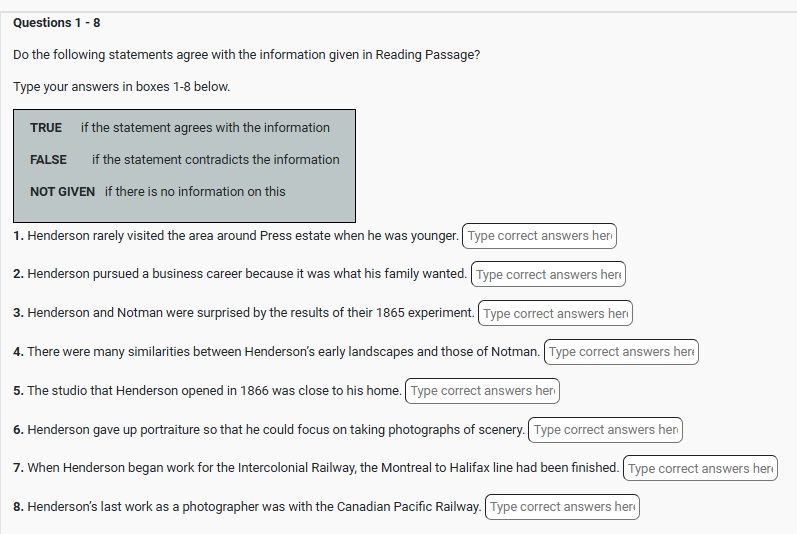
Alexander Henderson was born in Scotland in 1831 and was the son of a successful Q9 merchant. His grandfather, also called Alexander, had founded the family business, and later became the first chairman of the National Bank of Scotland. The family had extensive landholdings in Scotland.

Besides its residence in Edinburgh, Q1 it owned Press Estate, 650 acres of farmland about 35 miles southeast of the city. The family often stayed at Press Castle, the large mansion on the northern edge of the property, and Alexander spent much of his childhood in the area, playing on the beach near Eyemouth or fishing in the streams nearby.

Even after he went to school at Murcheston Academy on the outskirts of Edinburgh, Henderson returned to Press at weekends. Q2 In 1849 he began a three-year apprenticeship to become an accountant. Although he never liked the prospect of a business career, he stayed with it to please his family. In October 1855, however, he emigrated to Canada with his wife Agnes Elder Robertson and they settled in Montreal.

Henderson learned photography in Montreal around the year 1857 and quickly took it up as a serious amateur. He became a personal friend and colleague of the Scottish-Canadian photographer William Notman. The two men made a photographic excursion to Niagara Falls in 1860 and they cooperated on experiments Q3 with magnesium flares as a source of artificial light in 1865. They belonged to the same societies and were among the founding members of the Art Association of Montreal. Henderson acted as chairman of the association’s first meeting, which was held in Notman’s studio on 11 January 1860.

In spite of their friendship, Q4 their styles of photography were quite different. While Notman’s landscapes were noted for their bold realism, Henderson for the first 20 years of his career produced romantic images, showing the strong influence of the British landscape tradition. His artistic and technical progress was rapid and in 1865 he published his first major collection of landscape photographs. The publication had limited circulation (only seven copies have ever been found), and was called Canadian Views and Studies. The contents of each copy vary significantly and have proved a useful source for evaluating Henderson’s early work.

In 1866, Q5 he gave up his business to open a photographic studio, advertising himself as a portrait and landscape photographer. Q6 From about 1870 he dropped portraiture to specialize in landscape photography and other views. His numerous photographs of city life revealed in street scenes, houses, and markets are alive with human activity, and although his favourite subject was landscape he usually composed his scenes around such human pursuits as farming the land, cutting ice on a river, or sailing down a woodland stream. There was sufficient demand for these types of scenes and others he took depicting the lumber trade, steamboats and waterfalls to enable him to make a living. There was little competing hobby or amateur photography before the late 1880s because of the time-consuming techniques involved and the weight of the Q11 equipment. People wanted to buy photographs as Q10 souvenirs of a trip or as Q12 gifts, and catering to this market, Henderson had stock photographs on display at his studio for mounting, framing, or inclusion in albums.

Henderson frequently exhibited his photographs in Montreal and abroad, in London, Edinburgh, Dublin, Paris, New York, and Philadelphia. He met with greater success in 1877 and 1878 in New York when he won first prizes in the exhibition held by E and H T Anthony and Company for landscapes using the Lambertype process. In 1878 his work won second prize at the world exhibition in Paris.

In the 1870s and 1880s, Henderson travelled widely throughout Quebec and Ontario, in Canada, documenting the major cities of the two provinces and many of the villages in Quebec. He was especially fond of the wilderness and often travelled by canoe on the Blanche, du Lievre, and other noted eastern rivers. He went on several occasions to the Maritimes and in 1872 he sailed by yacht along the lower north shore of the St Lawrence River. Q7 That same year, while in the lower St Lawrence River region, he took some photographs of the construction of the Intercolonial Railway. This undertaking led in 1875 to a commission from the railway to record the principal structures along the almost-completed line connecting Montreal to Halifax. Commissions from other railways followed. In 1876 he photographed bridges on the Quebec, Montreal, Ottawa, and Occidental Railway between Montreal and Ottawa. In 1885 he went west along the Canadian Pacific Railway (CPR) as far as Rogers Pass in British Columbia, where he took photographs of the Q13 mountains and the progress of construction.

Q8 In 1892 Henderson accepted a full-time position with the CPR as manager of a photographic department which he was to set up and administer. His duties included spending four months in the field each year. That summer he made his second trip west, photographing extensively along the railway line as far as Victoria. He continued in this post until 1897 when he retired completely from photography.

When Henderson died in 1913, his huge collection of glass negatives was stored in the basement of his house. Today collections of his work are held at the National Archives of Canada, Ottawa, and the McCord Museum of Canadian History, Montreal.


Easily Get Required Score I am interested in IELTS Pass with Confidence, Dehradun Small Batch Size with Flexible Time, professional faculty.

phone icon
8439000086
8439000087
7055710003
7055710004
IELTS Simulation 323 GMS Road, Near Ballupur Chowk, Dehradun, India
Chat on WhatsApp
email: info at ieltsband7.com