
|
IELTS Reading Nature or Nurture? reading practice test has 10 questions belongs to Genetics & Human Development subject.. |
A. A few years ago, in one of the most fascinating and disturbing experiments in behavioural psychology, Stanley Milgram of Yale University tested 40 subjects from all walks of life for their willingness to obey instructions given by a ‘leader’ in a situation in which the subjects might feel a personal distaste for the actions they were called upon to perform. Q15&20 Specifically, Milgram told each volunteer ‘teacher-subject’ that the experiment was in the noble cause of education, and was designed to test whether or not punishing pupils for their mistakes would have a positive effect on the pupils’ ability to learn.
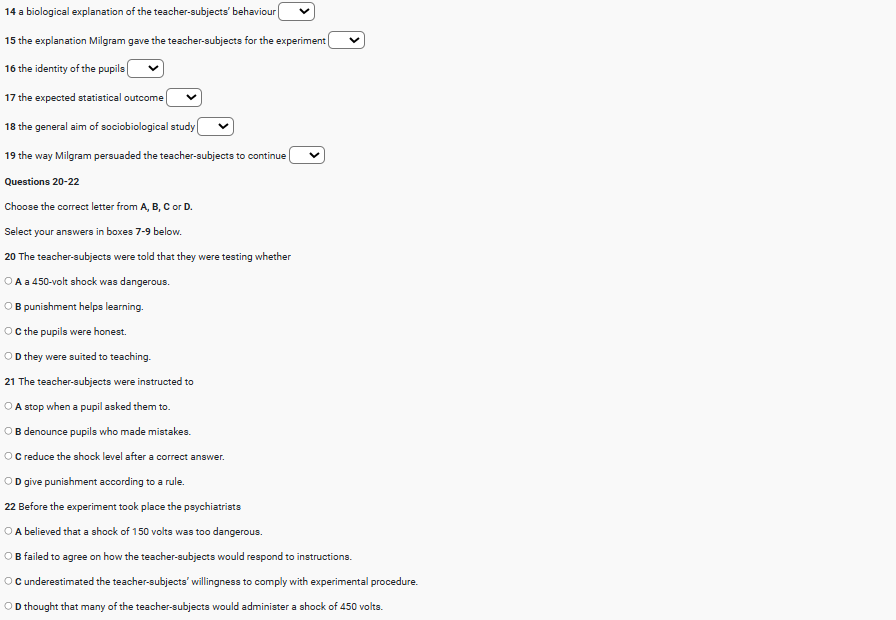
B. Milgram’s experimental set-up involved placing the teacher-subject before a panel of thirty switches with labels ranging from ’15 volts of electricity (slight shock)’ to ‘450 volts (danger – severe shock)’ in steps of 15 volts each. The teacher-subject was told that whenever the pupil gave the wrong answer to a question, a shock was to be administered, beginning at the lowest level and increasing in severity with each successive wrong answer. Q16 The supposed ‘pupil’ was in reality an actor hired by Milgram to simulate receiving the shocks by emitting a spectrum of groans, screams and writhings together with an assortment of statements and expletives denouncing both the experiment and the experimenter. Q21 Milgram told the teacher-subject to ignore the reactions of the pupil, andto administer whatever level of shock was called for as per the rule governing the experimental situation of the moment.
C. As the experiment unfolded, the pupil would deliberately give the wrong answers to questions posed by the teacher, thereby bringing on various electrical punishments, even up to the danger level of 300 volts and beyond. Q19 Many of the teacher-subjects balked at administering the higher levels of punishment, and turned to Milgram with questioning locks and/or complaints about continuing the experiment. In these situations, Milgram calmly explained that the teacher-subject was to ignore the pupil’s cries for mercy and carry on with the experiment. If the subject was still reluctant to proceed, Milgram said that it was important for the sake of the experiment that the procedure be followed through to the end. His final argument was, ‘You have no other choice. You must go on.’ What Milgram was trying to discover was the number of teacher-subjects who would be willing to administer the highest levels of shock, even in the face of strong persona! and moral revulsion against the rules and conditions of the experiment.
D. Q22 Prior to carrying out the experiment, Milgram explained his idea to a group of 39 psychiatrists and asked them to predict the average percentage of people in an ordinary population who would be willing to administer the highest shock level of 450 volts. Q17 The overwhelming consensus was that virtually all the teacher-subjects would refuse to obey the experimenter. The psychiatrists felt that ‘most subjects would not go beyond 150 volts’ and they further anticipated that only four per cent would go up to 300 volts. Furthermore, they thought that only a lunatic fringe of about one in 1.000 would give the highest shock of 450 volts.
E. Q22 What were the actual results? Well, over 60 per cent of the teacher-subjects continued to obey Milgram up to the 450-volt limit! In repetitions of the experiment in other countries, the percentage of obedient teacher-subjects was even higher, reaching 85 per cent in one country How can we possibly account for this vast discrepancy between what calm, rational, knowledgeable people predict in the comfort of their study and what pressured, flustered, but cooperative teachers’ actually do in the laboratory of real life?
F. Q14 One’s first inclination might be to argue that there must be some sort of built-in animal aggression instinct that was activated by the experiment, and that Milgram’s teacher-subjects were just following a genetic need to discharge this pent-up primal urge onto the pupil by administering the electrical shock. Q24 A modern hard-core sociobiologist might even go so far as to claim that this aggressive instinct evolved as an advantageous trait, having been of survival value to our ancestors in their struggle against the hardships of life on the plains and in the caves, ultimately finding its way into our genetic make-up as a remnant of our ancient animal ways.
G. An alternative to this notion ot genetic programming is to see the teacher-subjects’ actions as a result of the social environment under which the experiment was carried out. As Milgram himself pointed out. Most subjects in the experiment see their behaviour in a larger context that is benevolent and useful to society – the pursuit of scientific truth. The psychological laboratory has a strong claim to legitimacy and evokes trust and confidence in those who perform there. An action such as shocking a victim, which in isolation appears evil, acquires a completely different meaning when placed in this setting’.
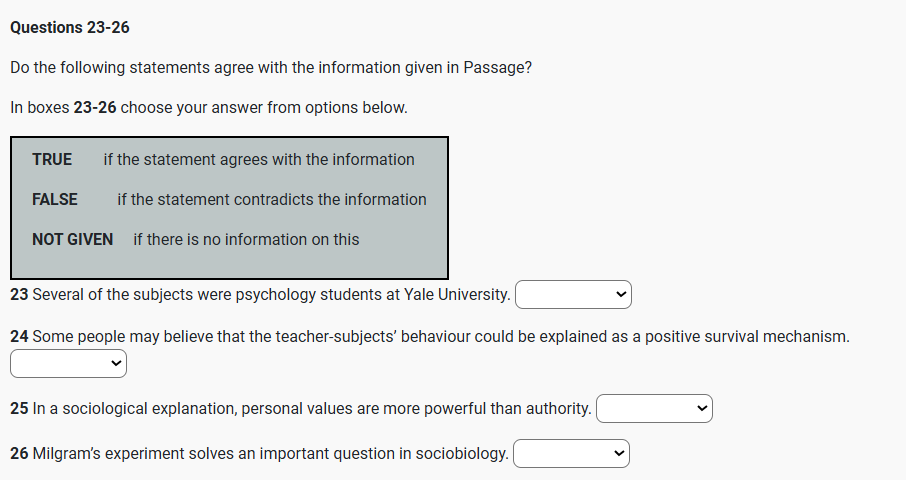
H. Q25 Thus, in this explanation the subject merges his unique personality and personal and moral code with that of larger institutional structures, surrendering individual properties like loyalty, self-sacrifice and discipline to the service of malevolent systems of authority.
I. Q26 Here we have two radically different explanations for why so many teacher-subjects were willing to forgo their sense of personal responsibility for the sake of an institutional authority figure. The problem for biologists, psychologists and anthropologists is to sort out which of these two polar explanations is more plausible. This, in essence, is the problem of modem sociobiology – to discover the degree to which hard-wired genetic programming dictates, or at least strongly biases, the interaction of animals and humans with their environment, that is, their behaviour. Q18 Put another way sociobiology is concerned with elucidating the biological basis of all behaviour.
Best Results Easily Get Required Score IELTS Exam Dates Available, Small Batch Size with Flexible Time, Professional.

8439000086
8439000087
7055710003
7055710004
IELTS Simulation 323 GMS Road, Near Ballupur Chowk, Dehradun, India

email: info at ieltsband7.com
Boost Your Score: Practice IELTS Online with IELTS Simulator Prepare for IELTS Effectively Using IELTS Simulator Ace the IELTS: Try Realistic Practice on IELTS Simulator IELTS Simulator: Online Practice to Improve Your IELTS Score Rocky Bay field trip listening practice test has 10 questions belongs to the Leisure & Entertainment subject. Prepare for IELTS IELTS Test International Experienced Teacher Best Training By CELTA Trainer. Best Results Easily Get Required Score IELTS Exam Dates Available, Small Batch Size with Flexible Time, Professional. Easily Get Required Score I am interested in IELTS Pass with Confidence, Dehradun Small Batch Size with Flexible Time, professional faculty. Learn From Experienced Teacher Best IELTS Coaching Dehradun Best IELTS in Dehradun Uttarakhand GMS Road BEST coaching in Dehradun Apply for Class Courses Today Good Results. Small Batch Size, Flexible Time and Professional IELTS Teacher Best IELTS coaching classes IDP certified British Council trained and CELTA certified experienced trainer. Easily Get Required Score Tel:8439000086 Tel:8439000087 Tel:7055710003 Tel:7055710004 Tel:7055710009