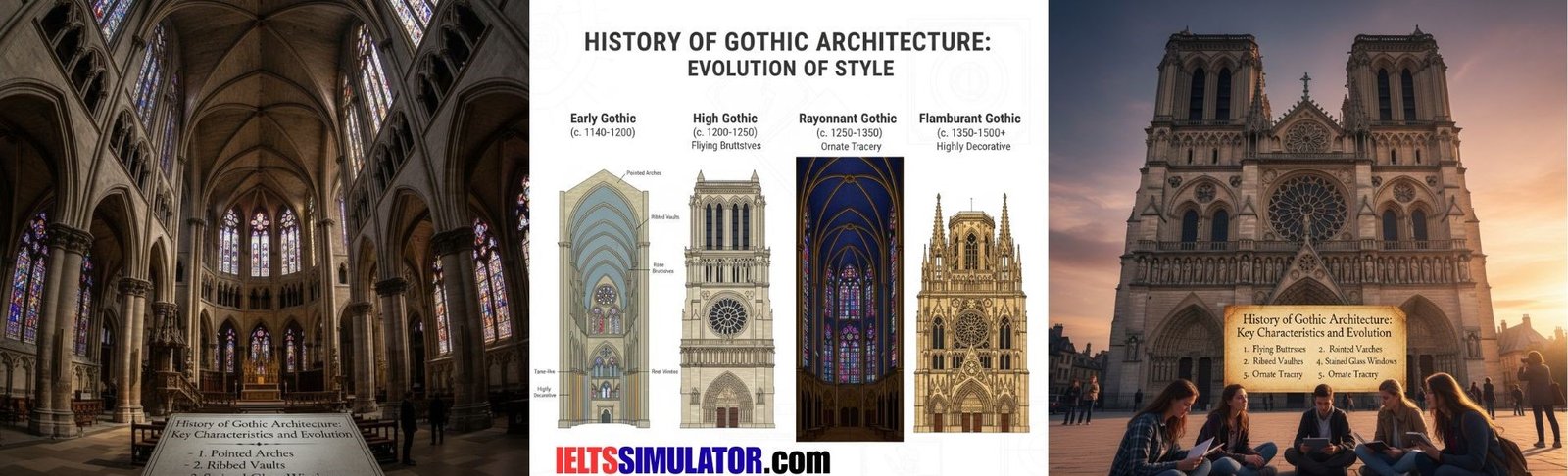
| IELTS listening History of Gothic Architecture listening practice test has 10 questions belongs to the Art & Architecture subject.. |
You will hear a university lecturer talking about the history of architecture. The houses of Parliament must be among the best-known sites of London, if not the world. Thousands of visitors flocked to the capital to have their photos taken with this iconic building, to hear the famous bells of the Westminster Times, and to hear the largest bell, Big Ben, as it strikes the hour. The building itself seems to be rooted in Britain’s ancient past, but it is, in fact, a much more recent Victorian example of how medieval architecture inspired contemporary design internationally in a movement referred to as the Gothic Revival.
The term Gothic refers to the style of architecture used in Europe from the 12th century to the 16th century, most importantly churches and cathedrals. After falling out of favour for about a hundred years, the style was reborn during the 18th century as the Gothic Revival.
The exception to this, however, was the famous university town of Oxford, described as England’s most medieval city.
After the 17th century English Civil War, Oxford remained fiercely loyal to the king against the victorious parliamentary forces.During the period of parliamentary rule, some Gothic style buildings were constructed by the university to show its support for loyalty. In the first part of the 18th century, examples of Gothic detailing appeared in garden follies. Decorative buildings constructed to make the grounds of large, stately homes more beautiful.
However, when it was introduced into domestic building, the origins of this most conspicuous of architectural revivals came from literature. The then-popular Gothic horror story found its expression in bricks and mortar, in Horace Walpole’s 1750 Villa, Strawberry Hill in Twickenham, a suburb to the west of London. Walpole and his friends designed the house to give an appropriate gloomy atmosphere for his collection of antiques. This early period, in which a romantic mood was sought, was replaced in the 19th century with a more academic approach, in which architect studied buildings from the medieval past in order to reproduce their features more authentically.
For Augustus Pugin, who designed the Gothic decoration of London’s houses of Parliament, the ultimate in Gothic design, was the particular style developed in Venice, with its rulers Doge’s Palace, combining Gothic, classic and Arabic elements to be as he described it, the central building of the world.
As the 19th century progressed, historical accuracy was abandoned, as architects designed hitherto unknown building types, such as railway stations, exhibition halls and museums.
What made this historic-looking style so successful in the modern world was the incorporation of contemporary technology, in particular the use of iron. The utilization of contemporary cast iron was found to be perfectly compatible with ancient Gothic forms, such as the pointed arch.
The development of iron framed buildings provides a link between the Victorian architects of the Gothic revival and the new skyscrapers, which were being developed in the United States by the end of the 19th century. These multi-story buildings were also made possible with the introduction of the safety lift. A good example is the Woolworth Building in New York, which was built in 1913.

It was a modern building with Gothic decoration and was the tallest building in the world at the time. I like to think of it as the grandfather of the famous Manhattan Skyline. As artists and architects became more experimentally in their use of iron, they wandered further and further from Pugans Gothic ideals, most notably in the work of Antonio Gaudi in Barcelona and the development of Art Nouveau, which represented a significant break from a historic view of architecture.
Though modern architecture seems to have little relation to the Gothic revival, they share a common feeling for volume and space, as essential to building design. Furthermore, the principles of decorative domestic architecture can still be felt in the suburbs of Europe and America. It’s only the original romantic sense of gloom and melancholy that has been thrown into the dustbin of history.
Online Practice to Improve Your IELTS Score.
Try Realistic Practice on IELTS Simulator.

8439000086
8439000087
7055710003
7055710004
IELTS Simulation 323 GMS Road, Near Ballupur Chowk, Dehradun, India

email: info at ieltsband7.com