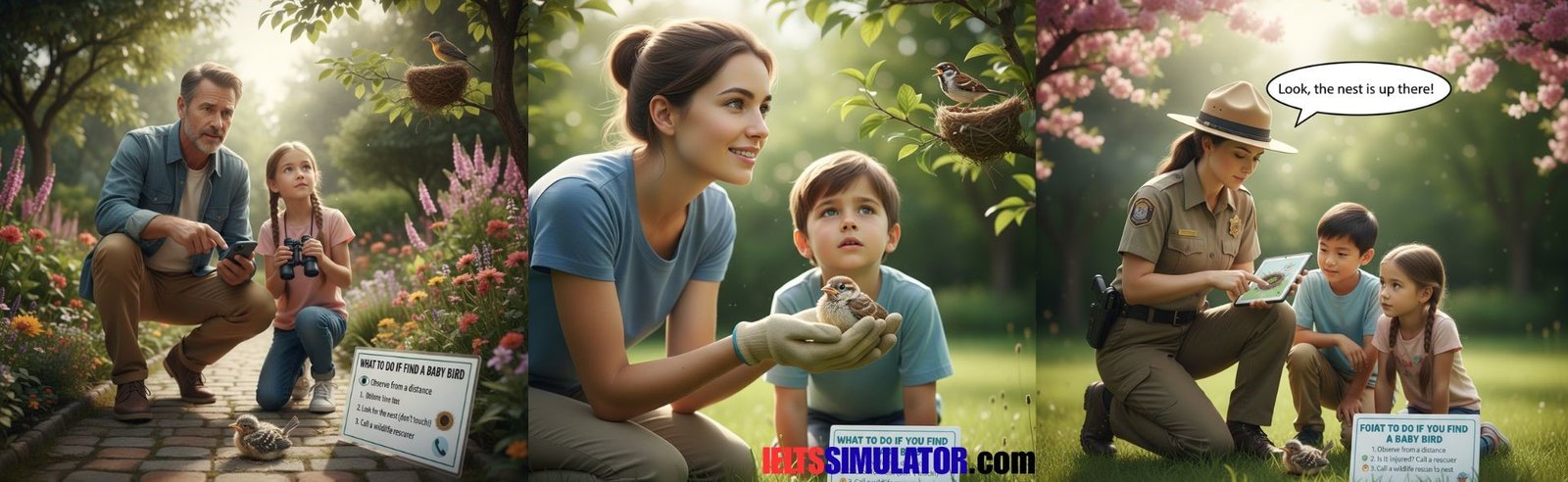
| IELTS listening What to Do If You Find a Baby Bird listening practice test has 10 questions belongs to the Environment & Wildlife Conservation subject.. |
Thanks, Graham. At this time of year, as new life hatches out, a lot of listeners have contacted us asking what to do if they find a baby bird. The recent cold snap has added to their concerns. But there’s certainly a lot of chirping going on, and some of the newly hatched chicks do leave the nest a little too early.
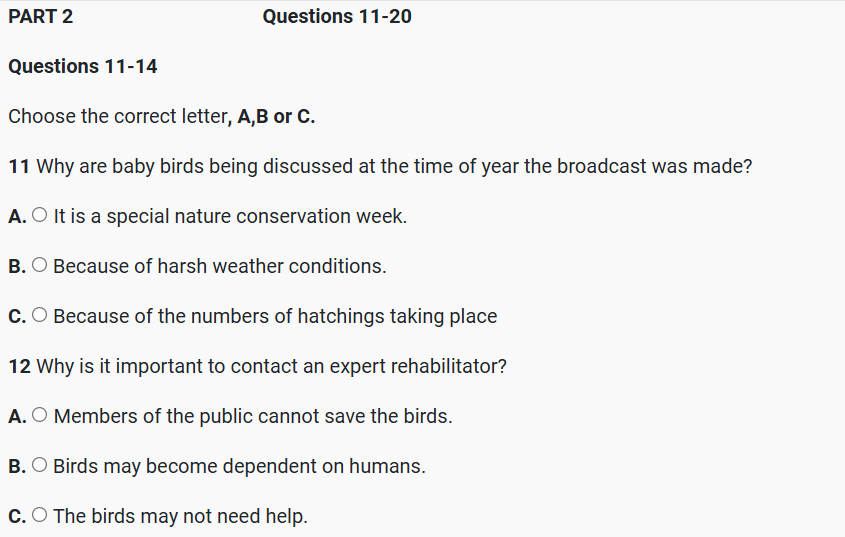
While it’s understandable that you want to help a little bird you find, if the chick is injured, your care may result in the little thing relying on your help and not being able to survive on its own in the wild. So if you find an injured chick, it’s best to contact a wildlife expert, such as the team at the RSPB. Contact details are available on the show’s website.
When finding a baby bird or a hatchling in general, it’s important to know if it’s a nestling. These are recently hatched chicks that haven’t developed feathers or a fledgling who have. It’s best to return a nestling to its nest if it can be found as soon as possible. This wouldn’t be a good idea with a fledgling.
Water birds, such as a duckling or cygnet, need a different approach to fledglings. In this case, try and find the mother and place the chick nearby, within the mother’s earshot. If you can’t find the mother, then contact an expert at the RSPB, the Royal Society for the Protection of Birds, or similar organisation. So what to do when you find a baby bird?
First, see if the bird is healthy or not. For instance, is it able to flutter its wings? If not, it may be ill or injured. Or is it bleeding? In either case, contact a wildlife rehabilitator. If the baby appears healthy, then decide if it’s a nestling, a fluffy one, so to speak, or a feathered fledgling. If it’s a nestling, look around for the nest.
If you can see it, place the bird in the nest. Then, if you can, observe the nest from a distance. If the parents visit the nest, your job is done and you can leave. If you can’t see a nest, and if you’re able, make a replacement nest using a box or carton lined with leaves or grass and hang it from a nearby tree. If the parents return to tend to the chick, you can leave them in peace.
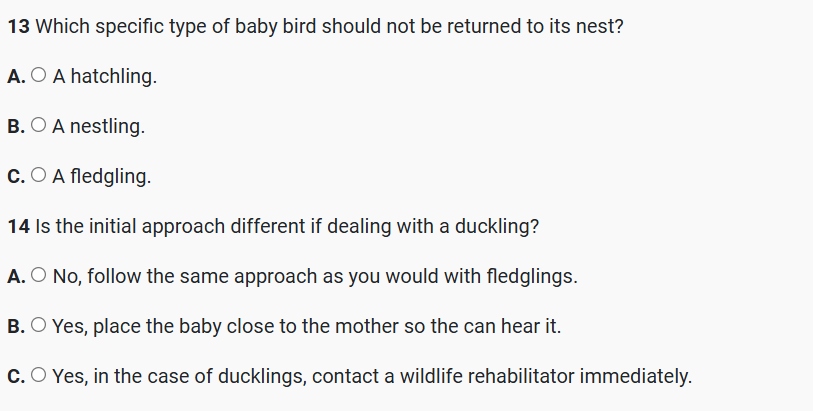
If not, contact a wildlife expert. If you’ve found a fledgling, the first thing to do is see if it’s safe from predators, such as cats. Then place the bird on a nearby branch. Again, observe from a distance. Are the parents close? If so, you can leave. If not, seek expert advice.
Now, though the people at the RSPB do a marvellous job, remember it is by its mother that any lost chick are most likely to survive. And that’s it. Remember to look at the station website for more information and contact details for local wildlife organizations. And it’s back to you, Graham.
Experienced Teacher Best Training By CELTA Trainer.
Small Batch Size, Flexible Time.

8439000086
8439000087
7055710003
7055710004
IELTS Simulation 323 GMS Road, Near Ballupur Chowk, Dehradun, India

email: info at ieltsband7.com