Unlock the Benefits of IELTS Listening

Access our library of Listening practice audio in MP3 format for on-the-go listening, and PDFs for offline study sessions. Download MP3 and download PDF file for offline practice. 

IELTS LISTENING – Pacific tapa cloth S62T3

 IELTS listening – Pacific tapa cloth listening practice test has 10 questions belongs to the Culture & Art  subject..
 
TUTOR: Come in Helen. How can I help you?
 
HELEN: Well, I’m doing research for the anthropology assignment and I was hoping to check a few details.
 
TUTOR: Sure you chose the topic of Pacific Island tupper cloth didn’t you? What if you found out so far?
 

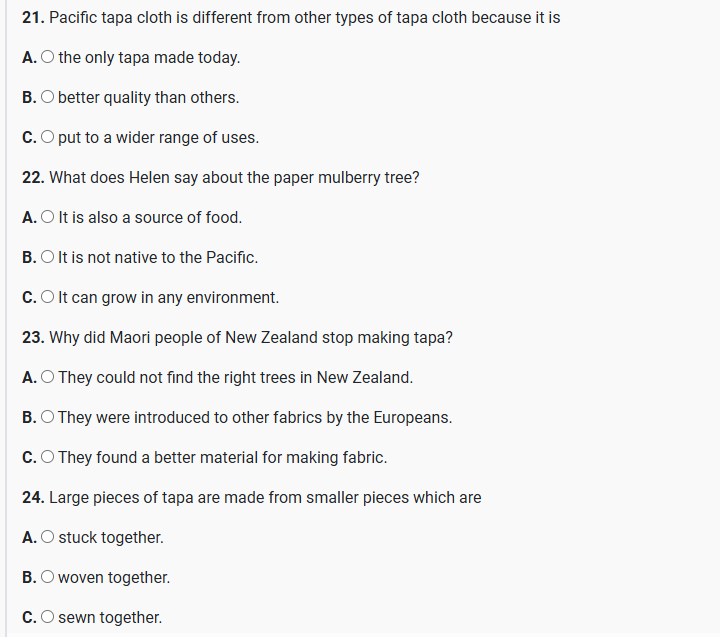
HELEN: Well, I was going to introduce my assignment by saying that the Tapper cloth is a fabric made from bark, just the outer layer of the trees. It’s particularly Q21 common in the Pacific Islands but not exclusive to them. In fact, many other peoples around the world have made high-quality cloth from back, but what sets Pacific tapa apart is the incredible variety of roles it’s played in this region.

TUTOR: Yes nice introduction, though I think you could be more specific regarding dates. Okay, so what about the raw materials used?

HELEN: Well tough is made from raw species of tree in the Pacific the paper mulberry tree is most common, but it doesn’t thrive in all conditions in fact it wasn’t originally found in the islands but was carried in their canoes by the first migrants. Tapa is also made from the breadfruit tree, which is convenient because its fruit is a staple food the paper mulberry tree is only grown for Tapper making though.

TUTOR: Yes that’s good now what about the Maori people here in New Zealand?

HELEN: The Maori don’t make tapa now.

TUTOR: That’s right and you need to account for it we know that when Mari migrated here from the other Pacific Islands they were prepared to make Tupper because they brought the paper mulberry tree with them. The thing was after they’d been in New Zealand a bit Q23 they found the flax plant which is superior to tapa because it makes a stronger fabric. By the time Europeans arrived in the 18th century, Maori were making all their fabric from flax and had been for some time.

HELEN: Okay so with the production process itself first did the inner bark is beaten with wooden hammers to soften the fibers in the different pieces are glued together using an adhesive paste made from the arrowrooter tuber this is the only way to fabricate large pieces of cloth because bark strains are too fine to be woven together and Q24 stitching isn’t strong enough.

TUTOR: So now you need details about different countries where would you start Samoa is the obvious place it’s famous for its very fine cloth called siapol which is hand-painted with representations of the ancestors. Still today at the most profound events in life such as births funerals weddings and the investiture of chiefs Samoans where siapol robes to add significance and meaning to the ceremony.
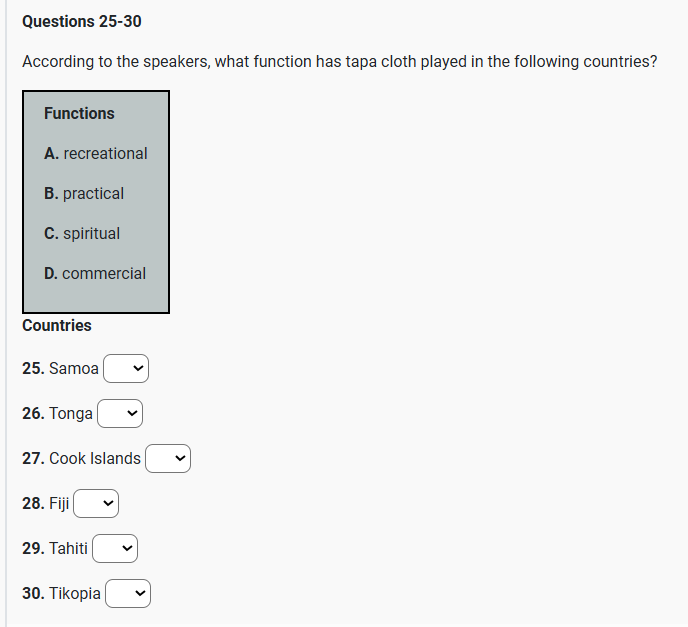
HELEN: Okay then I could talk about Tonga, it seems to me that the great innovation in Tonga has been developing a Q26 simple coarse cloth, which is quick and easy to make this is suitable for all sorts of everyday functions around the house like bed covers, mosquito Nets, and curtains.

TUTOR: Good point now what about Cook Islands Tupper?

HELEN: Well the soil there is poor quality so the breadfruit tree is often used. One type of thick cloth called tikuru was wrapped around the poles and used to Mark the entrances to Q27 places of worship so it was highly regarded in local culture.

TUTOR: You might mention Fiji as well which is interesting because tapple was actually Q28 used as a currency there. Fijians used to sail between the islands and exchange tapa for other Commodities like canoes or pigs.

HELEN: I know that in Tahiti the top of cloth is different because the patterns are in color which is considered more valuable than the usual Brown patterns.

TUTOR: You’re right about the Tahitians Q29 using colored pigments, but they aren’t more valuable the colors are only a decoration people enjoy wearing bright robes especially for dancing in competitive games and do it just for fun.

HELEN: Oh I’ll make a note of it. Well, the last place I was going to mention was Tikopia. Even today it’s commonplace to see Q30 people wearing clothes made of tuppercloth and many of the other Islands the tapa only comes out on special occasions, but here you see people working in the gardens wearing Tupper.

TUTOR: Sounds promising Helen I look forward to reading your assignment.


 Prepare for IELTS IELTS Test International Experienced Teacher Best Training By CELTA Trainer. Best Results Easily Get Required Score IELTS Exam Dates Available, Small Batch Size with Flexible Time, Professional.

phone icon
8439000086
8439000087
7055710003
7055710004
IELTS Simulation 323 GMS Road, Near Ballupur Chowk, Dehradun, India

Chat on WhatsApp
email: info at ieltsband7.com

IELTS LISTENING – GLOBAL MUSEUM EXHIBITIONS AND VISITOR GUIDE S62T2

 IELTS listening Global Museum Exhibitions and Visitor Guide listening practice test has 10 questions belongs to Leisure & Entertainment  subject..
 
Welcome to the global Museum located at the heart of This truly Multicultural city which is home to more than 60 different nationalities. The museum has a number of exciting displays and exhibitions and this audio guide is designed to help you make the most of your visit. Altogether the museum has 18 different Galleries and this season sees the opening of three new exhibitions. We recommend that you begin your tour by visiting this season’s highlights.


The Heritage Clothes exhibition is located in Gallery 5 of the museum. Q11 People who live in the area have spent two years preparing this exhibition, which brings together some of the fascinating garments traditionally worn in Q12 their own communities. They research the history of their communities clothing traditions and the customs and rituals associated with them. Altogether 16 countries are represented from Ghana to Korea from Turkey to Nepal. The photographs that accompany each display case were taken by some of the city college students who are studying design, and show the clothes being modeled by the real people who wear them in the course of their everyday lives.

Another highlight this season is the exhibition called Toys from the Past which can be found in gallery 9. This exhibition which will appeal to people of all ages is on tour throughout the country and will be here Q13 for 10 weeks only. The exhibits include dolls made over a hundred years ago with beautiful porcelain faces and in some cases real hair. The Collection covers the favorite toys such as wooden train sets from many different generations and provides plenty of interest for children and adults. The gigantic Q14 board games which are laid out on the gallery floor are one of the most popular activities in the exhibition and should not be missed this exhibition concludes with a special display of miniature toys. These small objects are on loan from countries all over the world and in some cases measure no more than a few centimeters. There’s a tiny car made from matchsticks a toy airplane complete with pilot and passengers made out of seashells and some Exquisite little buildings no higher than four centimeters.

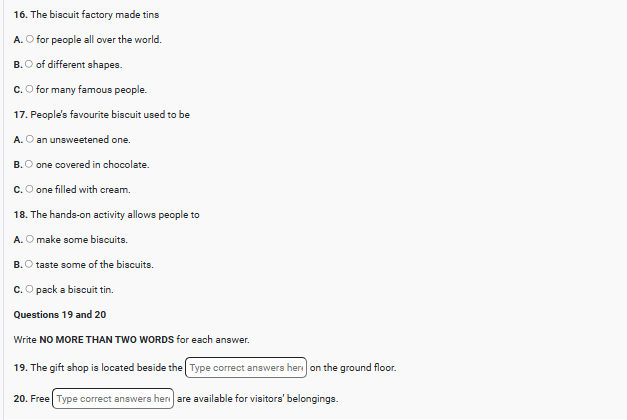
The final Gallery highlight of the season is the biscuit Gallery at number 15. Many years ago this city was famous for its biscuits although today the factory no longer exists. Did you know for example that before biscuits were packed in paper or cardboard boxes biscuit tins were fashion items. The factory made Q16 tins round, Square, triangular, and hexagonal, for a whole range of different occasions to celebrate National events festivals famous faces, and so on. One fascinating display deals with people’s favorite biscuits there are sweet biscuits and savory ones biscuits filled with jam and biscuits filled with currants biscuits with pink, yellow, and white sugar icing or colored sugar flowers. When the factory finally closed it announced that people’s favorite biscuit was not as you might expect a chocolate biscuit or one filled with jam and cream Q17 but a plain Savory one which was eaten with cheese.

When you get to the end of the exhibition there’s an entertaining Hands-On activity to Q18 fill your own biscuit tin. All the biscuits ever produced by the company are piled up on a table along with various tins. The biscuits are made out of thin pieces of wood but the weight colors and shapes replicate the original biscuits. Your job is to fill it in with biscuits so that when the lid is taken off they sit there as neatly as they did when the job was done by machine, it’s not as easy as it looks if you would like to buy a Memento of your visit there is a museum gift shop selling postcards, souvenirs, and handmade Pottery next to the Q19 information desk on the ground floor. And finally, if you don’t want to carry your coats and bags around with you during your visit please make use of the free Q20 lockers provided by the museum. Enjoy your visit.


Best Results Easily Get Required Score IELTS Exam Dates Available, Small Batch Size with Flexible Time, Professional.

phone icon
8439000086
8439000087
7055710003
7055710004
IELTS Simulation 323 GMS Road, Near Ballupur Chowk, Dehradun, India
Chat on WhatsApp
email: info at ieltsband7.com

IELTS LISTENING – Student Accommodation S62T1

 IELTS listening Student Accommodation listening practice test has 10 questions belongs to the Education & Housing subject.
 
MAN: College accommodation Bureau Darren speaking. How may I help you?
 
STUDENT: Oh good morning I’m starting at the college in September and I need to find some accommodation.
 
MAN: Right, well there are various options, the first one is to stay in college accommodation. That would be a single room.
 

STUDENT: How much would that cost?

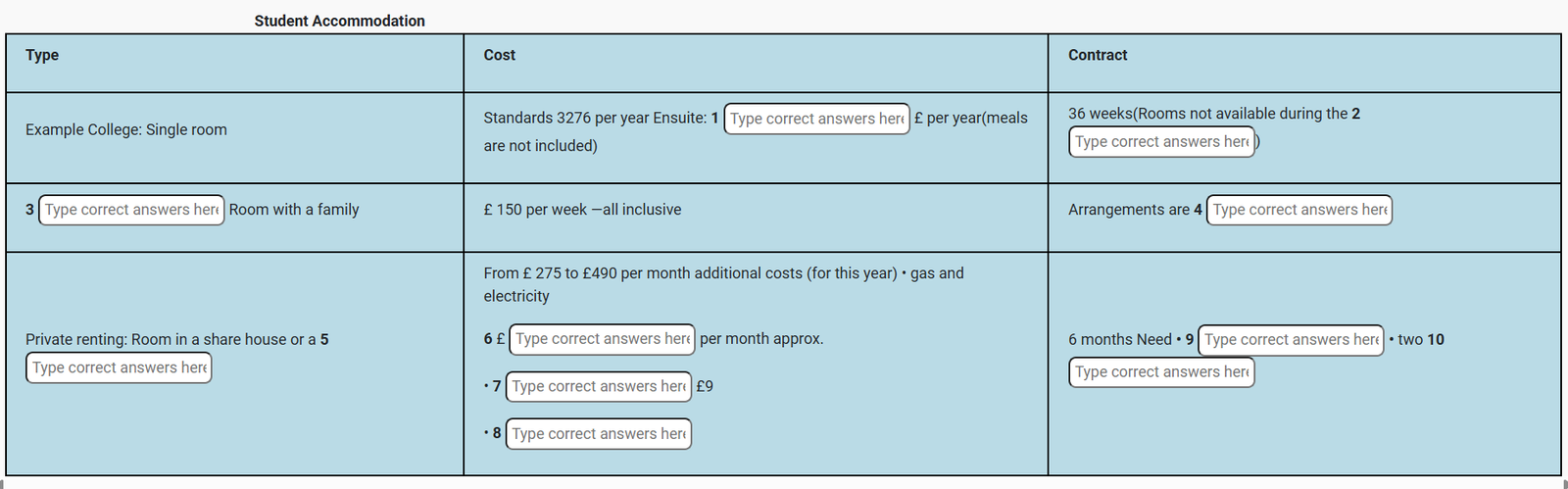
MAN: Well, it depends for a standard room you’re looking at 3276 pounds for the year, that’s just for a room with wash basin, or Q1 3834 pounds if you want an ensuite that’s with your own small bathroom.

STUDENT: I see that’s more than I expected.

MAN: It does include heating. That’s quarter saving because energy costs can be high, especially in Winter.

STUDENT: Hmm, does it include meals as well?

MAN: No, all our rooms are self-catering now there’s a shared kitchen on each Corridor where you can cook if you want to or there are plenty of places to eat out on campus.

STUDENT: Okay, and you said that’s the price for the whole year?

MAN: Well, you pay annually, but actually it’s for 36 weeks it doesn’t include Q2 holidays you have to vacate the room then.

STUDENT: Oh um, I need somewhere to stay in the holidays I can’t afford to go home the flights are too expensive.

MAN: Well, there is another option, several families who either work at the college or have children studying here offer visiting students a room in their homes.

STUDENT: Oh.

MAN: We call this arrangement Q3 home welcome and we’ve still got a few places left at the moment. You pay 150 pounds per week and that includes breakfast, a packed lunch, and dinner as well as Heating.

STUDENT: Is there a contract? Do you have to stay for the whole year?

MAN: No, it’s Q4 flexible.

STUDENT: Um, it sounds really good but I’m not sure. I really want to be a little more independent.

STUDENT: What about finding somewhere to live off campus?

MAN: Yes, you can rent a property in town privately. You might want to rent a room in a shared house, you’d have a room of your own and share the kitchen and bathroom with other students.

STUDENT: What about if I don’t want to share?

MAN: You can get what we call a Q5 studio, they’re often quite small but they’ll have everything you need.

STUDENT: Right how much with those two options cost?

MAN: Well, prices vary depending on which part of town the property is in generally speaking the cheapest is around 275 pounds a month for each student.

STUDENT: Oh uh, that’s not too bad.

MAN: Yes, but it can also be as high as 490 pounds and then you’ll have to pay all your other bills.

STUDENT: What sort of amount would I be looking at for those well last year students were paying on average about 43 pounds per month each for gas and electricity this year it’ll probably be somewhere in the region of Q6 48 pounds.

MAN: That’s a lot.

STUDENT: Yes, they’ve gone up quite a bit and on top of that you have to pay for Q7 water and that’ll probably be around nine pounds.

MAN: That didn’t occur to me and I guess I’d have to pay for Q8 transportation too.

STUDENT: That’s right most of these properties are quite a long way from the college.

MAN: It just gets worse and worse. What’s the minimum contract on this type of accommodation?

STUDENT: 6 pounds and you have to pay Q9 a deposit but of course, you can stay there over the holidays.

MAN: That’s true and you’d have to provide Q10 references.

STUDENT: They want two from someone in this country.

MAN: I see that’s not a problem.

STUDENT: If you do choose this option we can’t find the property for you you’d have to go through the estate agent which manages the property for the owner.

MAN: Right thanks, well I think I’d like to see what’s available privately. Could you give me the estate agent details?


 Prepare for IELTS  Test International Experienced Teacher Best Training By CELTA Trainer.

phone icon
8439000086
8439000087
7055710003
7055710004
IELTS Simulation 323 GMS Road, Near Ballupur Chowk, Dehradun, India
Chat on WhatsApp
email: info at ieltsband7.com

IELTS LISTENING – The Tiger Shark S61T4

 IELTS listening The Tiger Shark listening practice test has 10 questions belongs to the Leisure & Entertainment subject belongs to the Wildlife & Marine Life subject..

Researcher: Good morning, everyone. Today, I’m going to talk about the research project I’ve been involved in on the tiger shark. First of all, some background information. The tiger shark, also known as the leopard shark, is often thought to have got its name from its aggressive nature, but in actual fact, it’s called that because it has dark bands similar to those on a tiger’s body. It is a huge creature growing up to lengths of six and a half metres. It can be found just about everywhere throughout the world’s temperate and tropical seas, but it is most often found along the Q31 coast, rather than the open sea.

In terms of feeding, tiger sharks tend to be most active at night and are solitary hunters. Their preferred prey includes other sharks, turtles, seabirds and dolphins, to name but a few. However, it’s not uncommon to find Q32 garbage in its stomach. This is because it tends to feed in areas such as harbours and river inlets, where there is a lot of human activity.

Now to the project itself. We are particularly interested in some studies that had been done in the Raine Island area. Observations here have shown that there is a large population of tiger sharks present in the Q33 summer, during the turtle nesting season. However, during the winter months the sharks disappear – so we decided to do some of our own research there.

The first step was to tag a number of sharks so that we could follow their movements. To do this, we first needed to catch the sharks. Early in the morning, we baited lines with large bits of Q34 fish and set them in place. These lines were then Q35 checked every three or four hours. If no sharks were caught, the baits were replaced.

Once a shark had been caught on one of the baited hooks, it was pulled in close to the Q36 boat and secured so that we could carry out a number of brief activities to aid our research. This usually took no more than about ten minutes and was carried out as carefully as possible to minimise any stress to the shark. Each of the tiger sharks that we caught was measured and fitted with an identification tag and also a small amount of tissue was taken for genetic studies. For some larger sharks over three metres long, we also inserted into the belly a special acoustic tag capable of sending satellite signals, while on other large sharks we attached a Q37 camera to the dorsal fin, to enable us to study the behaviour and habitat use of the sharks. After this, the shark was Q38 released, and we were able to follow its movements.

So what was the purpose of all this tagging? Well, while we were already familiar with some aspects of the tiger sharks’ behaviour and food sources, what we hoped to do in this project was to see exactly what factors affected the Q39 migration patterns of tiger sharks and whether it was in fact food, weather and reproductive needs.

These are some of our findings: On February 21st a large female shark, whom we named Natalie, was attracted to our research boat at the northern tip of Raine Island and fitted with one of the satellite tags I’ve just mentioned. No transmissions were received from Natalie between April 2nd and April 29th indicating that she didn’t surface to feed during this period. The area in which she was last reported is very shallow, suggesting that she may have changed her feeding preferences during this period to focus on prey found on the sea floor.

We also made a number of other discoveries thanks to the various transmitters we used. It seems that tiger sharks move back and forth between the ocean floor and the surface quite often. This may help the sharks conserve energy while they swim, but it probably also helps them hunt, since this movement back and forth maximises its chances of not being detected by its prey until the last minute.

So far our findings have not been conclusive. However, we have gained some very interesting insights into the behaviour of tiger sharks and are now hoping to develop our research further.


Boost Your Score: Practice IELTS Online with IELTS Simulator.

phone icon
8439000086
8439000087
7055710003
7055710004
IELTS Simulation 323 GMS Road, Near Ballupur Chowk, Dehradun, India
Chat on WhatsApp
email: info at ieltsband7.com