Unlock the Benefits of IELTS Listening

Access our library of Listening practice audio in MP3 format for on-the-go listening, and PDFs for offline study sessions. Download MP3 and download PDF file for offline practice. 

IELTS LISTENING – Time Perspective S60T4

IELTS listening Time Perspective listening practice test has 10 questions belongs to the Psychology & Human Behaviour subject. 

Today, I’m going to be talking about time. Specifically, I’ll be looking at how people think about time, and how these time perspectives structure our lives. According to social psychologists, there are six ways of thinking about time, which are called personal time zones.
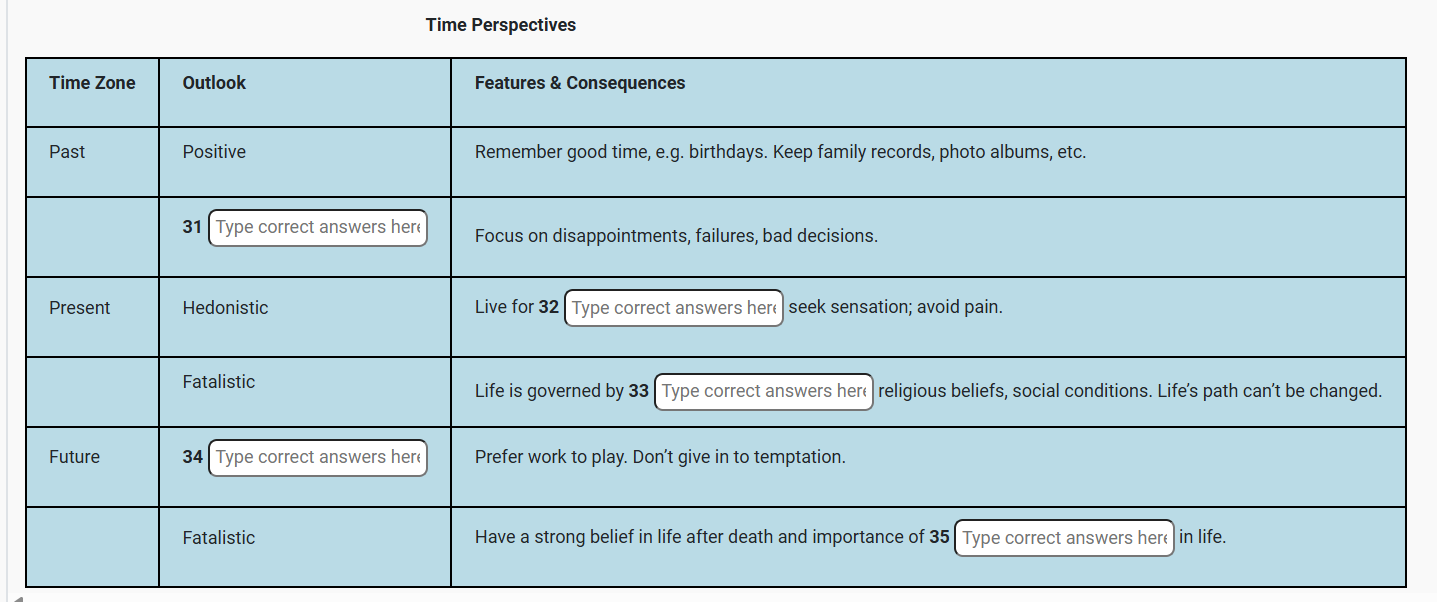
The first two are based in the past. Past positive thinkers spend most of their time in a state of nostalgia, fondly remembering moments such as birthdays, marriages, and important achievements in their life. These are the kinds of people who keep family records, books, and photo albums. People living in the past Q31 negative time zone are also absorbed by earlier times, but they focus on all the bad things – regrets, failures, and poor decisions. They spend a lot of time thinking about how life could have been.

Then, we have people who live in the present. Present hedonists are driven by Q32 pleasure and immediate sensation. Their life motto is to have a good time and avoid pain. Present fatalists live in the moment too, but they believe this moment is the product of circumstances entirely beyond their control; it’s their fate. Whether it’s Q33 poverty, religion, or society itself, something stops these people from believing they can play a role in changing their outcomes in life. Life simply “is” and that’s that.

Looking at the future time zone, we can see that people classified as future Q34 active are the planners and go-getters. They work rather than play and resist temptation. Decisions are made based on potential consequences, not on the experience itself. A second future-orientated perspective, future fatalistic, is driven by the certainty of life after death and some kind of a judgement day when they will be assessed on how virtuously they have lived and what Q35 success they have had in their lives.
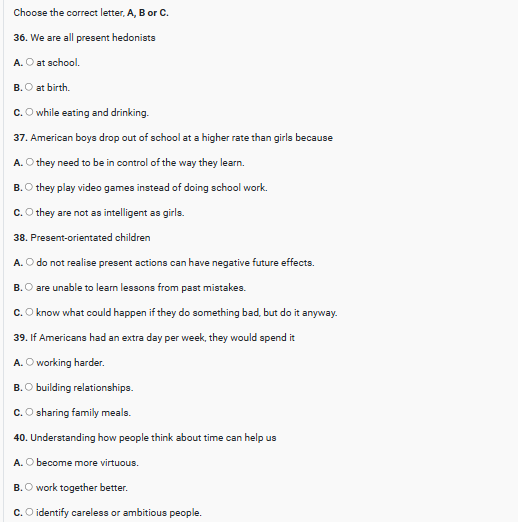
Okay, let’s move on. You might ask “how do these time zones affect our lives?” Well, let’s start at the beginning. Everyone is Q36 brought into this world as a present hedonist. No exceptions. Our initial needs and demands – to be warm, secure, fed, and watered – all stem from the present moment. But things change when we enter formal education – we’re taught to stop existing in the moment and to begin thinking about future outcomes.

But, did you know that every nine seconds a child in the USA drops out of school? For boys, the rate is much higher than for girls. We could easily say “Ah, well, boys just aren’t as bright as girls” but the evidence doesn’t support this. A recent study states that boys in America, by the age of twenty one, have spent 10,000 hours playing video games. The research suggests that they’ll never fit in the traditional classroom because these boys require a situation where they have the Q37 ability to manage their own learning environment.

Now, let’s look at the way we do prevention education. All prevention education is aimed at a future time zone. We say “don’t smoke or you’ll get cancer”, “get good grades or you won’t get a good job”. But with present-orientated kids that just doesn’t work. Although they understand the potentially negative consequences of their actions, they persist with the behaviour because they’re not living for the future; they’re in the moment right now. We can’t use logic and it’s no use reminding them of potential fall-out from their decisions or previous errors of judgment – we’ve got to get in their minds just as they’re about to make a choice.

Time perspectives make a big difference in how we value and use our time. When Americans are asked how busy they are, the vast majority report being Q39 busier than ever before. They admit to sacrificing their relationships, personal time, and a good night’s sleep for their success. Twenty years ago, 60% of Americans had sitdown dinners with their families, and now only 20% do. But when they’re asked what they would do with an eight-day week, they say “Oh that’d be great”. They would spend that time labouring away to achieve more. They’re constantly trying to get ahead, to get toward a future point of happiness.

So, it’s really important to be aware of how other people think about time. We tend to think: “Oh, that person’s really irresponsible” or “That guy’s power-hungry” but often what we’re looking at is not fundamental differences of personality, but really just different ways of thinking about time. Seeing these conflicts as differences in time perspective, rather than distinctions of character, can facilitate more effective cooperation between people and get the most out of each person’s individual strengths.


Boost Your Score: Practice IELTS Online with IELTS Simulator.

phone icon
8439000086
8439000087
7055710003
7055710004
IELTS Simulation 323 GMS Road, Near Ballupur Chowk, Dehradun, India

Chat on WhatsApp
email: info at ieltsband7.com
IELTS LISTENING – COUNSELING SERVICES S60T2

 IELTS listening Counseling Services  listening practice test has 10 questions belongs to the Education & Student Support subject.

SPEAKER: Hello everyone. I’m the counseling administrator here at St. Ive’s College and I’ve been asked to come and talk to you about our counseling team and the services that we offer.

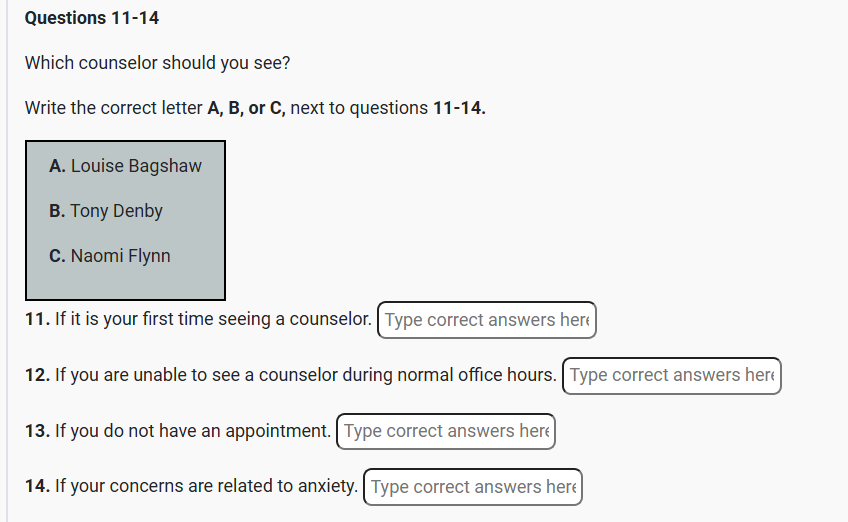
We have three professional counselors here at St. Ives: Louise Bagshaw, Tony Denby, and Naomi Flynn. They each hold daily one-on-one sessions with students, but which counselor you see will depend on a number of factors.

If you’ve never used a Q11&12 counselor before, then you should make an appointment with Q11&12 Naomi Flynn. Naomi specialises in seeing new students and offers a preliminary session where she will talk to you about what you can expect from counseling, followed by some simple questions about what you would like to discuss. This can be really helpful for students who are feeling a bit worried about the counseling process. Naomi is also the best option for students who can only see a counselor outside office hours. She is not in on Mondays, but starts early on Wednesday mornings and works late on Thursday evenings, so you can see her before your first class or after your last class on those days.

Q13 Louise Bagshaw staffs our drop-in centre throughout the day. If you need to see someone Q13 without a prior appointment then she is the one to visit. Please note that if you use this service then Louise will either see you herself or place you with the next available counselor. If you want to be sure to see the same counselor on each visit, then we strongly recommend you make an appointment ahead of time. You can do this at reception during office hours or by using our online booking form.

Q14 Tony Denby is our newest addition to the counseling team. He is our only male counselor and he has an extensive background in stress management and relaxation techniques. We encourage anyone who is trying to deal with Q14 anxiety to see him. Tony will introduce you to a full range of techniques to help you cope with this problem such as body awareness, time management, and positive reinforcement.

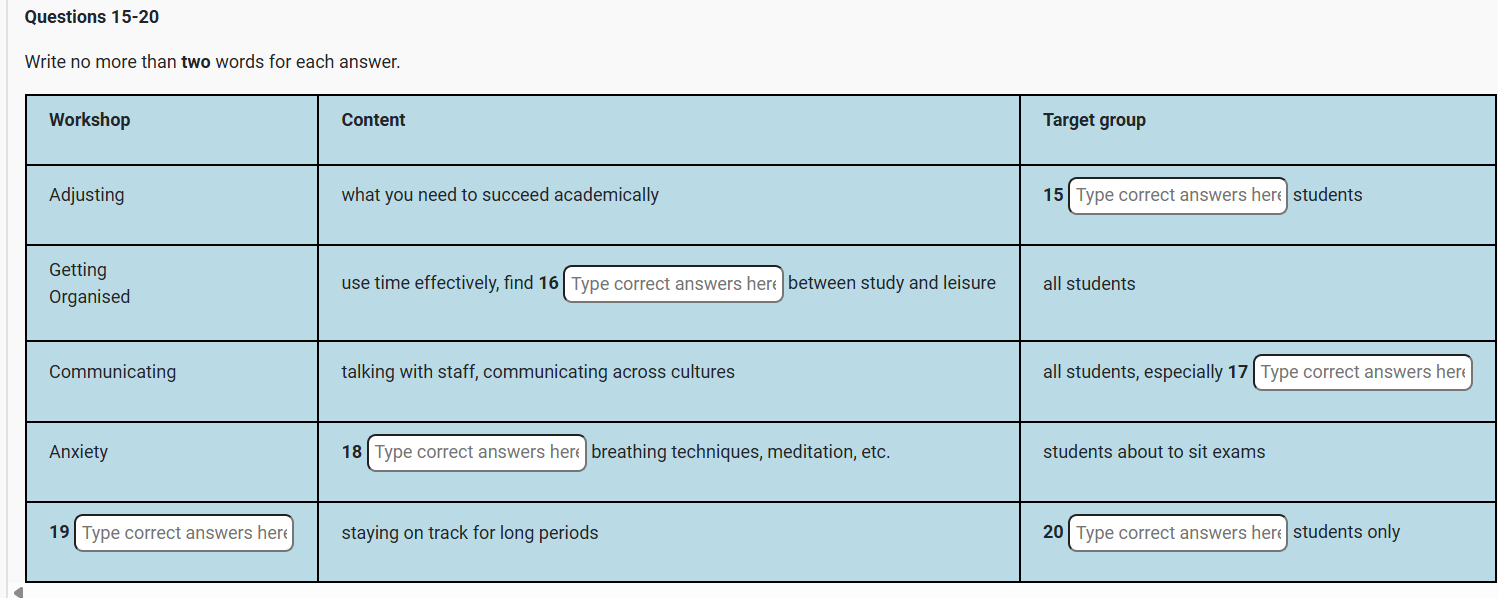
Each semester the counseling team runs a number of small group workshops. These last for two hours and are free to all enrolled students. Our first workshop is called Adjusting. We’ve found that tertiary education can come as a big shock for some people. After the structured learning environment of school, it is easy to feel lost. In this workshop, we will introduce you to what is necessary for academic success. As you might expect, we’re targeting Q15 first year students with this offering.

Getting organised follows on from the first workshop. Here, we’re going to help you break the habit of putting things off, get the most out of your time, and discover the Q16 right balance between academic and recreational activities. With Getting organised, we’re catering to a broader crowd, which includes all undergraduates and postgraduates.

Next up is a workshop called Communicating. The way people interact here may be quite different to what you’re used to, especially if you’ve come from abroad. We’ll cover an area that many Q17 foreign students struggle with – how to talk with teachers and other staff. We’ll cover all aspects of multicultural communication. International students tend to get a lot out of this class, so we particularly encourage you to come along, but I must say that sometimes students from a local background find it helpful too. So, everyone is welcome!

The Anxiety workshop is held later on in the year and deals with something you will all be familiar with – the nerves and anxiety that come when exams are approaching. Many students go through their entire academic careers suffering like this, but you don’t have to. Come to this workshop and we’ll teach you all about Q18 relaxation and how to breathe properly, as well as meditation and other strategies to remain calm. We’ve tailored this workshop to anyone who is going to sit exams.

Finally, we have the Q19 motivation workshop. The big topic here is how to stay on target and motivated during long-term research projects. This workshop is strictly for Q20 research students, as less-advanced students already have several workshops catering to their needs.

Well, that’s it, thanks for your time. If you have any questions or want more information about our services, do come and see us at the Counseling Service.


Boost Your Score: Practice IELTS Online with IELTS Simulator.

phone icon
8439000086
8439000087
7055710003
7055710004
IELTS Simulation 323 GMS Road, Near Ballupur Chowk, Dehradun, India
Chat on WhatsApp
email: info at ieltsband7.com

IELTS LISTENING – Transport from Bayswater S60T1

IELTS listening Transport from Bayswater listening practice test has 10 questions belongs to the Travel & Transport subject. 

Woman: Good morning, Travel Link. How can I help you?

Man: Good morning. I live in Bayswater and I’d like to get to Harbour City tomorrow before 11 am.

Woman: Well, to get to Bayswater…

Man: No, no. I live in Bayswater – my destination is Harbour City.

Woman: Sorry. Right, so that’s Bayswater to Harbour City. Are you planning to travel by bus or train?

Man: I don’t mind really, whichever option is faster, I suppose.

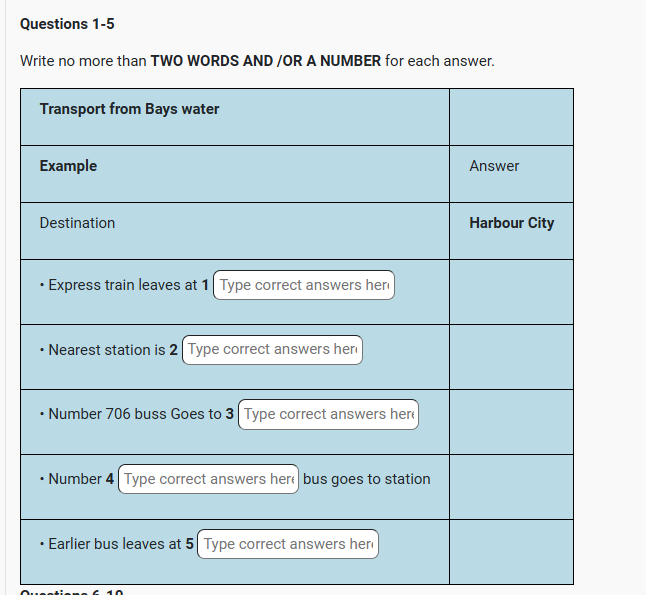
Woman: Well, if you catch a railway express, that’ll get you there in under an hour… Let’s see – yes, if you can make the Q1 9.30 am express, I’d recommend you do that.

Man: Great. Which station does that leave from?

Woman: Helendale is the nearest train station to you.

Man: Did you say Helensvale?

Woman: No, Q2 Helendale – that’s H-E-L-E-N-D-A-L-E.

Man: What’s the best way to get to the Helendale station then?

Woman: Well, hang on a minute while I look into that… Now, it seems to me that you have two options. Option one would be to take the 706 bus from the Bayswater Shopping Centre to Q3 Central Street. When you get there, you transfer to another bus which will take you to the station. Or, the second option, if you don’t mind walking a couple of kilometres, is to go directly to Central Street and get straight on the bus going to the train station.

Man: Okay. Which bus is that?

Woman: The Q4 792 will take you to the station.

Man: I guess the walk will be good for me so that might be the better option. What time do I catch the 792?

Woman: There are two buses that should get you to the station on time: one just before nine o’clock and one just after. But look, at that time of the morning it might be better to take the earlier one just in case there’s a traffic jam or something. The Q5 8.55 am is probably safer than the 9.05.

Man: Yeah, I don’t want to miss the train, so I’ll be sure to get on the five-to-nine bus.

Man: By the way, how much will I have to pay in fares?

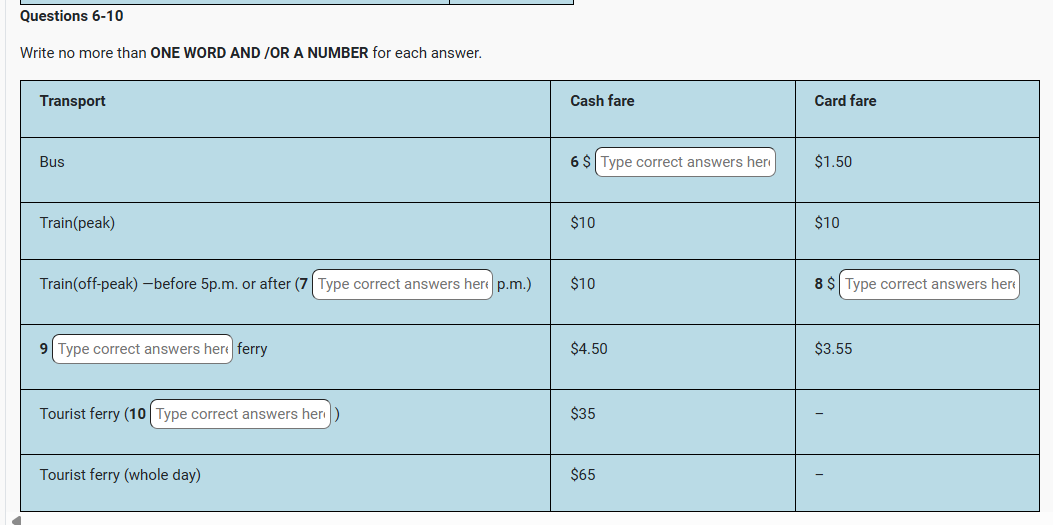
Woman: Well, you can get a ticket on the bus for Q6 $1.80 cash and you’ll need $10 each way for the train. Wait, do you have a Travel Link Card?

Man: No, but I can get one before tomorrow.

Woman: Okay, well that’ll make it considerably cheaper then. The bus will cost $1.50 each way, and the train will be – the train to Harbour City will … still cost $10.00 because you’ll be travelling during peak hours in the morning, so no savings there, I’m afraid. However, if you could come back at an off-peak time …

Man: What does that mean?

Woman: Well, if you could start your return journey before 5 pm or later than Q7 half past 7 in the evening … 

Man: Actually, I wasn’t planning on coming back till at least 8 o’clock anyway.

Woman: In that case, you can make quite a saving if you use your Travel Link Card. You did say you were planning to purchase one, didn’t you?

Man: Yes, I’ll pick one up later today.

Woman: Good – that would mean that your return train journey would only cost you Q8 $7.15 with your card.

Man: Thank you.

Woman: Is there anything else I can help you with?

Man: Actually, there is. Do you know if I can use the Travel Link Card on ferries?

Woman: If you’re thinking of the Harbour City ferries that go back and forth between the north and south bank, those are the Q9 commuter ferries, then yes. A one-way trip costs $4.50 but with your card, you’d make a 20% saving and only pay $3.55.

Man: So, $3.55 for the commuter ferry …What about the tour boats?

Woman: You mean the tourist ferries that go upriver on sightseeing tours? No, they only take cash or credit card. They’re not part of the Travel Link Company.

Man: Oh, I see. I don’t suppose you know the cost of a tour?

Woman: In actual fact, I do, because I took a friend on the trip upriver just last week. We decided on the Q10 afternoon tour and that was $35 each but I understand that you can do the whole day for $65.

Man: Thank you. You’ve been a great help.

Woman: My pleasure. Enjoy your day out.


Boost Your Score: Practice IELTS Online with IELTS Simulator.

phone icon
8439000086
8439000087
7055710003
7055710004
IELTS Simulation 323 GMS Road, Near Ballupur Chowk, Dehradun, India
Chat on WhatsApp
email: info at ieltsband7.com

IELTS LISTENING -IMPACT OF DIGITAL TECHNOLOGY ON EDUCATION S59T4

 IELTS listening Impact of Digital Technology on Education listening practice test has 10 questions belongs to the Education & Technology subject..
 
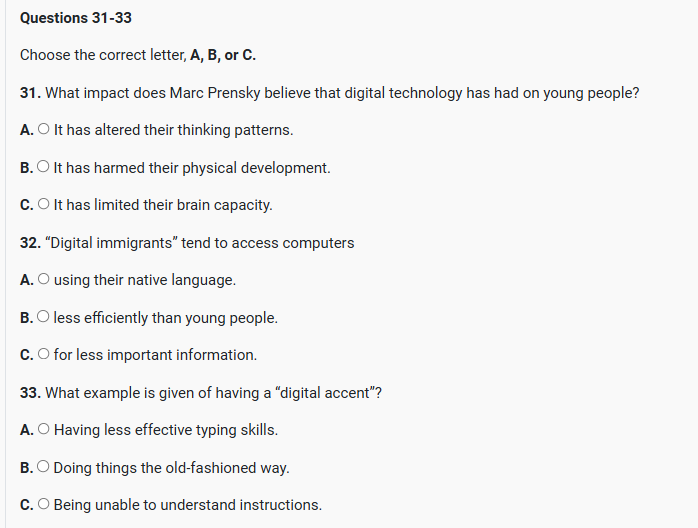
In this lecture series, we’re looking at changes occurring due to the rapid spread of digital technology in the last Decades of the 20th century. My digital technology I include any computer-related devices such as email, the internet, cell phones, instant messaging, to name but a few. Today’s lecture focuses on the ideas of Mark Prensky, and what he believes are the major effects that high exposure to digital technology has had on young people today.
 

Firstly what exactly does Prinsky believe, Argues that because today’s young people have been born into a digital world and spend hours simply playing with technology. They’ve changed in fundamental ways. He believes they’re evolving differently and as a result process information differently from previous generations. It’s even possible that Q31 these young people’s brains have physically changed although whether this is literally true isn’t yet known. Nor does Prensky go quite this far. Ensky divides people into digital Natives and digital immigrants. Q32 Today’s young people are the digital Natives and they belong in this new digital age because they were born into it and grew up as native speakers of the digital language of computer technology. Whereas ‘digital immigrants’ are those born in the generations before the digital age. Just as those who learn a second language often retain their foreign accent. The immigrants are usually in varying degrees not quite as effective at speaking the digital language as the natives are.

For example, they’re more comfortable finding phone numbers using a phone book or looking up information in an encyclopedia. Q33 Rather than using the internet as a primary source of information. Prensky calls this the ‘digital accent’ another example of the digital accent is scanning a manual for a computer program rather than assuming the program itself will teach you how to use it. Basically, people with a digital accent have never really stopped relying on their original non-digital means of sourcing information. They prefer doing things as they’ve always done them without typing something into a computer. Predicts that due to all this changes are in store mainly in the area of Education. But what do other Educators and theorists such as Thomas Allen, Samuel James, and Peter Vander believe.

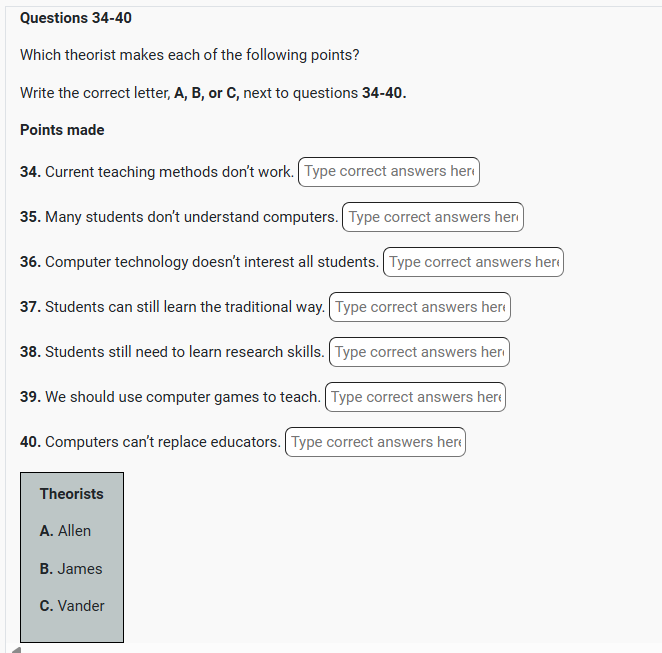
Samuel Q34&37&39 James from Sydney University agrees with Prensky’s predictions. That educators are Q34 no longer successful in the way they teach, however not surprisingly Prensky has been Q37 criticized by more traditional theorists like Peter Vander and Thomas Allen. They disagree with many of Prinsky’s assertions.

Q35 Vander argues that a typical classroom is more varied than Prinsky believes with students coming from a range of backgrounds. He maintains that a large percentage of these students are Q35 not necessarily proficient with technology, and not all students today fit the one stereotype and Q36&38 Allen adds that even though most students today have easy access to technology. Q36 Some just don’t find the digital medium appealing.

James disagrees though he believes that all today’s students do share the same basic interest in and knowledge of digital technology. However, James believes our younger students can communicate with their digital immigrant teachers and can still learn using methods which have proven to be successful in the past. James’s theories are taken a step further by Alan who recognizes that both digital immigrants and natives have to deal with vast amounts of information in today’s electronic Society.

Allen maintains that while most young students are proficient in playing computer games and using the web in quite basic ways. They’re not used to using the computer at Advanced levels. For example to conduct complex information searches which are so necessary for University study today. Irrespective of Alan’s research James believes it’s possible for Q39 computer games to play a major role in making classroom learning more stimulating and he cites many instances where this would be possible today. However, Vander asserts that rather than focusing on developing games Q40 we should think of better ways to assist teachers because no computer program comes close to doing what a human teacher does every day.


Boost Your Score: Practice IELTS Online with IELTS Simulator.

phone icon
8439000086
8439000087
7055710003
7055710004
IELTS Simulation 323 GMS Road, Near Ballupur Chowk, Dehradun, India
Chat on WhatsApp
email: info at ieltsband7.com