Access our library of Listening practice audio in MP3 format for on-the-go listening, and PDFs for offline study sessions. Download MP3 and download PDF file for offline practice.
IELTS listening Nanotechnologylistening practice test has 10 questions belongs to the Academic Lecture.
Good morning everyone. Welcome to the second lecture in our series on modern technology. Today I’ll be discussing the recent developments in nanotechnology in addition to its applications in a number of environments such as domestic and medical. First of all, I’d like to begin with a short explanation of what nanotechnology is. It is the manipulation of matter on an atomic molecular and super molecular scale. Because of its limitless applications and uses the government has invested billions of dollars into the research and development of nanotechnology in order to explore its potential.
It is only recently that we have been able to engage in the development of nanotechnology since particles are so minuscule that a new type of Q31microscope had to be invented to enable us to see them. Many of you may not realize that we all use nanotechnology in our homes, as a part of our daily lives. For example, a new dietary supplement uses nanotechnology in order to help our body to absorb Q32iron from our diet more efficiently which can help to prevent anemia. This technology also makes it easier and cheaper for factories to produce foods such as Q33chocolates. As the nano molecules help the food to meet our recommended daily intake of certain vitamins and minerals. This may sound odd but, in fact, it just means that the food is healthier and cheaper and has increased Q34flavour. Another application for nanotechnology is in the agriculture industry. In the past farmers have been using many artificial chemicals to fertilize the soil, which is extremely bad for the planet as it contaminates the water that we drink. By using nanotechnology scientists have been able to develop a spray which increases the efficiency of Q35fertilisers that occur naturally in the soil. This means that a lot more food can now be produced per square hectare making it cheaper and more efficient to grow without harming the planet.
One of the industries upon which nanotechnology has had the biggest impact is the production of pharmaceuticals. One of the most commonly occurring illnesses is food poisoning as many foods have naturally occurring contaminants that can be harmful if eaten without being thoroughly cooked. Nanotechnology makes it possible for us to sterilize the food and make it safe to eat by killing these Q36bacteria. A major success in the use of nanotechnology in the medical field is in the treatment of cancer. Researchers have found that they can attach medicine to nanoparticles which are then injected into the body and enable the therapeutic Q37drugs to be absorbed into the veins. These drugs then travel throughout the blood system and target cancerous tumors. Scientists have also discovered that certain metals contain nanoparticles that have antibacterial qualities with the ability to destroy over 650 types of bacteria. These metals are used for example on fridges to prevent the growth of bacteria. They can even be woven into materials to create clothing that is self-cleaning and has an attractive metallic appearance. The most popular of these materials contains Q38silver which naturally has the strongest antibacterial qualities these clothes have a special tag on them to show that they use nanotechnology so keep a look out for them next time you go shopping. Another observation made by some researchers showed that certain types of nanoparticles called splifferines can destroy fat tissues and therefore stimulate fat loss without the need for dieting or exercise. They are currently developing a supplement that can be ingested in order to help dieters with their Q39weight loss programs it is predicted that these supplements will be on the market by 2020.
I would like to finish today’s lecture with a final example of a domestic application for nanotechnology cosmetics. Nanoparticles are used in many makeups and body lotions but they have the greatest effect in sun cream. Ultraviolet rays given off by the Q40sun are a serious cause of skin cancer but the nanoparticles in sun cream protect the skin against the sun by blocking the ultraviolet radiation from entering the body this is why you must always wear suntan lotion on the beach.
Now I’d be happy to answer any questions you may have…
Boost Your Score: Practice IELTS Online with IELTS Simulator Prepare for IELTS Effectively Using IELTS Simulator Ace the IELTS: Try Realistic Practice on IELTS Simulator IELTS Simulator: Online Practice to Improve Your IELTS Score Rocky Bay field trip listening practice test has 10 questions belongs to the Leisure & Entertainment subject. Prepare for IELTS IELTS Test International Experienced Teacher Best Training By CELTA Trainer. Best Results Easily Get Required Score IELTS Exam Dates Available, Small Batch Size with Flexible Time, Professional. Easily Get Required Score I am interested in IELTS Pass with Confidence, Dehradun Small Batch Size with Flexible Time, professional faculty. Learn From Experienced Teacher Best IELTS Coaching Dehradun Best IELTS in Dehradun Uttarakhand GMS Road BEST coaching in Dehradun Apply for Class Courses Today Good Results. Small Batch Size, Flexible Time and Professional IELTS Teacher Best IELTS coaching classes IDP certified British Council trained and CELTA certified experienced trainer. Easily Get Required Score Tel:8439000086 Tel:8439000087 Tel:7055710003 Tel:7055710004 Tel:7055710009
IELTS listening Experiment Discussionlistening practice test has 10 questions belongs to the (Student Discussion with Tutor or Classmates.
Bill: Oh hi Jen and Irene are you two heading to class?
Irene: Hey bill, yes we’re just walking there now we’re a little bit early but we wanted to prepare our apparatus for the experiment. Do you want to walk with us?
Bill: Yes sure it’ll be good to catch up. How is everything going with your experiment? Have you decided what your test subject is yet?
Jen: It’s going really well and we’re conducting the test as laboratory partners we’ve decided to test the effects of gravitational force on a series of objects with different densities.
Irene: It’s interesting but it’s a lot of work i’ve been planning the experiment for the last two weeks and I only finished yesterday.
Bill: Gosh Irene, i’m really impressed by how hard working you are.
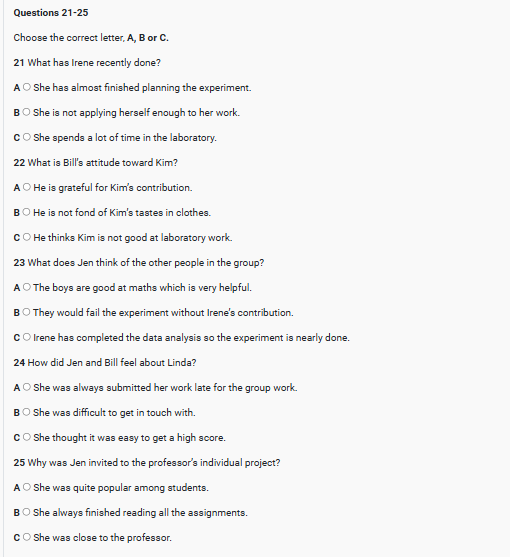
Irene: I enjoy chemistry so much that it doesn’t feel like work whenever I have some free time at the weekend Q21I spend it in the laboratory working on it. It almost feels like a second home to me.
Jen: How about you Bill, who is your laboratory partner?
Bill: The tutor partnered me with Kim. At first I was worried because i’ve never worked with him before and I was worried that he wouldn’t be very good at laboratory work, but actually Q22he’s very capable.
Irene: I’ve noticed that he’s always very well dressed.
Bill: Yes he’s very stylish and we share the same tastes in clothes. That doesn’t stop him from getting his hands dirty though, he’s a very hard worker and makes a significant contribution which i’m really grateful for.
Jen: Ah it’s good that you get on well with your partner. It makes the experiment so much more enjoyable when you work well together.
Irene: What do you think of the other people in our group?
Bill: A lot of the boys are really good at maths. Which is really helpful with all the calculations we have to do.
Jen: Irene is good at maths as well which makes her contribution really useful because she can do all the equations. I take care of all the writing because Irene finds that difficult we’d probably fail without each other’s help.
Irene: That’s true i’m so glad that we’re nearly finished
Jen: Only because Q23you finished the data analysis.
Irene: Oh Jen you give me too much credit,
Bill: i’m so glad that I didn’t get partnered with Linda again Jen and I were grouped with her for our last experiment and it was a nightmare.
Jen: Yes she always submitted her work on time for the group work, but she never had her phone on her so Q24it was impossible for anyone to keep in touch with her and vice versa.
Bill: Her attitude was pretty annoying but in all fairness she was a very hard worker because she realized the amount of work needed to get a high score.
Irene: Jen is such a hard worker in fact she has been invited to work on the professor’s personal project.
Bill: Wow that’s amazing well done. Why were you picked?
Jen: I thought he would pick one of the students that he’s closer to but he told me he was impressed with me because Q25I always complete reading the assignments in time for class.
Irene: I bet you’ll be really popular among the other students when they find out they’ll all want to hear about the project.
Irene: You should give everyone tasks so that they have the opportunity to participate.
Jen: That’s a really good idea actually. Will you help me decide who to assign each task to?
Bill: Of course, now let’s see well as Irene finds writing difficult perhaps it would be useful for her to practice that by doing the bibliography.
Irene: I think the bibliography is a bit long for me. I think i’d be better suited to the Q26methodology.
Jen: Yes that makes sense. Bill you’ve told us that Kim is a hard worker so I think he should be tasked with the conclusions as there is quite a lot of effort involved.
Bill: Okay sure I know that Kyle hasn’t been feeling well so he should take care of the abstract and the acknowledgement because there is very little work to be done for those tasks.
Irene: Jen do you want to Q28review some of the literature it’s a lot of work but I know that you really enjoy writing so i’m confident that you’ll do a good job.
Jen: Sure, sounds great.
Bill: Right so that leaves the Q29bibliography and the Q30discussion to assign I think that Linda will struggle with the amount of work involved in the referencing so perhaps I should take care of that task and she can do the other one.
Irene: That’s great guys. Thanks for your help i’ll tell the tutor when he arrives.
IELTS listening Leisure Complex Planlistening practice test has 10 questions belongs to the Public Talk.
Director: Hello and thank you for attending this meeting. I have called it to discuss station matters as there have been a number of changes made and I want to ensure that you are all filled in. Well as I’m sure you will all have heard there are plans underway to make some alterations to the station complex though we did the reconstruction work that occurred last year. From the data collected this year we have learned that our station is too small to cope with a large number of visitors passing through it on a daily basis.
However, relocation is unnecessary which means you our staff will be unaffected and can continue with your work as normal. We have decided that our only option is
to make the area bigger by building new platforms and new facilities such as cafes and lounge areas. We have already purchased the site on which these new facilities will be constructed. We had initially planned to build on the site of the old industrial buildings. However tests carried out on the soil and water showed that it was too highly contaminated with waste from the industrial processes instead we have purchased the site just across the road on which there used to be a lot of Q12houses that were later converted into shops. These buildings will of course be demolished to make room for our new facilities. What is going to be built on this new site, I see you thinking to yourselves there have been a lot of ideas put forward by all the parties involved initially the station had planned to use the site as Q13a car park. However we decided this would be a very unsatisfactory way to occupy the space, instead we have hired an architect who has an exciting vision to transform the site into a large leisure center
complete with cafes, shops and a lounge where visitors can relax. We hope that this new complex will attract many visitors not just from the station but also from the apartment blocks in the nearby town centre. As part of the construction works we are also going to create new formal gardens where visitors can enjoy the greenery and sit outside in the fresh air. The new leisure complex will be located to the right of Q14the shopping district so these formal gardens will serve as a meeting place for pedestrians.
Now i’m delighted to be able to introduce you all to the plans for our new complex, so if you could please focus your attention on the maps in front of you. We will start at the main entrance and make our way towards the Q15cafe which is located behind the wall that we can see directly in front of us, just next to the rear entrance. In this position the cafe is obscured from the entrances which will keep the space warm and also create an intimate atmosphere. Once visitors arrive at our station they often need further transport in order to reach their homes. Therefore we have introduced a Q16taxi rank with its own waiting area in order to reach these facilities the visitors must simply leave the complex via the rear entrance and turn left visitors who have traveled to the station by car can leave it in the Q17car park for a small fee, which is located just outside of the rear entrance to the right. At present our station does not have an internal seating area for passengers so they are forced to wait for their trains outside on the platforms which can be particularly unpleasant during the winter. We have therefore decided to introduce a Q18passenger waiting area inside the new complex to the right of the rear entrance, with comfortable seating where passengers can pass the time comfortably in the warmth. As this space is a distance away from the station we have also proposed a Q19waiting area for wheelchair users that is closer. As visitors enter through the main entrance this space will be located behind the wall to their left. Finally we have also decided that it would be a great idea to introduce a new Q20tourist office where visitors can get maps and information on our wonderful town. We want this new office to be easily accessible so visitors entering through the main entrance will find it directly to their right.
Now I think that’s all i have to tell you please feel free to ask any questions if you would like to know anything else.
IELTS listening Notes on A Part-time Societylistening practice test has 10 questions belongs to the Social Conversation & Telephone Inquiry.
WOMAN: Hello this is the Leighton Society, how can I help?
MAN: Oh hello, I’m just phoning you because I’m interested in becoming a member of your society and I was wondering if you could give me some more information.
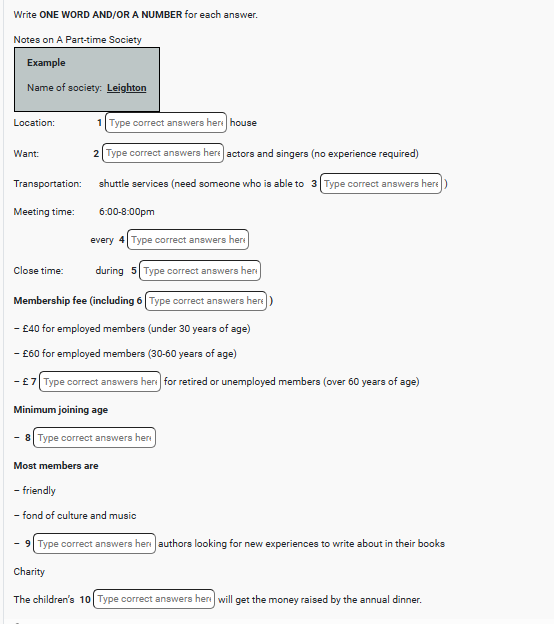
MAN: Well first of all I’d like to know where you hold the Q1club meetings. As I’m not very mobile anymore and I’m looking for somewhere that’s within walking distance of my house. Are you still down at the old Boathouse?
WOMAN: No we moved away from there a while ago, meetings are now held at the clubhouse.
MAN: Oh brilliant that’s only five minutes from me. Do you require members to have any skills or experience?
WOMAN: No there was no experience required. We have plenty of female singers and actresses but we don’t have many men who can play them male roles we are looking to resolve this, and are especially interested in recruiting Q2male actors and singers.
MAN: I’ve never sung professionally but I’m very keen on it and I’ve been told that I’m talented so I think this would be a good fit. Do you organize coaches to transport members to practice at the theater?
WOMAN: Unfortunately the club does not have sufficient funds to organize transportation though this is something we are working towards we are currently looking for members who can Q3drive so that we can organize car sharing, members who are able to shuttle people in their cars will obviously be compensated for their petrol usage.
MAN: I don’t drive but I’ll be happy to contribute some money in order to use the shuttle services.
WOMAN: Yes that is no problem are you aware of when the meetings take place?
MAN: No I couldn’t find the meeting times on your website.
WOMAN: We hold meetings from 6 to 8 P.M every Q4Tuesday.
MAN: Ah that’s lucky, I go to a debating club every Wednesday so I’m glad that it’s on a different night so I can attend both. Do you operate year round?
WOMAN: We used to close during December for the Christmas period but we found that a lot of members wanted to continue their practices during this time. We operate for most of the year but we do however close for Q5August because the weather gets so hot that we are unable to practice comfortably. This may change when we have enough funds to operate the air conditioning.
MAN: Okay, I also wanted to ask how much the membership fee is and what is included with it.
WOMAN: Our membership fee is inexpensive and it includes many benefits that certainly make the costs worth it, for example we hold an annual event where members can meet each other and Converse about topics that they have in common. We find that this is very popular as the Q6dinner is truly superb and included with your membership fee.
MAN: Wow that sounds great. And how much does membership cost?
WOMAN: We have a couple of membership rates depending on your age and situation through employed members under the age of 30 the fee is 40 pounds while it costs 60 pounds for members aged between 30 and 60 which of these categories do you fit into.
MAN: Oh I don’t fit into either of those I’m 65 years old and retired so I’m no longer employed.
WOMAN: That’s no problem at all you qualify for the lowest price membership fee of Q725 pounds which applies to those who are either unemployed or retired.
MAN: Wow that’s really affordable. I was thinking of bringing my grandson along to some of the practices so what would the membership cost for him, he’s 14.
WOMAN: I’m afraid that the club is for adults only that is to say we don’t allow members who are age Q816 and under he is welcome to join in two years time they.
MAN: Ah that’s a shame. I guess I couldn’t wait and buy him a membership for his birthday present.
WOMAN: Yes what a good idea.
MAN: I was hoping I could bring him with me so I have someone there to talk to I’m worried that I won’t have anything in common with the other members.
WOMAN: I’m sure you’ll fit in just fine, all our members are very friendly and interested in culture and music most of the people involved are Q9modern authors looking for new experiences to write about in their books you could read some of their books so you have something to discuss with them.
MAN: That’s a good suggestion I’ll definitely do that. I’m really looking forward to attending the annual dinner so I can meet new people and hopefully make some friends.
WOMAN: Absolutely everyone has a great night and it’s all for charity as all of the money raised from this event is donated to the children’s Q10hospital so they can buy toys and clothes.
MAN: Wow what a great cause well I will definitely be popping in soon to arrange my membership thank you for all of your help.