IELTS LISTENING- The Evolution of Pockets: A Fashion History S72T4
| IELTS LISTENING- The Evolution of Pockets: A Fashion History listening practice test has 10 questions belongs to the Social History & History of Fashion subject.. |
Good morning. Now, we’ve been asked to choose an aspect of European clothing or fashion and to talk about its development over time.
I decided to focus on a rather small area of clothing and that’s pockets. I chose pockets for two reasons, really. We all have them – in jeans, jackets, coats, for example – and even though we often carry bags or briefcases as well, nothing is quite as convenient as being able to pop your phone or credit card into your pocket. Yet, I suspect that, other than that, people don’t really think about pockets too much and they’re rather overlooked as a fashion item. Q31
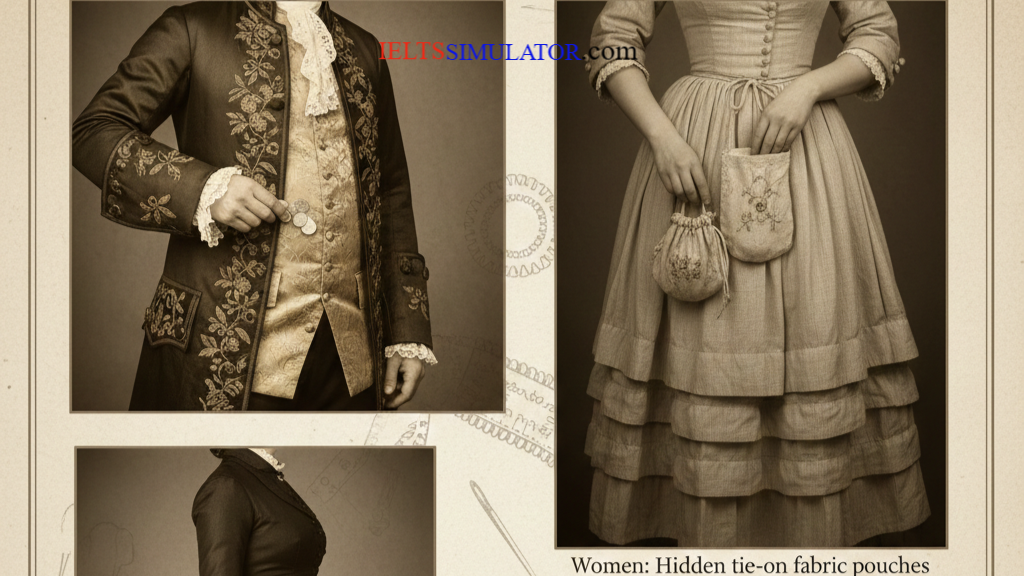
It’s certainly very interesting to go back in time and see how pockets developed for men and women. In the 18th century, fashions were quite different from the way they are now, and pockets were too. If we think about male fashion first … that was the time when suits became popular. Q32 Trousers were knee-length only and referred to as ‘breeches’, the waistcoats were short and the jackets were long, but all three garments were lined with material and pockets were sewn into this cloth by whichever tailor the customer used. Q33 The wearer could then carry small objects such as pencils or coins on their person and reach them through a gap in the lining. Coat pockets became increasingly decorative on the outside for men who wanted to look stylish, but they were often larger but plainer if the wearer was someone with a profession who needed to carry medical instruments – a doctor or physician, for example. Q34
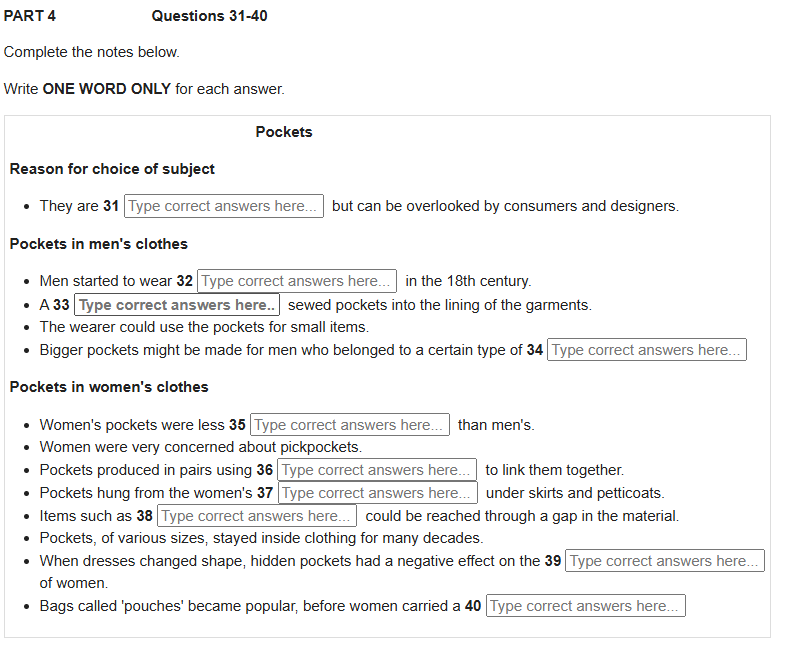
The development of women’s pockets was a little different. For one thing, they weren’t nearly as visible or as easy to reach as men’s. Q35 In the 18th and 19th centuries, women carried numerous possessions on their person and some of these could be worth a lot of money. Women were more vulnerable to theft and wealthy women, in particular, worried constantly about pickpockets. So – what they did was to have a pair of pockets made that were tied together with string. Q36 The pockets were made of fabric, which might be recycled cloth if the wearer had little money or something more expensive, such as linen, sometimes featuring very delicate embroidery. Women tied the pockets around their waist so that they hung beneath their clothes. Q37 Remember, skirts were long then and there was plenty of room to hide a whole range of small possessions between the layers of petticoats that were commonly worn. They would have an opening in the folds of their skirts through which they could reach whatever they needed, like their perfume. Q38 Working women, of course, also needed to carry around items that they might use for whatever job or trade they were involved in, but their pairs of pockets still remained on the inside of their clothing, they just got bigger or longer sometimes reaching down to their knees!So the tie-on pockets went well into the 19th century and only changed when fashion altered towards the end of that period. That’s when dresses became tighter and less bulky, and the pairs of pockets became very noticeable – they stood out too much and detracted from the woman’s image. Q39 Women who had been used to carrying around a range of personal possessions – and still wanted to – needed somewhere to carry these items about their person. That was when small bags, or pouches as they were known, came into fashion and, of course, they inevitably led on to the handbag of more modern times, particularly when fashion removed pockets altogether. Q40
Learn From Experienced Teacher Best IELTS.
Small Batch Size, Flexible Time.

8439000086
8439000087
7055710004
IELTS Simulation 323 GMS Road, Near Ballupur Chowk, Dehradun, India

email: info at ieltsband7.com