Unlock the Benefits of IELTS Listening

Access our library of Listening practice audio in MP3 format for on-the-go listening, and PDFs for offline study sessions. Download MP3 and download PDF file for offline practice. 

IELTS LISTENING – MARKETING ASSIGNMENT S35T3

IELTS SIMULATOR ONLINE ACADEMIC IELTS LISTENING- MARKETING ASSIGNMENT S35AT3 FREE COMPUTER DELIVERED ONLINE
IELTS listening MARKETING ASSIGNMENT listening practice test has 10 questions belongs to the Academic &  Student Discussion subject. 

Jack: Lucy, we really need to get working on this marketing assignment. We’ve only got five weeks left to the end of term to design it, carry it out, and then write up the results.

Lucy: Sure. Well, let’s get started right now. Let’s go over the instructions. What exactly do we have to do?

🎧Attempt Free Listening Test…
⬇️  Download Free PDF

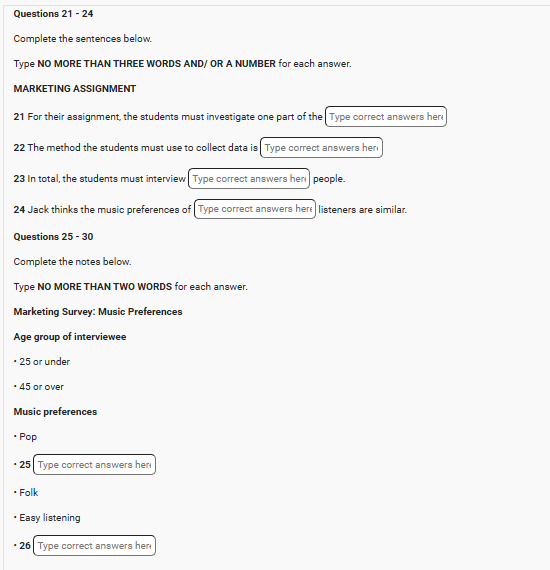
Jack: Well, it says here we have to look at one area of the Q21 entertainment industry – There’s a list of the different types.

Lucy: What are they?

Jack: Music, cinema, theatre, sport, and eating out.

Lucy: Is that all?

Jack: Looks like it.

Lucy: So we choose one branch of the industry and then we look at how two different groups of people use it? Is that right?

Jack: Yes.

Lucy: And do we have to use any particular method to get our data? Can we mail out a questionnaire, or do face-to-face interviews, or maybe even observations?

Jack: Well actually, it looks like we don’t have a choice. We have to do Q22 telephone interviews.

Lucy: OK, so at least we don’t have to waste time deciding between the different methods.

Jack: Yeah, that’s right. Oh, and the other requirement is the number of interviewees.

Lucy: Not too many, I hope. Ten? Twenty?

Jack: Well, we have to do two groups, remember, and it looks like we have to interview fifteen for each group.

Lucy: That’s Q23 thirty altogether then. It’s going to take ages.

Jack: Yes, but remember we’re working on this together, so we’ll only have to do fifteen each.

Lucy: OK, so those are all the requirements?

Jack: Yes, looks like it.

Lucy: So, first, which area are we going to choose? My preference would be cinema, since that’s where I spend most of my money.

Jack: Hmm, I don’t think that’s such a good idea. I don’t think there are huge differences in the market there. I mean you get young and old, Q24 male and female, rich and poor all going to the same movies.

Lucy: Yeah, maybe you’re right. Let’s make it music then.

Jack: Right. So, what two groups will we compare and contrast?

Lucy: Male and female?

Jack: No. Most of my female friends like the same music as me. Different age groups would be much more likely to show up differences,

I think.

Lucy: Yeah, I suppose you’re right again. I’ll take some notes, shall I? So. .. Age Groups. Well. What do you think? Maybe twenty-five or under for one group, and forty-five or over for the other group? That should show up differences.

Jack: Right.

Lucy: OK. Next. How about the kind of music they like – let’s give them some choices and then we can just tick boxes.

Jack: OK. Let’s have pop, Q25 jazz, folk, easy listening… What else?

Lucy: Well, we should include Q26 classical – Some people like it. you know.

Jack: OK. OK. And then we should have how they listen to music.

Lucy: The medium. Right. Let’s include radio, CD – and then I guess there’s TV.

Jack: What about Q27 concerts? You know, in pubs and halls.

Lucy: Oh yeah, we should include live music of course.

Jack: OK, we’re on a roll now! Next point could be about where they actually get their music.

Lucy: You mean like, do they buy it in music shops, or Q28 department stores?

Jack: Yes, or download it from the Internet.

Lucy: Right. That could be for recorded music. Then we need another section for live music. Where do they go for that?

Jack: OK. Let’s say disco, pub, Q29 club, concert hall…

Lucy: Or Q30 opera house! And I guess we should include karaoke bars.

Jack: Not many of them in this city!

Lucy: OK. We’ll leave that out then. So, what’s left to do?

Jack: That’s it. Well, now we can make a time-scale for doing it.

🎧Attempt Free Listening Test…

Prepare for IELTS IELTS Test International Experienced Teacher Best Training By CELTA Trainer.

phone icon
8439000086
8439000087
7055710003
7055710004
IELTS Simulation 323 GMS Road, Near Ballupur Chowk, Dehradun, India

Chat on WhatsApp
email: info at ieltsband7.com

IELTS LISTENING – THE HISTORY OF ROSEWOOD HOUSE S35T2

IELTS SIMULATOR ONLINE ACADEMIC IELTS LISTENING- THE HISTORY OF ROSEWOOD HOUSE S35AT2 FREE COMPUTER DELIVERED ONLINE
IELTS Listening THE HISTORY OF ROSEWOOD HOUSE listening practice test has 10 questions belongs to the Historical / Architecture subject. 

GUIDE:

Welcome, everybody, to the lovely house and gardens of Rosewood, once the home of the famous writer, Sebastian George. once bought the house in 1902 although he had first seen it two years earlier. Q11 At that time the owners let it out to a tenant because George was too slow making up his mind to buy it. When it came back on the market, there was no hesitation and lie bought it immediately, for £9,300, even though the house had no bathroom, no running water upstairs, and no electricity.

🎧Attempt Free Listening Test…

⬇️  Download Free PDF

When he came here, he’d been married for ten years. During that time, he’d become one of the most famous writers in the English-speaking world. His professional success was enormous, but his personal life wasn’t as successful. Q12 He was no longer on speaking terms with his brother and had been devastated by the death at the age of seven of his elder daughter, Josephine.

Moving to Rosewood allowed the family to start a new life. Q13 George regarded Rosewood as a pure example of a traditional country house of this part of England and did some of his most successful writing here. The house and its grounds became the family haven and their escape to privacy and quiet. The walls and the mullioned windows were built of the local sandstone, the tiles on the roofs and the bricks of the chimney stack were baked from local clay, and the wooden structures inside came from oak trees which grow around here.

Now, please look at the map I’ve given you of the house and gardens. We’re here at the Information Centre. Follow the path marked with the arrow and the first area you come to is the orchard on your left.

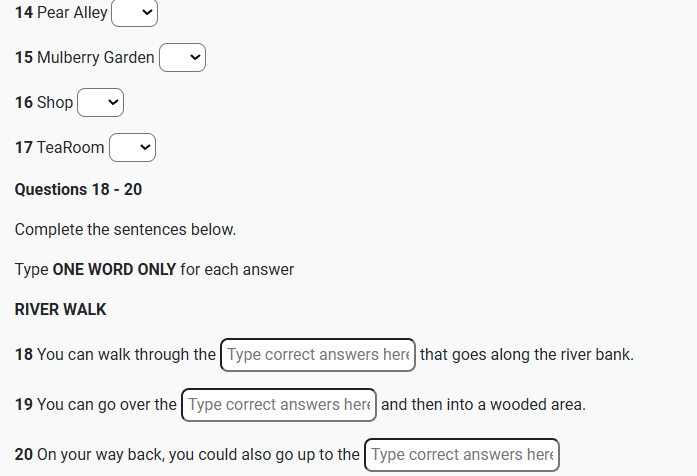
Q14 As you go further down the path, there’s the kitchen garden on the right and as you go round the first sharp corner you will find, to your left, an area where different types of pear tree have been planted as well as some lovely flowers, and this is known as Pear Alley -designed by George himself.

Next to this is the greenhouse where some exotic plants and fruits are grown. Follow the path round the second corner and on your right you will see the entrance to the Mulberry Garden with its 500-year-old tree. Q15 Past the Mulberry Garden, follow the path until you reach the front of the house. I suggest you spend a good hour wandering around this lovely building. A guide takes visitor groups round every two hours.

Q16 If you would like to purchase any of George’s books or other souvenirs, then leave the house by the side entrance, where yon will find our shop, which is situated between the house and the garage which contains the magnificent old Rolls-Royce car which used to belong to George. I expect by this time you may also be in need of a rest and some refreshment. Q17 Most visitors are, so why don’t you visit the tea room on the far side of the garage?

If you have time, there is a lovely walk down towards the River Dudwell. For me, this is the best part of the estate. This isn’t on the map but it is all clearly signposted. You cross the Q18 field which spreads along the banks of the river. In spring, this area is well worth a visit.

Spend a minute or two watching the water pass by underneath as you cross the Q19 footbridge, and then continue along the River Walk through the woodland. On a hot summer’s day, the trees along this path provide welcome shade. Eventually, you come to the water mill which used to provide the electricity for the house – only about four hours every evening – in George’s time. And, finally, for those of you who would like to see stunning views of the surrounding countryside and who are a little bit more energetic, when you return from the mill take the first turning on your left and climb up to the Q20 viewpoint. You won’t regret it.

Enjoy your visit!

🎧Attempt Free Listening Test…

Learn From Experienced Teacher Best IELTS Coaching Dehradun Best IELTS in Dehradun Uttarakhand GMS Road BEST coaching in Dehradun Apply for Class Courses Today Good Results.

phone icon
8439000086
8439000087
7055710003
7055710004
IELTS Simulation 323 GMS Road, Near Ballupur Chowk, Dehradun, India
Chat on WhatsApp
email: info at ieltsband7.com

IELTS LISTENING – HISTORY OF MOVING PICTURES S34T4

IELTS SIMULATOR ONLINE ACADEMIC IELTS LISTENING- HISTORY OF MOVING PICTURES S34AT4 FREE COMPUTER DELIVERED ONLINE
IELTS Listening HISTORY OF MOVING PICTURES listening practice test has 10 questions belongs to the Education & Training subject. 

Lecturer: Many believe that the story first began in America in 1877 when two friends were arguing over whether a horse ever had all four feet or hooves off the ground when it galloped. To settle the bet, a photographer was asked to photograph a horse galloping and the bet was settled because you could see that Q31 all the hooves were off the ground in some of the photos. What was even more interesting was that if the photos were shown in quick succession the horse looked like it was running – in other words ‘moving pictures’.

🎧Attempt Free Listening Test…

⬇️  Download Free PDF

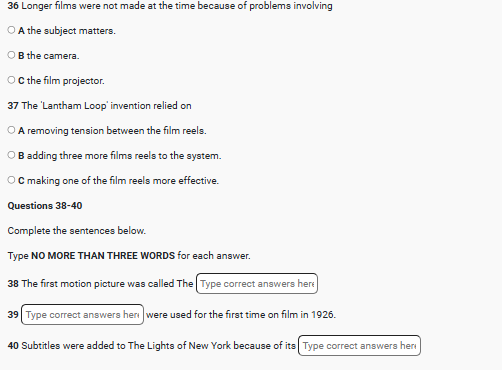
The person who became interested in taking the moving pictures to its next step was the famous American inventor Thomas Edison. Actually, he didn’t do the work himself but rather asked a young Scotsman in his employ to design a system, which he did. Now this young fellow was clever because the first thing he did was study other systems – primitive as they were – of moving pictures and then Q32 put all the existing technologies together to make the first entire motion picture system. He designed a camera, a projection device, and the film. The system was first shown in New York in 1894 and was really very popular. Apparently, people lined up around the block to see the wonderful new invention. There were, however, a couple of problems with the system. Q33 The camera weighed over 200 kilograms and only one person at a time could see the film.

Well now, news of the new system in America travelled fast and Q34 a number of rival European systems started to appear once people had heard about it. The single problem with all the systems was they couldn’t really project the film onto a Screen – you know, so more than one person could see it. Q35 Then in 1895, three systems were all developed, more or less at the same time and independently of each other. I guess the most famous of these was by the Lum are Brothers from France, and they called their system the cinematography which of course is where the word cinema comes from. There were also two brothers in Germany who developed a successful system and they called it a bioskop.

Well now, once the problem of projection had been solved, the next challenge for the inventors was to make the films longer and more interesting. A continuing problem at the time was that the Q36 films had a tendency to break when they were being played – a problem which was caused by the tension between the two wheels, or ‘reels’ as they are called, which hold the film. Now this problem was solved by two American brothers. They developed the ‘Lantham Loop’, which was the simple addition of a third reel between the two main reels, and this took Q37 all the tension away with the result that the film stopped snapping.

So now there was a real possibility of having films of more than two or three minutes, and this led to the making of The Q38 Great Train Robbery – the very first movie made. It only lasted 11 minutes but was an absolute sensation, and there were cases of people watching the movie and actually fainting when the character fired a gun at the camera! Almost overnight movies became a craze, and by 1905 people in America were lining up to see movies in `store theatres’, as they were called then.

I guess the next big step in terms of development of technology was to have people actually talking on the film, and the first step towards this was in 1926 when Q39 sound effects were first used on a film. It wasn’t until the following year however that the first ‘talkie’, as they were called then, was made. This film featured actors speaking only during parts of the film and was called The Jazz Singer, and it wasn’t until 1928 that the first all-talking film was produced, and this was called The Lights of New York. Unfortunately, the sound on this early film was not very good and I believe they put subtitles on the film – that is, they printed the dialogue along the bottom of the film to compensate for this Q40 poor sound quality. Now, with the addition of sound, moving pictures became far more difficult to make …

🎧Attempt Free Listening Test…

Learn From Experienced Teacher Best IELTS Coaching Dehradun Best IELTS in Dehradun Uttarakhand GMS Road BEST coaching in Dehradun Apply for Class Courses Today Good Results.

phone icon
8439000086
8439000087
7055710003
7055710004
IELTS Simulation 323 GMS Road, Near Ballupur Chowk, Dehradun, India
Chat on WhatsApp
email: info at ieltsband7.com

IELTS LISTENING – The Social History of the East End of London S33T4

IELTS SIMULATOR ONLINE ACADEMIC IELTS LISTENING- The Social History of the East End of London S33AT4 FREE COMPUTER DELIVERED ONLINE
IELTS listening The Social History of the East End of London listening practice test has 10 questions belongs to the Social History subject. 

In the last few weeks, we’ve been looking at various aspects of the social history of London, and this morning we’re continuing with a look at life in the area called the East End. I’ll start with a brief history of the district, and then focus on life in the first half of the twentieth century.

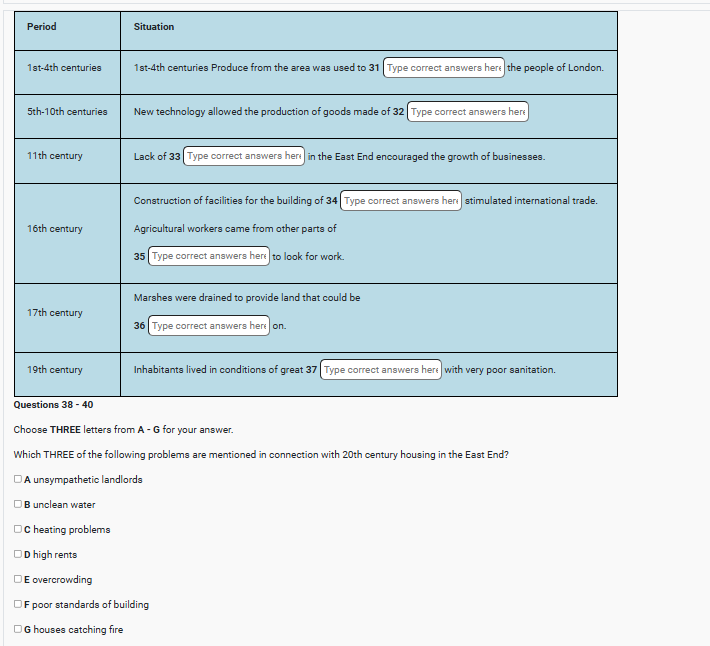
Back in the first to the fourth centuries AD, when the Romans controlled England, London grew into a town of 45,000 people, and what’s now the East End – the area by the river Thames, and along the road heading north-east from London to the coast – consisted of farmland with crops and livestock which helped to Q31 feed that population.

🎧Attempt Free Listening Test…

⬇️  Download Free PDF

The Romans left in 410, at the beginning of the fifth century, and from then onwards the country suffered a series of invasions by tribes from present-day Germany and Denmark, the Angles, Saxons, and Jutes, many of whom settled in the East End. The technology they introduced meant that Q32 metal and leather goods were produced there for the first time. And as the East End was by the river, ships could transport goods between there and foreign markets.

In the eleventh century, in 1066 to be precise, the Normans conquered England, and during the next few centuries, London became one of the most powerful and prosperous cities in Europe. The East End benefited from this, and because there were fewer Q33 restrictions there than in the city itself, plenty of newcomers settled there from abroad, bringing their skills as workers, merchants, or money-lenders during the next few hundred years.

In the sixteenth century, the first dock was dug where Q34 ships were constructed, eventually making the East End the focus of massive international trade. And in the late sixteenth century, when much of the rest of Q35 England was suffering economically, a lot of agricultural workers came to the East End to look for alternative work.

In the seventeenth .century, the East End was still a series of separate, semi-rural settlements. There was a shortage of accommodation, so marshland was drained and Q36 built on to house the large numbers of people now living there.

By the nineteenth century, London was the busiest port in the world, and this became the main source of employment in the East End. Those who could afford to live in more pleasant surroundings moved out, and the area became one where the vast majority of people lived in extreme Q37 poverty and suffered from appalling sanitary conditions.

That brief outline takes us to the beginning of the twentieth century, and now we’ll turn to housing.

At the beginning of the century, living conditions for the majority of working people in East London were very basic indeed. Houses were crowded closely together and usually very badly built because there was no regulation. But the poor and needy were attracted by the possibility of work, and they had to be housed. Q38 It was the availability, rather than the condition, of the housing that was the major concern for tenants and landlords alike.

Q39 Few houses had electricity at this time, so other sources of power were used, like coal for the fires which heated perhaps just one room. Of course, the smoke from these contributed a great deal to the air pollution for which London used to be famous.

Q40 A tiny, damp, unhealthy house like this might well be occupied by two full families, possibly including several children, grandparents, aunts, and uncles.

Now, before I go on to health implications of this way of life, I’ll say something about food and nutrition.

🎧Attempt Free Listening Test…

Easily Get Required Score I am interested in IELTS Pass with Confidence, Dehradun Small Batch Size with Flexible Time, professional faculty.

phone icon
8439000086
8439000087
7055710003
7055710004
IELTS Simulation 323 GMS Road, Near Ballupur Chowk, Dehradun, India
Chat on WhatsApp
email: info at ieltsband7.com