Unlock the Benefits of IELTS Listening

Access our library of Listening practice audio in MP3 format for on-the-go listening, and PDFs for offline study sessions. Download MP3 and download PDF file for offline practice. 

IELTS LISTENING – Marathon-tips for spectators S13T2

IELTS SIMULATOR ONLINE IELTS LISTENING - Marathon-tips for spectators S13T2 FREE COMPUTER DELIVERED ONLINE IELTS SIMULATION Best BAND7 IELTS Dehradun IELTS online simulator IELTS BAND 7 Coaching Classes
IELTS Listening Marathon-tips for spectators listening practice test has 10 questions belongs to the Leisure & Sports / Community Events subject. 

Sweater: Now we’re grateful to Fred Mckinnon for coming into the studio today to give everyone a few tips about the city marathon that’s taking place next Saturday.

Fred Mckinnon: Thanks Yes, we’re all very excited about the big event. Let me just remind listeners that Marathon is a 26-mile or 42-kilometer Race and this year, we have 12,000 runners taking part. So if you’re thinking of going out to support the runners and I know that many of you are. Here are some tips to help make your day more enjoyable. First of all, be certain to Q11 plan your day. Don’t leave everything to the last minute. Many roads are going to be closed.

🎧Attempt free listening test…

⬇️  Download free PDF

We don’t have exact times for these closures yet, but my big advice to you is don’t rely on your car to get you anywhere. In fact, the best way to get around the town will be Q12 on foot. You may choose the cycle, but you still won’t be able to go on roads near the runner’s route. No, we did a broadcast last week in which we told all our runners to wear the right kind of shoes on. I’m going to tell you to put on Q13 sensible clothes. A lot of visitors will be coming to the city. You may be hunting for someone in the race that you want to support. The Q14 weather may be hot or it may be wet, which leads me on to another thing. Make sure you look at the forecast on Friday night. It is going to rain taken umbrella and it is going to be hot take some drinks. However, please don’t try to pass these to the runners. We already have hundreds of Q15 volunteers who will be standing on the roadside, so let them give out the drinks. When you get into the town, find yourself a spot to stand in. You may well want to walk up and down the route, but please don’t cross the road. There could be thousands of people running towards you, some very tired and not able to focus clearly, we don’t want any Q16 accidents and runners don’t want obstacles like you in their path. What they do need is your support, particularly when their energies is a low, so cheer them on and for once. Don’t worry about noise. The louder the better. Lastly, if you have friends or relatives who are taking part in that run, please don’t say that you’ll see them at the Q17 finish line. If everyone does that, the whole area will be terribly congested and you won’t be able to find anyone. Well, that’s most of the advice. But no, I mentioned transport earlier, and I’ve just got a few more bits of information about survival on the day. As I said before, roads in the town center will be closed.
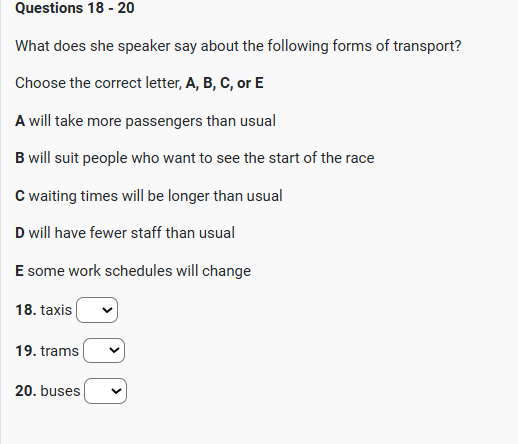
But Q18 if you need to be picked up at your home, then you could take a taxi some of the weeks. Unlike the trams and trains, however, they’ll be held up on the roads, so passengers shouldn’t expect them to be as punctual as they normally are. Don’t be put off by this, too. They’ll be extra drivers working that day on, you’ll get one eventually. Q19 If you’re meeting up with friends and want to be around when the runners set off, that’s 9 a.m. by the way, whatever end of the city you’re coming from, I see used the trams. They still have roots. That crossroads on this will inevitably lead to some problems, but they’re likely to have more reliable timetables than buses at this time of day. And as you know, unlike taxis, they can carry plenty of passengers. Lastly, Q20 the buses quite a number of bus routes will be altered slightly, and it’s already been decided that some will be closed. There won’t be fewer drivers, but they will be operating on different routes and some will have longer breaks than they normally do. We’ll be including a full list of all the bus routes and numbers and where they’ll be going in this week’s local paper. So we’ll look out for that. Well, that’s it for me. Back to you, sweater.

Sweater: Thanks very much, Fred.

🎧Attempt free listening test…

Boost Your Score: Practice IELTS Online with IELTS Simulator.

phone icon
8439000086
8439000087
7055710003
7055710004
IELTS Simulation 323 GMS Road, Near Ballupur Chowk, Dehradun, India

Chat on WhatsApp
email: info at ieltsband7.com

IELTS LISTENING – A Project on Household Waste Recycling S31T4

IELTS SIMULATOR ONLINE ACADEMIC IELTS LISTENING- A Project on Household Waste Recycling S31AT4 FREE COMPUTER DELIVERED ONLINE
IELTS Listening A Project on Household Waste Recycling listening practice test has 10 questions belongs to the Science & Environment subject. 

Well, my group has been doing a project on how household waste is recycled in Britain.

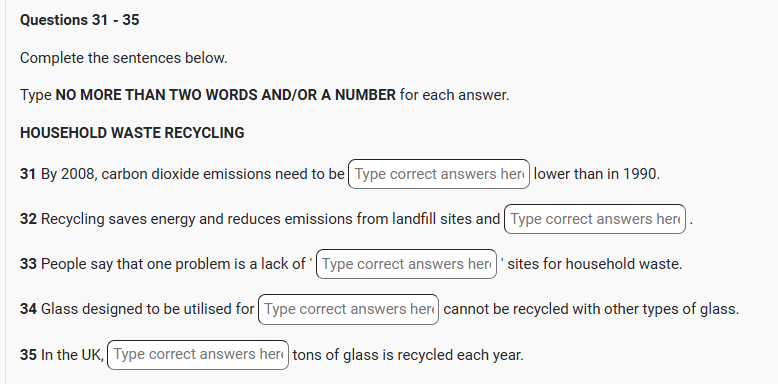
We were quite shocked to discover that only 9% of people here in the UK make an effort to recycle their household waste. This is a lower figure than in most other European countries and needs to increase dramatically in the next few years if the government is going to meet its recycling targets.

🎧Attempt Free Listening Test…

⬇️  Download Free PDF

The agreed targets for the UK mean that by 2008 we must reduce our carbon dioxide emissions by Q31 12.5%, compared with 1990. And recycling can help to achieve that goal, in two main ways: the production of recycled glass and paper uses much less energy than producing them from virgin materials, and also recycling reduces greenhouse gas emissions from landfill sites and Q32 incineration plants.

As part of our project, we carried out a survey of people in the street, and the thing that came up over and over again is that people don’t think it’s easy enough to recycle their waste. One problem is that there aren’t enough Q33drop-off‘ sites, that is, the places where the public are supposed to take their waste.

We also discovered that waste that’s collected from householders is taken to places called ‘bring banks’, for sorting and baling into loads. One problem here is taking out everything that shouldn’t have been placed in the recycling containers: people put all sorts of things into bottle banks, like plastic bags and even broken umbrellas. All this has to be removed by hand. Another difficulty is that toughened glass used for Q34 cooking doesn’t fully melt at the temperature required for other glass, and so that also has to be picked out by hand.

Glass is easy to recycle because it can be reused over and over again without becoming weaker. Two million tons of glass is thrown away each year, that is, seven billion bottles and jars; but only Q35 500.000 tons of that is collected and recycled.

Oddly enough, half the glass that’s collected is green, and a lot of that is imported, so more green glass is recycled than the UK needs. As a result, new uses are being developed for recycled glass, particularly green glass, for example in fiberglass manufacture and water filtration. A company called CLF Aggregates makes a product for  Q36 roads, and 30% of the material is crushed glass. For recycling paper, Britain comes second in Europe with 40%, behind Germany’s amazing 70%.

When recycling started, there were quality problems, so it was difficult to use recycled paper in office printers. But these problems have now been solved, and Martin’s, based in South London, produces a range of office stationery which is 100% recycled, costs the same as normal paper, and is of equally high quality.

But this high quality comes at a cost in terms of the waste produced during the process. Over a third of the waste paper that comes in can’t be used in recycled paper, leaving the question of what to do with it. One firm, Papersave, currently sells this to farmers as a Q37 soil conditioner, though this practice will soon be banned because of transport costs and the smell, and the company is looking into the possibility of alternative uses.

Plastic causes problems, because there are so many different types of plastic in use today, and each one has to be dealt with differently. Pacrite recycles all sorts of things, from bottles to car bumpers, and one of its most successful activities is recycling plastic bottles to make Q38 containers which are used all over the country to collect waste.

The Save-a-Cup scheme was set up by the vending and plastics industries to recycle as many as possible of the three-and-a-half billion polystyrene cups used each year. At the moment 500 million poly cups are collected, processed, and sold on to other businesses, such as Waterford, which turns the cups into Q39 pencils, and Johnson & Jones, a Welsh-based firm, which has developed a wide variety of items, including Q40 business cards.

Well, to sum up, there seems to be plenty of research going on into how to reuse materials, but the biggest problem is getting people to think about recycling instead of throwing things away. At least doing the research made us much more careful.

🎧Attempt Free Listening Test…

Boost Your Score: Practice IELTS Online with IELTS Simulator.

phone icon
8439000086
8439000087
7055710003
7055710004
IELTS Simulation 323 GMS Road, Near Ballupur Chowk, Dehradun, India
Chat on WhatsApp
email: info at ieltsband7.com

IELTS LISTENING – New Caledonian Crow and The Use of Tools S12T4

IELTS SIMULATOR ONLINE IELTS LISTENING - New Caledonian Crow and The Use of Tools S12T4 FREE COMPUTER DELIVERED ONLINE IELTS SIMULATION Best BAND7 IELTS Dehradun IELTS online simulator IELTS BAND 7 Coaching Classes
  IELTS Listening New Caledonian Crow and The Use of Tools listening practice test has 10 questions belongs to the Science & Biology subject.

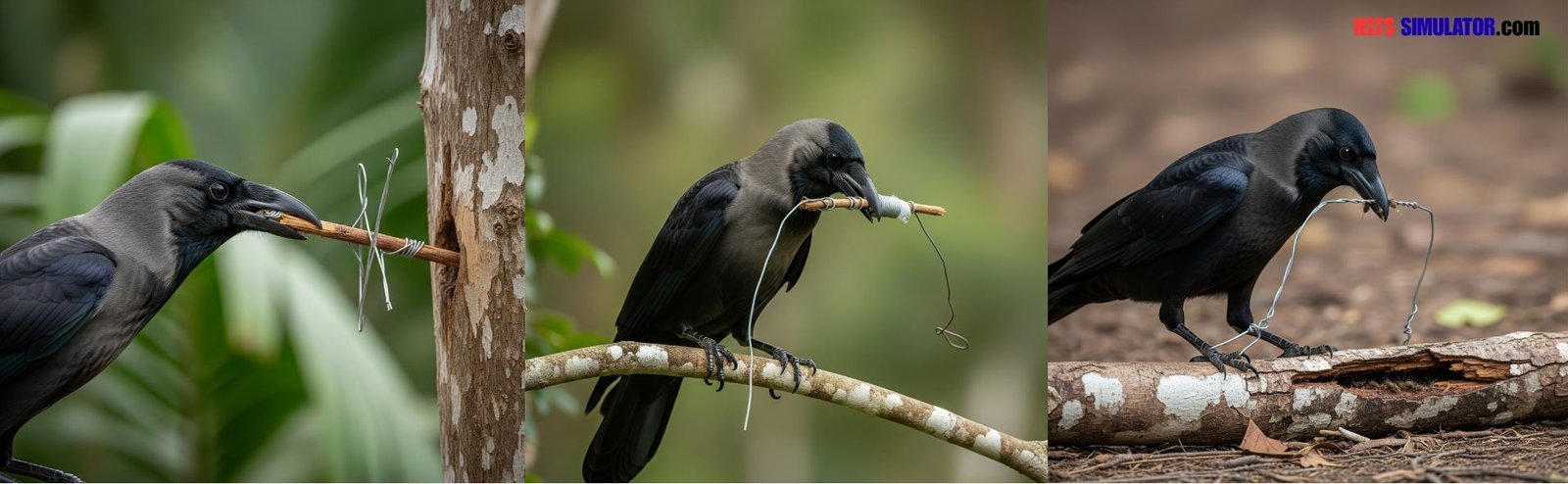
Lecturer: I’m going to talk today about research into a particular species of bird, the new Caledonian crow, whose natural habitat is small islands in the Pacific Ocean. And it seems that these crows are exceptionally resourceful. Using sticks or other tools to find food isn’t unknown among birds and animals. Some chimpanzees, for example, are known to bang nuts on stones in order to break the shell and get the edible kernel inside. One new Caledonian crow called Betty spent some straight wire into a Q31 hook and used it to lift a small bucket of her favorite food from a vertical pipe. This experiment was the first time she’d been presented with wire, which makes it very impressive.

🎧Attempt free listening test…

⬇️  Download free PDF

Another crow, called Barney, has demonstrated his skill at using sticks to forage for food. In one research project, scientists from New Zealand and Oxford set captive New Caledonian crows a three-stage problem. If they wanted to extract food from a hole. The crows first had to pull up a Q32 string to get a short stick, then use that short stick to remove a long stick from a toolbox, and finally used the long stick to reach the food. Amazingly, they worked out how to do this successfully.

Further experiments carried out at Oxford suggest that crows can also use sticks as tools to inspect all sorts of objects, possibly to assess whether or not they present a Q33 danger. The idea for the experiment came from observing the birds using tools to picket random objects, such as a picture of a spider that was printed on some cloth. In this research, five pairs of crows, including Barney, underwent tests to see how they would react to a variety of objects, which were carefully chosen so the birds wouldn’t be tempted to view them as a possible source of food.

As a further precaution, all the crows had been fed beforehand on eight occasions. A bird’s first contact was by using a tool In all three trials. Barney began by using a stick for inspection. One involved a Q34 rubber snake. First, he approached it but didn’t touch it, then retreated to pick up a stick. He then prodded it with the stick. After some more investigation, he discarded the stick and carried on pecking at the snake more confidently, apparently convinced that it wouldn’t move. In other experiments, two different birds called Pierre and Corbeau also made a first approach with tools. On three separate occasions, Pierre used a short piece of wood chip to touch a Q35 light which was flashing, and Corbeau was seen prodding a metal toad with a stick significantly the crows tender to use sticks only to make their first contact with the object. Subsequently, they either ignored the object or dropped the tool and pecked at the object, which is very different from using the tool to get access to food.

So what conclusions can be drawn from the research? Evidence is building up from experiments such as these that the birds are able to plan their actions in advance, which is very interesting for understanding their cognition. They don’t seem to be responding in a pre-programmed sort of way. It may even be possible that they’re able to view a problem and work out what the answer is. However, a major difficulty is assessing whether this tool-using behavior is a sign of Q36 intelligence. To some extent, this is related to the ecological circumstances in which the animal is found. So scientists want to find out much more about how the crows behave in their native habitat. And a team from Exeter and Oxford University’s is carrying out research in New Caledonia. They’re looking into whether the birds way of searching for food gives them any possible evolutionary advantage.

The birds are hard to observe as they live in a region of mountainous forest, so the researchers have attached tiny cameras to the Q37 tails of some birds as one method of investigating their behavior. The birds are masters at using sticks to find their food in particular beetle larvae from the trees. It’s possible that the birds can derive so much Q38 energy from these grubs that they only need to eat a few each day. This would mean that they wouldn’t have to spend most of their waking time searching for food, as most animals do. The beetle larvae have a distinct Q39 chemical makeup, which can be traced through the feathers and blood of birds that eat them. Scientists have collected samples from crows in order to estimate the proportion of larvae in their Q40 diet, they should then be able to gauge the extent to which individual birds depend on using sticks to feed themselves. We have went a great deal about the ability of New Caledonian crows to use tools, and some very interesting research is being carried out into them.

🎧Attempt free listening test…

Boost Your Score: Practice IELTS Online with IELTS Simulator.

phone icon
8439000086
8439000087
7055710003
7055710004
IELTS Simulation 323 GMS Road, Near Ballupur Chowk, Dehradun, India
Chat on WhatsApp
email: info at ieltsband7.com


IELTS LISTENING – DESERT PLANTS S13T4

IELTS SIMULATOR ONLINE IELTS LISTENING - DESERT PLANTS S13T4 FREE COMPUTER DELIVERED ONLINE IELTS SIMULATION Best BAND7 IELTS Dehradun IELTS online simulator IELTS BAND 7 Coaching Classes
IELTS Listening DESERT PLANTS listening practice test has 10 questions belongs to the Science / Environment subject. 

Lecturer: In today’s lecture, I’m going to continue our work on plants and talk about plants that live in the desert. Now, just a bit of background information first. As you know, about 1/3 of the world is covered in desert, and the sort of area they’re found in is important. Does it usually created because the area of land where they lie is located in something that’s called a Q31 rain shadow?

🎧Attempt free listening test…

⬇️  Download free PDF

Now, this is a region that’s beneath a mountain range, and what happens is that the wind blows over the mountains towards the area. But as it does so, the air loses its moisture and becomes very dry. Because of this downwind location, rainfall often totals just a Q32 few inches a year, or in some regions, there’s absolutely none, and you can imagine the effect of this. It means that whatever rain does fall evaporates quickly from the ground, and that makes the soil salty and also leaves behind a whole range of other Q33 minerals as well.

Now, despite this, desserts are home to many living things, in fact, there second only to tropical rainforests in the variety of plant and animal species that live there. So how do plants grow in a place that’s so dry? Well, their specially adapted to do this? In fact, many of the fascinating features of desert plants are adaptations. These are traits that helped the plants survive in its harsh environment, and desert plants have two main adaptations. The first is that they have an ability to Q34 collect water and to store it. Some have large root systems and amazing internal water storage systems. 

The second adaptation is that they have features that can actually reduce water loss, and these are often very special leaf designs or additions to the plant’s structure. So let’s have a look at some examples. Desert plants often look very different from any other plants. Okay, This 1st 1 is the Saguaro Cactus, which grows in North America. It looks a bit like an open hand with long fingers. This plant has a large network of roots that extend far, far away from its trunk, and these roots collect water after rain. Then the waters taken here to the green Q35 stem. This is where all its water is kept, and it keeps the whole plant alive until the next rain comes. It’s a pretty woody plant. In fact, its skeleton is actually used in building materials, so it’s quite strong. This next plant is called the barrel cactus, named because it does look rather like a barrel. It can grow up to a meter in height, which is pretty big, and it has long yellow spines. Now this plant has an interesting adaptation because its shape allows it to Q36 expand when it rains, hence the barrel and store water in its spongy tissue. But then it shrinks in size during dry times as it uses the stored water. So that’s a clever design.

The third cactus, often just one plant reaching upwards, has these Q37 white hairs all over its surface. It’s called the old man cactus because of the white hairs, and these help the plant reflect the hot desert sun. So this adaptation is, Ah, water conservation aid, if you like. Another adaptation, not directly connected with water but with survival, is found on something like the prickly pear cactus. There are hundreds of these in the Mexican desert. I’m sure you’ve seen them on films and adverts. Um, Yes, so because desert plants store water in their spongy tissue, animals will eat them. So the plant has sharp Q38 thorns specially designed to prevent the predator from being able to well get near it a tool. Our next plant is called the desert Spoon. This plant has long leaves that fan out, and they’re very succulent because they can also store water inside. However, there also usually very Q39 tough, and this helps keep the water inside and also makes from less tasty. 

Finally, we come to the aloe plant. This is one that many people keep in their homes. It’s an attractive plant, which has leaves that look and feel rather waxy. This surface behaves in a similar way, toe a Q40 plastic wrapper, and helps the plant to hold the water in. It’s a wonder plant, this one. Its juice has been used as a medicine for centuries, and even today you can find it in products on the pharmacist’s shelves or in creams and lotions. Okay, well, we’re going to take a closer look.

🎧Attempt free listening test…

Boost Your Score: Practice IELTS Online with IELTS Simulator.

phone icon
8439000086
8439000087
7055710003
7055710004
IELTS Simulation 323 GMS Road, Near Ballupur Chowk, Dehradun, India
Chat on WhatsApp
email: info at ieltsband7.com