Unlock the Benefits of IELTS Listening

Access our library of Listening practice audio in MP3 format for on-the-go listening, and PDFs for offline study sessions. Download MP3 and download PDF file for offline practice. 

IELTS LISTENING – Cities Built By The Sea S16T3
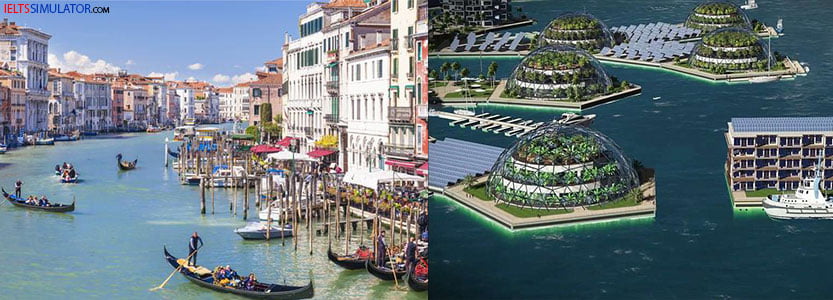
IELTS SIMULATOR ONLINE ACADEMIC LISTENING EASY DEMO – Cities Built By The Sea S16AT3 FREE COMPUTER DELIVERED ONLINE IELTS SIMULATION 
IELTS Listening Cities Built By The Sea listening practice test has 10 questions belongs to the Academic / Training context subject.

Tutor: Okay, So what I’d like you to do now is to talk to your partner about your presentations on urban planning. You should have done most of the reading now, so I’d like you to share your ideas on the.

Talk about the structure of your presentation and what you need to do next.

Carla: Okay? I’m glad we chose quite a specific topic Cities built next to the sea. It made it much easier to find relevant information.

Rob: Yeah, And City’s growing so quickly. I mean, we know that more than half the world’s population lives in cities now.

🎧Attempt Free Listening Test…
⬇️  Download Free PDF

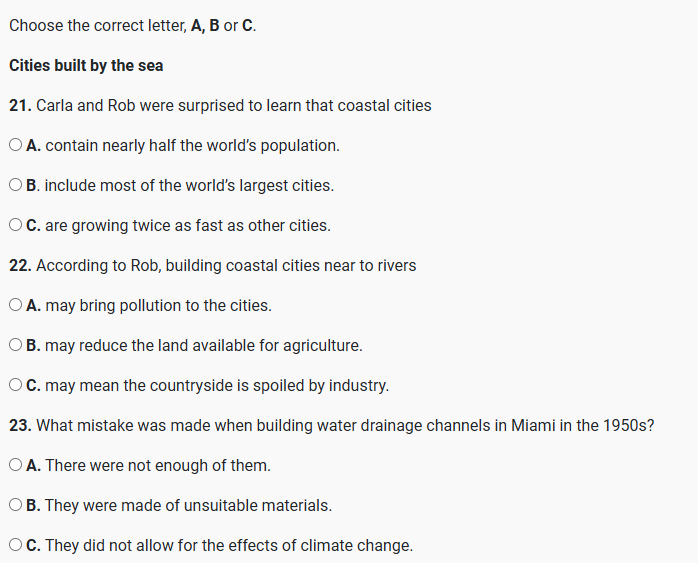
Carla: Yeah, though Q21 that’s all cities, not just ones on the coast, but most of the biggest cities are actually built by the sea. I’ve not realized that before.

Rob: No, me on what’s Maura? Lot of them are built at places where rivers come out into the sea. But apparently, this could be a problem. Why? Well, as Q22 the city expands, agriculture and industry tend to spread further inland along the rivers, and so agriculture moves even further inland up the river. That’s not necessarily a problem, except that means more and more pollutants that discharged into the rivers.

Carla: So these are brought downstream to the city’s right.

Rob: Did you read that article about Miami on the east coast of the U. S. A. Well, apparently, back in the 1950s, they built channels to drain away the water in case of flooding.

Carla: Sounds sensible.

Rob: Yeah, they spent quite a lot of money on them, but Q23 what they didn’t take into account was global warming. So they built the drainage channels too close to sea level, and now sea levels are rising there, more or less useless. If there’s a lot of rain, the water can’t run away. There’s nowhere for it to go. The whole design was faulty.

Carla: So what are the authorities doing about it now?

Rob: I don’t know. I did read that they’re aiming to stop disposing of wastewater into the ocean over the next 10 years

Carla: That would help with flood prevention now, will it?
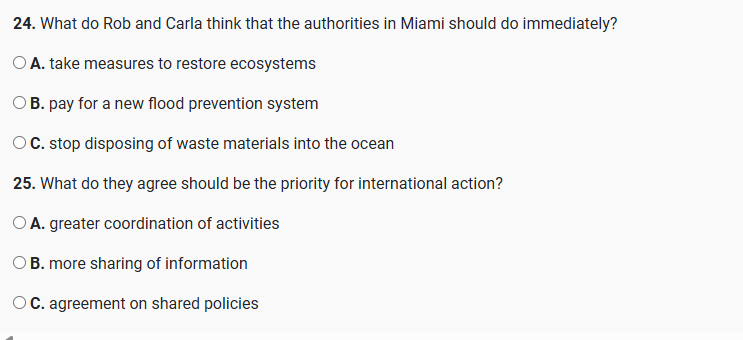
Rob: No, really. Q24 They just need to find the money for something to replace the drainage channels in order to protect against flooding now. But in the long term, they need to consider the whole ecosystem, right?

Carla: Really? Though coastal cities can’t deal with their problems on their own, can they? I mean, Q25 they’ve got to start acting together at an international level instead of just doing their own thing.

Rob: Absolutely. The thing is, everyone knows what the problems are. And environmentalists have a pretty good idea of what we should be doing about them. So they should be able to work together to some extent. But it’s going to be a long time before countries come to a decision on what principles they’re prepared to abide by.

Carla: Yeah, if they ever do. So I think we’ve probably got enough for our presentation. It’s only 15 minutes.

Rob: Okay, so I suppose we’ll begin with some general historical background about why coastal cities were established. But Q26 We don’t want to spend too long on that. The other students will already know a bit about it. It’s all to do with communications and so on.

Carla: Yes, we should mention some geographical factors. Q27 Things like wetlands and river estuaries and coastal erosion and so on. We could have some maps of different cities with these features marked

Rob: on a handout, You mean some slides everyone can see?

Carla: Yeah, that’d be better.

Rob: It would be good to go into past mistakes in a bit more detail. Did you read that case study of the problems there were in New Orleans with flooding a few years ago?

Carla: Yes. Q28 We could use that as the basis for that part of the talk. I don’t think the other students will have read it, but they’ll remember hearing about the flooding at the time.

Rob: Okay, so that’s probably enough background.

Carla: So then we’ll go on to talk about what action is being taken to deal with the problems of coastal cities. Okay, what else do we need to talk about? Maybe something on future risks looking more at the long term. Q29 If populations continue to grow. Yeah, we’ll need to do a bit of work there. I haven’t got much information. 

Rob: Have you know we’ll need to look at some websites? Shouldn’t take too long.

Carla: Okay? And I think we should end by talking about international implications. Q30 Maybe we could ask people in the audience. We’ve got people from quite a lot of different places. That would

Rob: be interesting if we have time. Yes. So now shall we.


🎧Attempt Free Listening Test…


Boost Your Score: Practice IELTS Online with IELTS Simulator.

phone icon
8439000086
8439000087
7055710003
7055710004
IELTS Simulation 323 GMS Road, Near Ballupur Chowk, Dehradun, India

Chat on WhatsApp
email: info at ieltsband7.com


IELTS LISTENING – CITY TRANSPORT LOST PROPERTY ENQUIRY S9T1

IELTS SIMULATOR ONLINE ACADEMIC LISTENING EASY DEMO – CITY TRANSPORT LOST PROPERTY ENQUIRY S9AT1 FREE COMPUTER DELIVERED ONLINE IELTS SIMULATION
IELTS Listening CITY TRANSPORT LOST PROPERTY ENQUIRY listening practice test has 10 questions belongs to the Services / Transport subject. 

MEN: Hello city transport lost property how can I help you?

WOMEN: Who yes I’m calling about to suit case I lost yesterday I don’t suppose I’ll get it back but I thought I’d try.

MEN: Well some people do hand-lost items eaten so you might be lucky let’s put the details into the computer.

WOMEN: Okay.

🎧Attempt free listening test…

⬇️  Download free PDF

MEN: Right so let’s start with a description of the suitcase.

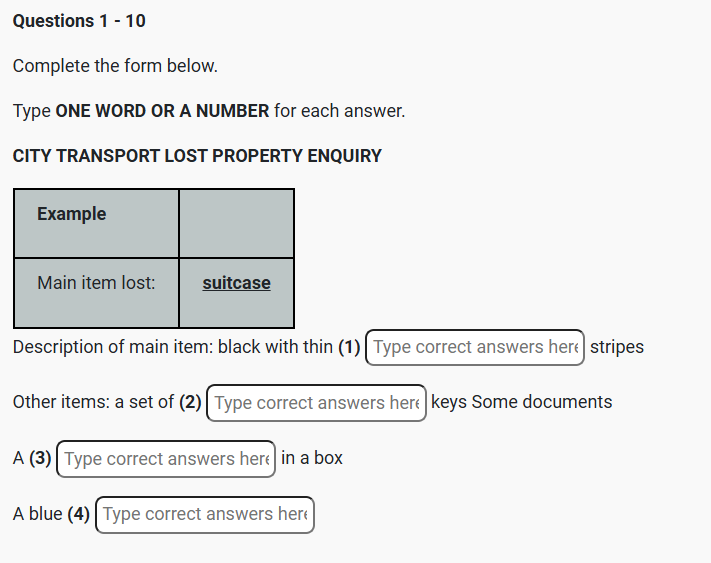
WOMEN: Okay well it’s smooth and it’s the type you can put along on wheels.

MEN: How about the color?

WOMEN: Yes it’s blank but not exactly plain black it has some narrow stripes down it sort of gray I should note that Q1 white now I think about it.

MEN: Our cash a I’ll just add that information now were there any items inside it?

WOMEN: Yes I had a big bunch of keys in that luckily my assistant

MEN: ager has an identical set so she’s going out this morning to get some copies made.

MEN: So therefore your Q2 office.

WOMEN: That’s right my house keys were in my pocket thank goodness.

MEN: Anything else?

WOMEN: And there were lots of documents that saved on my laptop anyway so at they did not just that much but the thing I’m really worried about I mean I haven’t even taken it out of the box yet it’s a Q3 camera I just boards that’s really why I’m cooling I can’t believe I’ve lost it already.

MEN: I say well let’s hope we can find it for you was there anything else?

WOMEN: I didn’t think so.

MEN: And a credit cards.

WOMEN: They were in my handbag and I had my passport inside my jacket pocket.

WOMEN: Before you hear the rest of the conversation you will have some time to look at the questions five to ten.

WOMEN: Now listen and also questions five to ten.

MEN: My name clothing and a personal items.

WOMEN: Let me think.

WOMEN: I had an Q4 umbrella it was black, not blue but obviously that isn’t as important as the other things.

MEN: But it all helps us identify your property and get it back to you any way I just need to ask you for some basic details about your journey so it was yesterday was it.

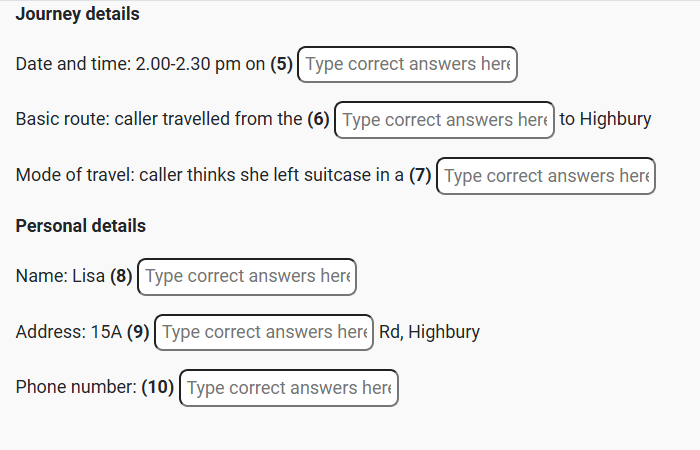
WOMEN: That’s right in the afternoon around two PM maybe two thirty.

MEN: R. K. so that’d be made the Q5 thirteen may.

WOMEN: Yes I was heading to high brie that’s where I live.

MEN: All right and you mentioned a possible water I sing so you were coming from the Q6 airport I presume.

WOMEN: Yes and I was looking forward to getting home so much and what with being tied and everything I think that’s why I just forgot about the case.

MEN: And how were you traveling when you lost your property I mean what kind of transport were you using?

WOMEN: I thought about getting the train but that would have meant a bus journey as well and I couldn’t be bothered so I decided to take a Q7 taxi eventually that’s where I must have left it.

MEN: Well that’s good news in a way it’s more likely that a driver would have found it and handed it in.

MEN: Well I need your personal details now can I have your full name, please?

WOMEN: Yes Lisa Q8 Docherty I’ll spell that for you it’s D. O. C. H. E. R. T. Y.

MEN: Sign Q. and next if I could have your address the best address to send you the property if we MEN: age to locate it.

WOMEN: Sure it’s number fifteen a Q9 river wrote and that’s high praise as I said.

MEN: Frank Q. just a moment there’s just one final saying that your phone number.

WOMEN: I guess my mobile would be best and hang on I can never remember my own number.

WOMEN: Okay I’ve got it it’s a Q10 07979605437.

MEN: Barry while I think that’s everything we need at this end I’ll have a look at that data.

WOMEN: Section one.

WOMEN: You now have Haas a minute to check your balances.

🎧Attempt free listening test…


Learn From Experienced Teacher Best IELTS Coaching Dehradun Best IELTS in Dehradun Uttarakhand GMS Road BEST coaching in Dehradun Apply for Class Courses Today Good Results.

phone icon
8439000086
8439000087
7055710003
7055710004
IELTS Simulation 323 GMS Road, Near Ballupur Chowk, Dehradun, India
Chat on WhatsApp
email: info at ieltsband7.com

IELTS LISTENING – Kite-Making by the Maori People of New Zealand S8T4

IELTS SIMULATOR ONLINE IELTS LISTENING - Kite-Making by the Maori People of New Zealand S8T4 FREE COMPUTER DELIVERED ONLINE IELTS SIMULATION Best BAND7 IELTS Dehradun IELTS online simulator IELTS BAND 7 Coaching Classes
IELTS Listening Kite-Making by the Maori People of New Zealand listening practice test has 10 questions belongs to the Culture & History / Anthropology subject. 

Lecturer: Well, good morning, everyone. As you know, we’ve been looking at different kinds of art and craft that were practiced by the married people of New Zealand at least before the Europeans began to arrive in the 18th century.

So the focus of this lecture is kite making. How the kites were made, their appearance on the purposes they served well, let’s start with why that one night. As with other Maori artistic traditions, kite-making involved certain rituals. So firstly, only priests were allowed to fly and handle the largest, most sacred kites. 

🎧Attempt free listening test…

⬇️ Download free PDF

There were rules, too, for the size and scale of the kites that the priests had to follow. And during the preparation of both small and large kites, Q31 food was strictly forbidden. In terms of appearance, kites were frequently designed in the image of a native bird or a Maori God, and sometimes perhaps less often a well-known Q32 hero. You can imagine the wind Maori first arrived in the new country in New Zealand, it may have taken some time to find suitable materials for their kites, but through trial and error, no doubt they found plants and trees that provided bark and even routes that they could use to make the frames and wings of their kites. And after the frame had been constructed, the kite then had to be decorated. For this, the priests used long grasses on these. When the card was in, the air would stream along behind it.

They also used a variety of Q33 feathers to add color to their creations. Well, all this meant it was easy to see a kite in the sky, but you could also hear maori kites. They could be quite noisy indeed, and this was because some priests like to hang a long row of Q34 shells from the kite. You can imagine how they’d rattle and clatter in the wind, how they might completely capture your attention. As I said before, the most common image was probably a bird, and that’s the same for other kite-making cultures. But the kites were designed in particular shapes, so there were kites that the triangular rectangular and also shaped like a Q35 diamond, and some of them was so large it would actually require several men to operate them. Um, some of the carts were also covered in patterns, and to make these patterns that Mary used different pigments of red and black. And these were either made from a charcoal base or from red-brown clay, which had been combined with oil obtained from a local species of Q36 shark.

Now, before I forget, if you have a chance, do visit the Auckland Museum because they have the last surviving Bird man Kite on display. This is the kind of kite that has a wooden mask, the top of the frame. It’s a mask of a human head, and you can clearly see it has a tattoo and also a set of Q37 teeth, quite impressive and a good example of Maori, craftsmanship, and symbolism, right? Turning to the purpose and function of the kites, they certainly had multiple uses. Primarily, the flying of kites was a way of communicating with the gods. On when the kites rose into the air, the Mary used them to deliver Q38 messages, perhaps requesting a good harvest, good fortune in war, a successful hunting expedition.

So these kites were incredibly valuable to a community. Treasured objects that one generation would pass to the next. People would also fly kites for other reasons, for example, to attract the attention of a neighboring village. This was done when a Q39 meeting was required between Mary Elders, a convenient method indeed. And finally, when it comes to war, there are traditional stories that describe how when a Maori warrior found himself surrounded by his enemies, a kite could actually provide the possibility of Q40 escape. The cuts were powerful enough to take a man up into the air, and for this reason, they could also be used to lower him into enemy fortifications so that an attack could begin from the inside. Well, I’m happy to say that seems to be a revival and growing interest in kite making.

🎧Attempt free listening test…

Learn From Experienced Teacher Best IELTS Coaching Dehradun Best IELTS in Dehradun Uttarakhand GMS Road BEST coaching in Dehradun Apply for Class Courses Today Good Results.

phone icon
8439000086
8439000087
7055710003
7055710004
IELTS Simulation 323 GMS Road, Near Ballupur Chowk, Dehradun, India
Chat on WhatsApp
email: info at ieltsband7.com


IELTS LISTENING – Hadley Park Community Gardens Project S8T2

IELTS SIMULATOR ONLINE IELTS LISTENING - Hadley Park Community Gardens Project S8T2 FREE COMPUTER DELIVERED ONLINE IELTS SIMULATION Best BAND7 IELTS Dehradun IELTS online simulator IELTS BAND 7 Coaching Classes
IELTS LISTENING Hadley Park Community Gardens Project listening practice test has 10 questions belongs to the Community & Environment. subject. 

Manager: Good morning. It’s great to see so many people here. Thank you all very much for coming. Well, as you know, the community gardens that Hadley Park are really not looking as good as they should. Quite bad, really and although the local council has a budget to deal with some of the problems, we do need volunteers for other tasks. If you don’t mind, I’m going to divide you into two groups. So everyone on this side of the room is Group A and the rest of you, are group B. So Group A there are a couple of things we’d like you to help. First of all, don’t worry about any litter or empty bottles you see lying about one-off. The local schools has offered to help out with that as part of their own environmental project.

🎧Attempt free listening test…

⬇️ Download free PDF

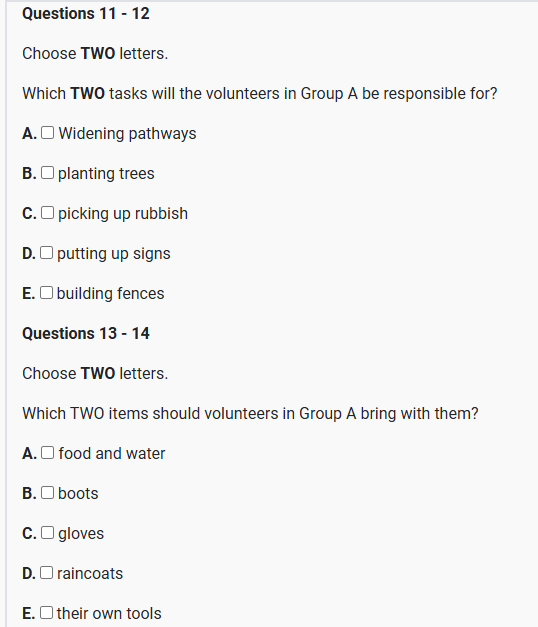
Q11 The priority for you will be to give us a hand with the new wooden fencing it needs constructing along parts of the bicycle track as there are parts which have now fallen down or broken. As I’m sure you’ve seen, you probably also noticed that some of the pathways that come from the bicycle track are quite narrow, and there are plans to make them wider. But the council will be dealing with that later in the year and they’ve also promised to produce some informational signs about the plants in the gardens. Hopefully, they’ll be up in a few weeks time. The other thing Q12 we’re doing is getting rid of some of the foreign species that are growing in the gardens on putting back from native plants and trees. So you’ll be doing some digging for us and getting those into the ground. So Group A, there’s some items you’ll need to bring along with you. I was going to say raincoats, but the forecast has changed so you can leave those at home. I definitely recommend a strong pair of Q13 boots. Waterproof would be best. It’s quite muddy at the moment on your own. Q14 Gloves would also be advisable. Tools will be available, spades and hammers, that kind of thing. You just need to make sure they go back in the trucks and oh, there’s no need to worry about food and drink as well. Be supplying sandwiches and coffee possibly some biscuits.

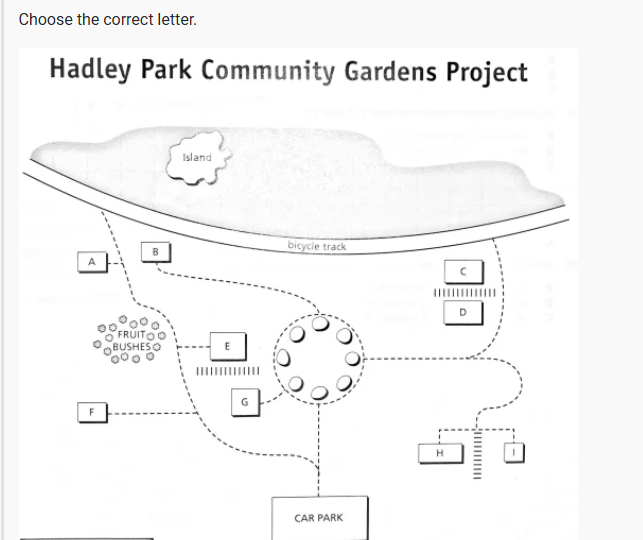
Even Okay, Group B, your turn. Does everyone have a copy of the plan? Oh, great. Okay, we’ll all be meeting in the car park that’s on the bottom of the plan see. Now, if you’ve been assigned to the vegetable beds to get there, you go out of the car park and go up the footpath until you reach the circle of trees. Q15 There they are in the middle of the plan, and you see that the footpath goes all the way around them. Well, on the left-hand side of that circular footpath, there’s a short track which takes you directly to the vegetable beds. You could see a bamboo fence mark just above them. All right. Okay. If you’re helping out with the bee hives, pay attention. Look again at the circle of trees in the middle of the plan and the footpath that goes around them. On the right side of that circle, you can see that the footpath goes off in an easterly direction, heading towards the right-hand side of the plan. And then the party splits into two and you can either go up or down. Q16 You want the path that heads down, and at the end of this, you see two areas divided by a bamboo fence. And as we’re looking at the plan, the bee hives are on the right of the fence. The smaller section, I mean, now, don’t worry. All these have been removed. You just need to transport the hives back to the car park. Okay for this eating, Q17 look at the circular footpath at the top of it. There’s a path that goes from there on takes you up to the seating area alongside the bicycle track. And, with a good view of the island, has suppose. Okay, if you’re volunteering for the adventure playground area, Q18 let’s start from the car park again and go up the footpath but then you want the first left hand. Go out there and then you see, there’s a short part that goes off to the right. Go down there. And that’s the adventure playground area above the bamboo fence. That fence does need repairing, I’m afraid. Right. What else? Oh, yes, the sand area. We’ve got that circular footpath in the middle. Q19 Find the track that goes east towards the right-hand side of the plan. On where that track divides, you need the little path that goes up towards the bicycle track. The sand area is just above the bamboo fence there. And finally, Q20 the pond area. So it’s on the left-hand side of your plan towards the top, just above the fruit bushes, and to the left of the little path. Okay. As I said already, hopefully, will be.

🎧Attempt free listening test…


Boost Your Score: Practice IELTS Online with IELTS Simulator.

phone icon
8439000086
8439000087
7055710003
7055710004
IELTS Simulation 323 GMS Road, Near Ballupur Chowk, Dehradun, India
Chat on WhatsApp
email: info at ieltsband7.com