Unlock the Benefits of IELTS Listening

Access our library of Listening practice audio in MP3 format for on-the-go listening, and PDFs for offline study sessions. Download MP3 and download PDF file for offline practice. 

IELTS LISTENING – Joanna’s psychology study S4T3

IELTS SIMULATOR ONLINE GENERAL TRAINING LISTENING EASY DEMO – Joanna’s Psychology Study S11GT3 FREE COMPUTER DELIVERED ONLINE IELTS SIMULATION
IELTS LISTENING Joanna’s psychology study listening practice test has 8 questions belongs to the Education & Psychology subject..

SUPERVISOR: Hi, Joanna, good to meet you. Now, before we discuss your new research project, I’d like to hear something about the psychology study you did last year for your Master’s degree. So how did you choose your subjects for that?

JOANNA: Well, I has six subjects, all professional musicians, and all female. Three were violinists and there was also a cello player and a pianist and a flute player. They were all very highly regarded in the music world and Q22 they’d done quite extensive tours in different continents and quite a few had won prizes and competitions as well.

🎧Attempt free listening test…

⬇️ Download free PDF

SUPERVISOR: And they were quite young, weren’t they?

JOANNA: Yes, between 25 and 29 – the mean was 27.8. I wasn’t specifically looking for artists who’d Q21 produced recordings, but this is something that’s just taken for granted these days and they all had.

SUPERVISOR: Right. Now you collected your data through telephone interviews, didn’t you?

JOANNA: Yes. I realized if I was going to interview Q24 leading musicians it’d only be possible over the phone because they’re so busy. I recorded them using a telephone recording adaptor. I’d been worried about the quality, but it worked out all right. I managed at least a 30- minutes interview with each subject, sometimes longer.

SUPERVISOR: Did doing it on the phone make it more stressful?

JOANNA: I’d thought it might… it was all quite informal though and in fact, they seemed very keen to talk. And Q23 I don’t think using the phone meant I got rich data, rather the opposite in fact.

SUPERVISOR: Interested. And you were looking at how performers dress for concert performances?

JOANNA: That’s right. my research investigated Q26 the way players see their role as a musician and how this linked to the type of clothing they decided to wear. But that focus didn’t emerge immediately. When I started I was more interested in trying to investigate the impact of what was worn on those listening and also Q25 whether someone like a violinist might adopt a different style of clothing from say, someone playing the flute or the trumpet.

SUPERVISOR: It’s interesting that the choice of dress is up to the individual, isn’t it?

JOANNA: Yes, you’d expect there to be rules about it in orchestras, but that’s quite rare.

SUPERVISOR: You only had women performers in your study. Was that because male musicians are less worried about fashion?

JOANNA: I think Q27 a lot of the men are very much influenced by fashion, but in social terms, the choices they have are more limited … they’d really upset audiences if they strayed away from quite narrow boundaries.

SUPERVISOR: Hmm. Now, popular music has quite different expectations. Did you read Mike Frost’s article about the dress of women performers in popular music?

JOANNA: No.

SUPERVISOR: He points out that Q28 a lot of female singers and musicians in popular music tend to dress down in performances and wear less feminine clothes, like jeans instead of skirts, and he suggests this is because otherwise they’d just be discounted as trivial.

JOANNA: But you could argue they’re just wearing what’s practical … I mean, a pop-music concert is usually a pretty energetic affair.

SUPERVISOR: Yes, he doesn’t make that point, but I think you’re probably right. I was interested by the effect of the audience at a musical performance when it came to the choice of dress.

JOANNA: The subjects I interviewed felt this was really important. It’s all to do with what we understand by performance as a public event. They believed the audience had certain expectations and it was up to them as performers to full fill these expectations, to Q29 show a kind of esteem

SUPERVISOR:… they weren’t afraid of looking as if they’d made an effort to look good.

JOANNA: Mmm. I think in the past the audience would have had those expectations of one another too, but that’s not really the case now, not in the UK anyway.

SUPERVISOR: No.

JOANNA: And I also got interested in what sports scientists are doing too, with regard to clothing.

SUPERVISOR: Musicians are quite vulnerable physically, aren’t they, because the movements they carry out are very intensive and repetitive, so I’d imagine Q30 some features of sports clothing could safeguard the players from the potentially dangerous effects of this sort of thing.

JOANNA: Yes, but musicians don’t really consider it. They avoid clothing that obviously restricts their movements, but that’s as far as they go.

SUPERVISOR: Anyway, coming back to your own research, do you have any idea where you’re going from here?

JOANNA: I was thinking of doing a study using an audience, including …

🎧Attempt free listening test…

Boost Your Score: Practice IELTS Online with IELTS Simulator.

phone icon
8439000086
8439000087
7055710003
7055710004
IELTS Simulation 323 GMS Road, Near Ballupur Chowk, Dehradun, India

Chat on WhatsApp
email: info at ieltsband7.com


IELTS LISTENING – Basement of Museum S4T2

IELTS SIMULATOR ONLINE GENERAL TRAINING LISTENING EASY DEMO – Basement of Museum S11GT2 FREE COMPUTER DELIVERED ONLINE IELTS SIMULATION
IELTS READING Basement of museum listening practice test has 9 questions belongs to the Leisure & Entertainment subject. 

Good morning, and welcome to the museum – one with a remarkable range of exhibits, which I’m sure you’ll enjoy. My name’s Greg, and I’ll tell you about the various collections as we go round.

But before we go, let me just give you a taste of what we have here.

Well, for one thing, we have a fine collection of Q11 twentieth and twenty-first century paintings, many by very well-known artists. I’m sure you’ll recognize several of the paintings. This is the gallery that attracts the largest number of visitors, so it’s best to Basement of museum go in early in the day before the crowds arrive.

🎧Attempt free listening test…

⬇️ Download free PDF

Then there are the Q12 nineteenth-century paintings. The museum was opened in the middle of that century, and several of the artists each donated one work – to get the museum started, as it were. So they’re of special interest to us – we feel closer to them than to other works.

The Q13 sculpture gallery has a number of fine exhibits, but I’m afraid it’s currently closed for refurbishment. You’ll need to come back next year to see 11 properly, but a number of the sculptures have been moved to other parts of the museum.

Q14 Around the world is a temporary exhibition you’ve probably seen something about it on TV or in the newspapers. It’s created a great deal of interest. because it presents objects from every continent and many countries and provides information about their social context -why they were made. who for, and so on.

Then there’s the collection of Q15 coins. This is what you might call a focused, specialist collection. because all the coins come from this country and were produced between two thousand and a thousand years ago. And many of them were discovered by ordinary people digging their gardens, and donated to the museum!

All our Q16 porcelain and glass was left to the museum by its founder when he died in 1878. And in the terms of his will, we’re not allowed to add anything to that collection: he believed it was perfect in itself, and we don’t see any reason to disagree!

OK, that was something about the collections, and now here’s some more practical information, in case you need it. Most of the museum facilities are downstairs, in the
basement, so you go down the stairs here. When you reach the bottom of the stairs, you’ll find yourself in a sitting area, with comfortable chairs and sofas where you can have a rest before continuing your exploration of the museum.

We have a very good Q17 restaurant, which serves excellent food all day, in a relaxing atmosphere. To reach it. when you get to the bottom of the stairs. go straight ahead to the far side of the sitting area, then turn right into the corridor, You’ll see the door of the restaurant facing you.

If you just want a snack, or if you’d like to eat somewhere with facilities for children, we also have a Q18 cafe. When you reach the bottom of the stairs you’ll need to go straight ahead turn right into the corridor, and the cafe is immediately on the right.

And talking about children. there are Q19 baby-changing facilities downstairs: cross the sitting area. continue straight ahead along tile corridor on the left, and you and your baby will find the facilities on the left-hand side.

The Q20 cloakroom, where you should leave coats, umbrellas, and any large bogs is on the left-hand side of the sitting area. It’s through the last door before you come to the corridor.

There are toilets on every floor, but in the basement, they’re the first rooms on the left when you get down there.

OK, now if you’ve got anything to leave in the cloakroom, please do that now, and then we’ll start our tour.

🎧Attempt free listening test…

Learn From Experienced Teacher Best IELTS Coaching Dehradun Best IELTS in Dehradun Uttarakhand GMS Road BEST coaching in Dehradun Apply for Class Courses Today Good Results.

phone icon
8439000086
8439000087
7055710003
7055710004
IELTS Simulation 323 GMS Road, Near Ballupur Chowk, Dehradun, India
Chat on WhatsApp
email: info at ieltsband7.com


IELTS LISTENING – Jazz band S4T1

IELTS SIMULATOR ONLINE LISTENING EASY DEMO - Jazz band S4T1 FREE COMPUTER DELIVERED ONLINE SIMULATION.....................

 IELTS LISTENING Jazz band listening practice test has 10 questions belongs to the Arts / Music subject..

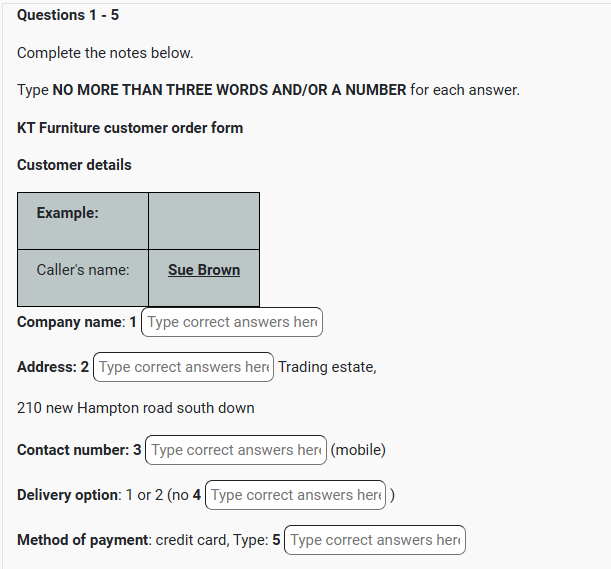
ROB: Good morning. Stretton Festival box office. How can I help you?

MELANIE: Oh, hello. My family and I are on holiday in the area, and we’ve seen some posters about the festival this week. Could you tell me about some of the events, please?

ROB: Of course.

MELANIE: First of all, are there still tickets available for the jazz band on Saturday?

ROB: There are, but only £ Example 15. The £12 seats have all been sold.

🎧Attempt free listening test…

⬇️ Download free PDF

MELANIE: OK. And the venue is the school, isn’t it?

ROB: Yes. that’s right, the Q1 secondary school. Make sure you don’t go to primary school by mistake! And there’s an additional performer who isn’t mentioned on the posters – Carolyn Hart is going to play with the band.

MELANIE: Oh, I think I’ve heard her on the radio. Doesn’t she play the oboe, or Q2 flute, or something?

ROB: Yes. the flute. She usually plays with symphony orchestras, and apparently, this is her first time with a jazz band.

MELANIE: Well, I’d certainly like to hear her. Then the next thing I want to ask about is the duck races – I saw a poster beside a river. What are they, exactly?

ROB: Well, you buy a yellow plastic duck – or as many as you like – they’re a pound each. And you write your name on each one. There’ll be several races, depending on the number of ducks taking part. And John Stevens, a champion swimmer who lives locally is going to start the races. All the ducks will be launched into the river at the back of the Q3 cinema, then they’ll float along the river for 500 meters, as far as the railway bridge.

MELANIE: And are there any prizes?

ROB: Yes, the first duck in each race to arrive at the finishing line wins its owner free tickets for the Q4 concert on the last night of the festival.

MELANIE: You said you can buy a duck? I’m sure my children will both want one.

ROB: they’re on sale at a stall in the Q5 market. You can’t miss it – it’s got an enormous sign showing a couple of ducks.

MELANIE: OK. I’ll go there this afternoon. I remember walking past there yesterday. Now could you tell me something about the flower show, please?

ROB: Well, admission is free, and the show is being held in Q6 Bythwaite Hall.

MELANIE: Sorry, how do you spell that?

ROB: B-Y-T-H-W-A-l-T-E. Bythwaite.

MELANIE: Is it easy to find? I’m not very familiar with the town yet.

ROB: Oh, you won’t have any problem. It’s right in the centre of Stretton. It’s the only old building in the town, so it’s easy to recognise.

MELANIE: I know it. I presume it’s open all day.

ROB: Yes, but if you’d like to see the prizes being awarded for the best flowers, you’ll need to be there at 5 o’clock. The prizes are being given by a famous Q7 actor, Kevin Shapless. He lives nearby and gets involved in a lot of community events.

MELANIE: Gosh, I’ve seen him on TV. I’ll definitely go to the prize-giving.

ROB: Right.

MELANIE: I’ve seen a list of plays that are being performed this week, and I’d like to know which are suitable for my children, and which ones my husband and I might go to.

ROB: How old are your children?

MELANIE: Five and seven. What about ‘Q8 The Mystery of Muldoon’?

ROB: That’s aimed at five to ten-year-olds.

MELANIE: So if I take my children, I can expect them to enjoy it more than I do?

ROB: I think so. Q9 If you’d like something for yourself and your husband, and leave your children with a babysitter. you might like to see ‘Fire and Flood’ – it’s about events that really happened in Stretton two hundred years ago, and children might find it rather frightening.

MELANIE: Oh, thanks for the warning. And finally, what about ‘Q10 Silly Sailor’?

ROB: That’s a comedy, and it’s for young and old. In fact, it won an award in the Stretton Drama Festival a couple of months ago.

MELANIE: OK. Well, goodbye, and thanks for all the information. I’m looking forward to the festival!

ROB: Goodbye.

🎧Attempt free listening test…

+


Boost Your Score: Practice IELTS Online with IELTS Simulator.

phone icon
8439000086
8439000087
7055710003
7055710004
IELTS Simulation 323 GMS Road, Near Ballupur Chowk, Dehradun, India
Chat on WhatsApp
email: info at ieltsband7.com


IELTS LISTENING – ETHNOGRAPHY IN BUSINESS S3T4

IELTS SIMULATOR ONLINE IELTS LISTENING - ETHNOGRAPHY IN BUSINESS S4T4 FREE COMPUTER DELIVERED ONLINE IELTS SIMULATION.................
IELTS LISTENING Ethnography in Business listening practice test has 10 questions belongs to the Human Culture & Business subject. 

So what I’m going to talk about to you today is something called Ethnography. This is a type of research aimed at exploring the way human cultures work. It was first developed for use in anthropology,

and it’s also been used in sociology and communication studies. So what’s it got to do with business, you may ask. Well, businesses are finding that ethnography can offer them deeper insight into the possible needs of customers,

🎧Attempt free listening test…

⬇️  Download free PDF

either present or future, as well as providing valuable information about their Q31 attitude towards existing products. And ethnography can also help companies to design new products or services that customers really want.

Let’s look at some examples of how ethnographic research work in business. One team of researchers did a project for a company manufacturing kitchen equipment. They watched how cooks used measuring cups to measure out things like sugar and flour. They saw that the cooks had to check and recheck the content because although the measuring cups had Q32 numbers inside them, the cooks couldn’t see these easily. So a new design of cup was developed to overcome this problem, and it was a top seller.

Another team of ethnographic researchers looked at how cell phones were used in Uganda, Africa. They found that people who didn’t have their own phones could pay to use the phones of local entrepreneurs. Because these customers paid in advance for their calls, they were eager to know how much Q33 time they’d spent on the call so far. So the phone company designed phones for use globally with this added feature.

Ethnographic research has also been carried out in computer companies. In one company, IT systems administrators were observed for several weeks. It was found that a large amount of their work involved communicating with colleagues in order to solve problems, but that they didn’t have a standard way of exchanging information from spreadsheets and so on. So the team came up with an idea for Q34 software that would help them to do this.

In another piece of research, a team observed and talked to nurses working in hospitals. This led to the recognition that the nurses needed to access the computer records of their Q35 patients, no matter where they were. This led to the development of a portable computer tablet that allowed the nurses to check records in locations throughout the hospital.

Occasionally, research can be done even in environments where the researchers can’t be present. For example, in one project done for an airline, respondents used their smartphones to record information during airline trips, in a study aiming at tracking the Q36 emotions of passengers during a flight.

So what makes studies like these different from ordinary research? Let’s look at some of the general principles behind ethnographic research in business. First of all, the researcher has to be completely open-minded – he or she hasn’t thought up a hypothesis to be tested, as is the case in other types of research. Instead, they wait for the participants in the research to inform them. As far as choosing the participants themselves is concerned, that’s not really all that different from ordinary research – the criteria according to which the participants are chosen may be something as simple as the age bracket they fall into, or the researchers may select them accordingly to their Q37 income or they might try to find a set of people who all use a particular product, for example. But it’s absolutely crucial to recruit the right people as participants. As well as the criteria I’ve mentioned, they have to be Q38 comfortable talking about themselves and being watched as they go about their activities. Actually, most researchers say that people open up pretty easily, maybe because they’re often in their own homes or workplace.

So what makes this type of research special is that it’s not just a matter of sending a questionnaire to the participants, instead the research is usually based on first-hand Q39 observation of what they are doing at the time. But that doesn’t mean that the researcher never talks to the participants. However, unlike in traditional research, in this case, it’s the participant rather than the researcher who decides what direction the interview will follow. This means that there’s less likelihood of the researcher imposing his or her own ideas on the participant.

But after they’ve said goodbye to their participants and got back to their office, the researchers’ work isn’t finished. Most researchers estimate that 70 to 80 percent of their time is spent not on the collecting of data but on its Q40 analysis -looking at photos, listening to recordings and transcribing them, and so on. The researchers may end up with hundreds of pages of notes. And to determine what’s significant, they don’t focus on the sensational things or the unusual things, instead, they try to identify a pattern of some sort in all this data, and to discern the meaning behind it. This can result in some compelling insights that can in turn feed back to the whole design process.

 
🎧Attempt free listening test…

Boost Your Score: Practice IELTS Online with IELTS Simulator.

phone icon
8439000086
8439000087
7055710003
7055710004
IELTS Simulation 323 GMS Road, Near Ballupur Chowk, Dehradun, India
Chat on WhatsApp
email: info at ieltsband7.com