Unlock the Benefits of IELTS Listening

Access our library of Listening practice audio in MP3 format for on-the-go listening, and PDFs for offline study sessions. Download MP3 and download PDF file for offline practice. 

IELTS LISTENING- Conservation of Reptiles S70T4

 IELTS listening Conservation of Reptiles listening practice test has 10 questions belongs to the Environment & Wildlife Conservation subject..

You will hear a lecture on the conservation of reptiles. I’d like to welcome everyone to the last lecture in our series on conservation. This time, we’ll be talking about reptiles. You might not have thought much about conservation in terms of reptiles, which includes lizards, snakes, crocodiles, and turtles, and there’s a good reason for that. Reptiles are, generally speaking, not well represented in conservation strategies.

Few people are aware that around 100 species of snake are threatened with extinction, for example. As well as the illegal pet trade, lizards are most at risk from rising temperatures globally, as it affects their ability to hunt. So, what are reptiles and where do they live? Reptiles are cold-blooded, which means their body temperature varies with the outside environment, unlike us mammals, whose temperature remains constant. Reptiles can be found in diverse habitats.
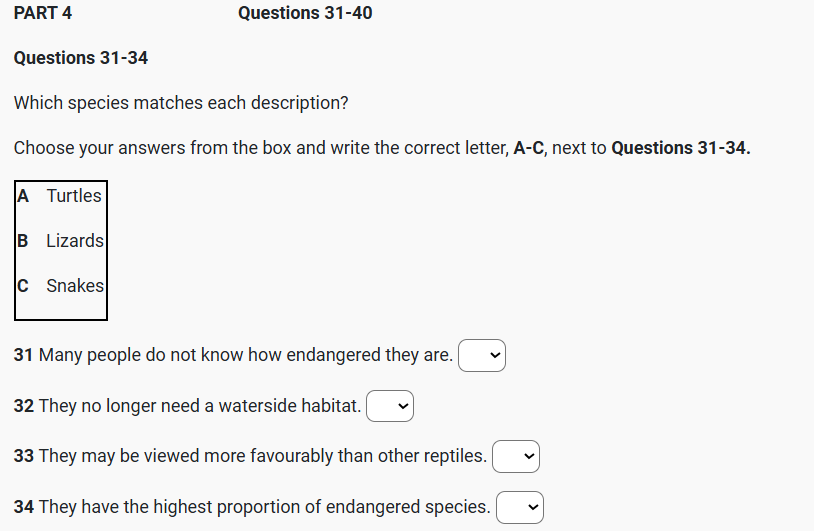
Although they prefer environments which offer both land and water, many, such as lizards, have adapted to live away from the water. they live in the tropics, as well as freshwater and oceanic habitats. People often assume that there are fewer conservation efforts concerning reptiles because they lack the cute and cuddly appeal of species with fur or feathers. This isn’t necessarily true of turtles, though, who lack the scary perception of most reptiles. That may be one of the reasons that conservationists also lack data on reptile species, meaning their conservation needs are less well understood. We do, however, know that between 18 and 33% of reptile species are in danger of extinction. When it comes to turtles, this rises to 59% of the species. To put this into context, 15% of bird species are threatened with extinction, much fewer than reptiles.

Like many other species, reptiles are at risk of habitat loss due to urban expansion and the rise of animal agriculture, pollution and climate change. The biggest threat faced by reptiles, however, is from hunting, due to their value in fashion and traditional medicine. There are many reasons why we need to put more effort into the conservation of reptiles. They play a crucial role in maintaining the balance of the natural world. Many of them are top predators, controlling the population of insects and small animals that could otherwise cause havoc in the ecosystem. Reptiles also play an important role as pollinators. This means they spread the seeds of plants which sustain countless other species. One particular reason to conserve reptiles is that they represent billions of years of evolutionary history, including the ability to adapt to diverse environments.

You may have heard that, in spite of there being few initiatives focusing on the conservation of reptiles, many reptile species benefit from conservation efforts that target other species, especially mammals and birds. This is true in that reptiles are most threatened in areas where other species are also threatened. However, some reptile species with small ranges, meaning they spend their entire lives within a limited area, require special interventions to survive. So what can be done specifically to help reptiles that are at risk of extinction? As with most other species, education is certainly more crucial than all the others. It can be hard to change people’s perception of species they have always hunted, but we have seen many examples of conservation programmes around the world that have turned lifelong hunters into protectors of endangered species. Linked to education is the need for legislation.

Where species are at risk, it is crucial for governments to take action to protect them via the law, imposing harsh penalties on those who continue to kill them. I’d now like to focus on a few examples of reptiles in danger. First of all, one of the largest living reptiles and the largest predator in the Americas, the Orinoco crocodile, which is only found in the basin of the Orinoco River in Venezuela and Colombia. The species came very close to extinction in the mid-20th century as it was hunted for its skin. The Orinoco crocodile was given protected status in the 1970s, but has still not recovered, and there are only an estimated 250 to 500 individuals left in the wild. While the Colombians have introduced captive breeding programs and released baby crocs into the wild, the programs cannot be considered a complete success due to lack of funds and other issues.

The second reptile species I’d like to talk about is the Madagascar big-headed turtle, which is a top priority of conservationists. As the name would suggest, this species lives only in the freshwater habitats of Madagascar, off the coast of Africa. The reason for the endangerment of this species is the huge appetite for its meat in Asia, and in spite of a ban on their export, this trade continues. The Turtle Conservation Fund is focused on protecting this important species through education programmes, captive breeding and reintroduction. The final reptile I want to discuss is one of the rarest snakes in the world, the ornate ground snake. There are thought to be less than 20 individuals left on a single island called Maria Major in Saint Lucia. The reason for the endangerment of this species is the introduction of invasive species, such as mongoose, to the other islands.

The species was actually declared extinct in 1936, but rediscovered in 1973, and a captive breeding programme is now underway to save this critically endangered species.


Experienced Teacher Best Training By CELTA Trainer.

Small Batch Size, Flexible Time.

phone icon
8439000086
8439000087
7055710003
7055710004
IELTS Simulation 323 GMS Road, Near Ballupur Chowk, Dehradun, India

Chat on WhatsApp
email: info at ieltsband7.com

IELTS LISTENING – EVENTS DURING KENTON FESTIVAL S23T1

 IELTS listening Events During Kenton Festival listening practice test has 10 questions belongs to the Events & Leisure subject..

MAN: Good morning, Kenton Festival box office. How can I help you?

WOMAN: Oh, good morning. I’m coming to Kenton for a few days’ holiday next month, and a friend told me there’s a festival. She gave me this number to find out about it.

MAN: That’s right. Example The festival begins on the 16th of May and goes on till the 19th.


WOMAN: Oh, that’s great. I’ll be there from the 15th till the 19th. So could you tell me the programme, please?

MAN: Well, on the first day, there’s the opening ceremony, in the town centre. People start gathering around 2 o’clock, to get a good place to see from, and Q1 the events will start at 2.45. and finish about 5.30.

WOMAN: OK, thanks. I’ll make sure I get there early to get a good spot.

MAN: The festival will be officially opened by the mayor. He’ll just speak for a few minutes, welcoming everyone to the festival. All the town councillors will be there, and of course lots of other people.

WOMAN: Right.

MAN: Q2 Then there’ll be a performance by a band. Most years we have a children’s choir, but this year the local army cadets offered to perform and they’re very good.

WOMAN: Uhuh.

MAN: Q3 After that, a community group from the town will perform a play they’ve written themselves, just a short one. It’s about Helen Tungate. I don’t know if you’ve heard of her.

WOMAN: I certainly have. Q4 She was a scientist years ago.

MAN: That’s right. She was born in Kenton exactly 100 years ago, so we’re celebrating her centenary.

WOMAN: I’m a biologist, so I’ve always been interested in her. I didn’t realise she came from Kenton.

MAN: Yes. Well, all that will take place in the afternoon, and Q5 later, as the sun sets, there’ll be a firework display. You should go to the park to watch, as you’ll get the best view from there, and the display takes place on the opposite side of the river. It’s always one of the most popular events in the festival.

WOMAN: Sounds great.

WOMAN: And what’s happening on the other days?

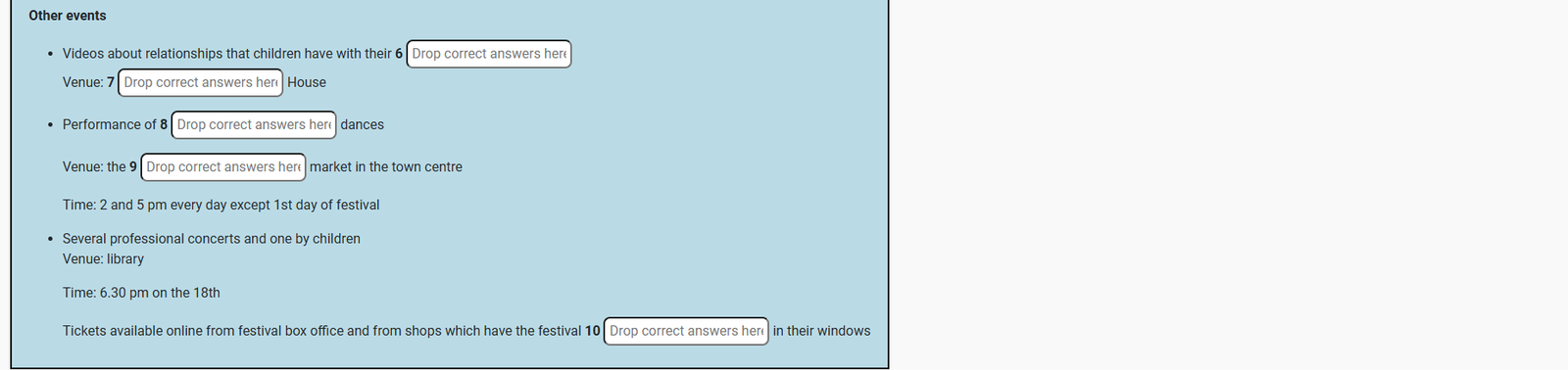
MAN: There are several events that go on the whole time. For example, Q6 the students of the art college have produced a number of videos, all connected with relationships between children and their grandparents.

WOMAN: That sounds interesting. It makes a change from children and parents, doesn’t it!

MAN: Exactly. Because the art college is in use for classes, throughout the festival, Q7 the videos are being shown in Handsworth House.

WOMAN: How do you spell the name?

MAN: H-A-N-D-S-W-O-R-T-H. Handsworth House. It’s close to the Town Hall.

WOMAN: Right.

MAN: Now let me see, what else can I tell you about?

WOMAN: Are there any displays of ballet dancing? I’m particularly interested in that as l do it as a hobby.

MAN: There isn’t any ballet. I’m afraid, but Q8 there’ll be a demonstration of traditional dances from all round the country.

WOMAN: Oh, that’d be nice. Where’s that being held?

MAN: Q9 It’s in the market in the town centre – the outdoor one. not the covered market. And it’s on at 2 and 5 every afternoon of the festival, apart from the first day.

WOMAN: Lovely. I’m interested in all kinds of dancing, so I’m sure I’ll enjoy that!

MAN: Mmm. I’m sure you will.

WOMAN: And I’d really like to go to some concerts if there are any.

MAN: Yes, there are several. Three performed by professionals, and one by local children.

WOMAN: And where is it being held?

MAN: It’s in the library, which is in Park Street. On the 18th, at 6.30 in the evening.

WOMAN: I presume I’ll need tickets for that.

MAN: Q10 Yes. you can book online, or you can buy them when you arrive in Kenton, either at the festival box office or from any shops displaying our logo in the windows.

WOMAN: Well, I think that’ll keep me busy for the whole of my stay in Kenton. Thank you so much for all your help.

MAN: You’re welcome. I hope you enjoy your stay.

WOMAN: Thank you. Goodbye.


Prepare for IELTS  Test International Experienced Teacher Best Training By CELTA Trainer.

phone icon
8439000086
8439000087
7055710003
7055710004
IELTS Simulation 323 GMS Road, Near Ballupur Chowk, Dehradun, India
Chat on WhatsApp
email: info at ieltsband7.com
IELTS LISTENING – Equipment Floor Plan S66T2

IELTS Simulator Listening Lab Design

IELTS LISTENING  Equipment Floor Plan listening practice test has 10 questions belongs to the Workplace & Business subject..
Welcome everybody to browning smith laboratories, I’ll be giving you a short tour around your new working environment and pointing out several key features. It’s very much state of the art as I’m sure you’ll see, please now look at the plan of the laboratory building I gave you earlier. At the moment we’re standing in the large storage room it’s right there positioned at the top on your plans and roughly in the middle, we’ve just come through the entrance door indicated and that’s now behind us okay so got your bearings, all know where we are?
 

Good let’s continue our tour then and go next to the dry lab, as we go straight ahead down this corridor the caretaker’s room is the next room on your right immediately after are the Q11 unisex toilets (C). Now let’s go through these doors ahead of us and into the dry lab. Okay so here we are now in the dry lab which is the laboratory’s biggest work area, if you look at your map as we are standing now with the doors behind us you can see the acid storage bin area clearly marked off to your right. Let’s walk over there and take a look you can see on your maps that we’re standing in the far end of the building now, the acid storage bins are a hazardous area obviously, if one of you should accidentally come into contact with not only these stored materials but any other hazardous substance then please proceed immediately to the Q12 eyewash emergency shower (D) area. That’s just back where we came in right after the doors opening onto the dry lab on the outside corner of the unisex toilets. I think those are the main features this end of the lab apart from the Q13 chest freezer (B) and cooler you see off to your right as you’re facing the acid storage bins, the cooler area is divided into two sections. Okay let’s go and see the rooms now at the other end of the building, now don’t turn off to your left that’s where we entered the lab if you’ll remember.

The next entrance off to your left however is the wet lab which if you’ll look on your plan is adjacent to the large storage area but can only be reached by this entrance. Let’s pass on by this lab and the clean lab adjacent to it and make our way to the small storage area, it’s the first room through these doors ahead of us now please hold the door open for the person behind you as we file through. Good I think that’s everyone here now this is the small storage area and now we are at this end of the building there remains for me to show you only one other room, you can see two doors leading off this room the one ahead is an exit which will take you outside the building the other leads to the Q14 walk-in cooler (F). Oh, there is one more area I need to mention that’s the Q15 walk-in freezer (G) it can only be accessed by leaving the building entirely either through the exit, I just pointed out or the first entrance we came in. I hope that’s all clear now but you will soon become more familiar with the general layout of the laboratory building.

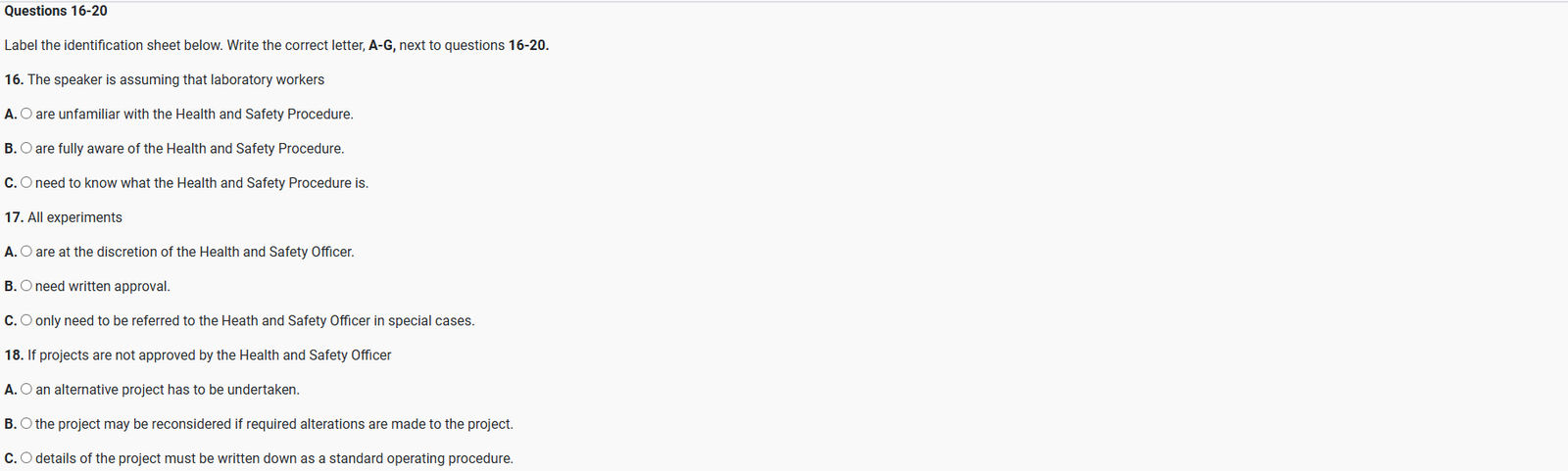
Now I’d just like to refer to health and safety procedure, Q16 this is essentially to fulfill basic health and safety requirements since I know that you are not unfamiliar with such procedures and must know them off by memory. Okay so firstly I’d like to say that if you are undertaking any project whether supervised or not all of you will be required to Q17 discuss it first with your health and safety coordinator. In certain cases, written approval is required the health and safety coordinator has the final decision in situations where formal approval is needed. Everyone undertaking a project will have to first submit a form of a written standard operating procedure to the health and safety coordinator outlining the steps and justifications for the experimental process to be carried out. Should the undertaking of a project not be granted initially plans for the project if satisfactorily amended Q18 can be represented to the health and safety coordinator for approval at a later date. Assuming acceptance of the undertaking of a project strict laboratory procedures must be adhered to. Overalls and non-hazardous equipment can be kept in the large storage room, on no account can either laboratory clothing or samples be removed from the building itself. Obviously the same goes for equipment that is portable this way we can ensure that no cross-contamination can occur with Q19 samples or specimens kept in the laboratories. Finally and this goes without saying when hazardous materials are being handled full protective equipment should be worn, safety goggles, and protective overalls are kept in the small storage room for this purpose. If using sharp contaminated objects such as needles these can be temporarily stored in clearly marked containers on your laboratory work surface. However, Q20 they must be disposed of by the end of the day in the waste disposal bins clearly indicated outside the laboratory building. These bins are to be found just outside the exit by the small storage room. In the event of fire, please make your way immediately to the nearest of the two exits either by the small storage or large storage room that I pointed out earlier. All that remains for me to do is to welcome you all to the company and wish you good luck.


Easily Get Required Score I am interested in IELTS Pass with Confidence, Dehradun Small Batch Size with Flexible Time, professional faculty.

phone icon
8439000086
8439000087
7055710003
7055710004
IELTS Simulation 323 GMS Road, Near Ballupur Chowk, Dehradun, India
Chat on WhatsApp
email: info at ieltsband7.com

IELTS LISTENING – CONFLICT AT WORK S23T4

IELTS listening Conflict at Work listening practice test has 10 questions belongs to the Business & Workplace Communication subject. 

Over the years, attitudes towards workers have changed considerably. After all, there was a time when workers had no rights at all and laboured in appalling conditions. Conditions have improved a lot, but conflict in the workplace is still common. And human resources managers nowadays need to be able to deal with it when necessary.

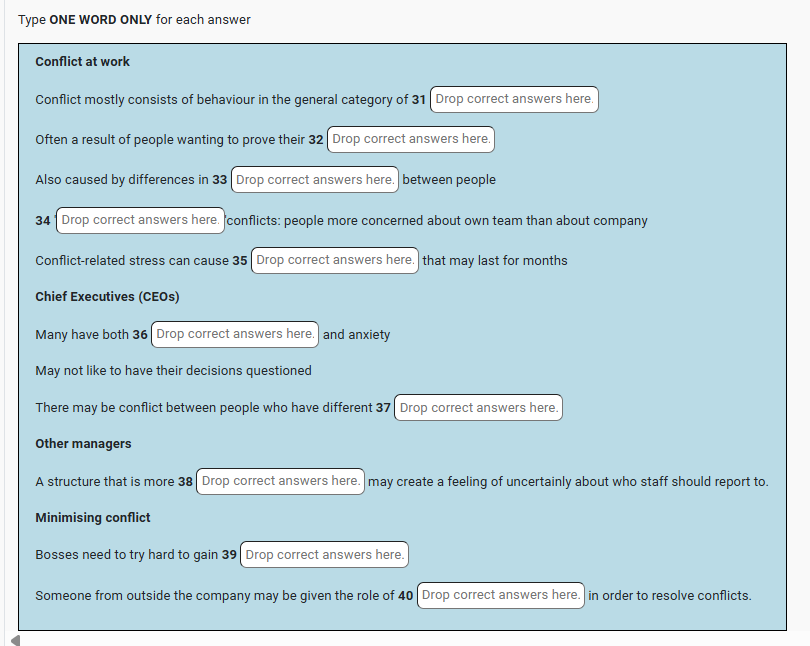
Q31 What is conflict in the workplace? Definitions vary, but I’m taking it to refer to a whole range of behaviours that the victim finds unacceptable, from minor, harmless arguments to at the opposite extreme – physical violence. Much of this is covered by the term bullying, by which I mean one or more people behaving abusively or aggressively against another who is in a weaker position. Although all behaviour like this is a form of conflict, not all conflict can be described in these terms.


As with all human behaviour, there are numerous reasons for it. But Q32 often it’s caused by someone who feels the need to show their superiority over someone else, in order to feel that they aren’t at the lowest level in a hierarchy or a group of people.

Q33 In some cases, one person simply dislikes the other, on the basis that the personality of one is in some way incompatible with that of the other person. A general habit of optimism in one person could make them intolerant of a colleague who’s constantly pessimistic – not that that justifies treating them badly, of course.

Q34 Some conflicts arise when people are more interested in promoting themselves and their team than in the company as a whole. These conflicts are called ‘structural’ and could come about, for example, when a sales team believe they are the only people in the business who do any useful work and look down on behind-the-scenes administrators.

Q35 Conflict obviously affects the individuals concerned – the situation is likely to be very stressful for victims, resulting in their absence from work, possibly for months. For the company, if no effort is made to deal with conflict, it can spiral out of control, and even lead to the breakdown of the business.

Some interesting work with chief executives – CEOs – has uncovered some of the reasons why they may treat colleagues badly. Q36 Many CEOs combine two opposing characteristics: confidence – that is, the belief that they’re capable of great achievements – with a high level of anxiety, and a fear of missing targets, whether set by themselves or by the directors of the company. This combination can make them respond badly to anyone who questions their decisions.

In a high-pressure work environment, such characteristics become problematic. And Q37 it’s particularly difficult to tackle the situation where colleagues, managers and board members are all trying to achieve their own visions. When they can’t agree on strategic issues and on where they see the business going, there are real problems.

For managers at lower levels within the organisation, it might seem that an autocratic form of management – where the chief executive gives orders and everyone else has to obey – would see more conflict than others. Interestingly. though, Q38 a company with a more democratic business model can suffer more, when uncertainty about who to report to leads to conflicting demands.

Now I’ll say a little about dealing with the type of conflict that has harmful effects. Of course the ideal is to prevent it arising in the first place. Q39 A good manager. at any level, will make efforts to earn the respect of the people they work with, particularly those who report to them. That will involve politeness in all communications, and treating them as equals who happen to have a different role within the organisation.

Sometimes, of course, conflict does occur, and can get out of hand. In such cases, the human resources department often gets involved. However, Q40 if one of the parties in a conflict sees human resources as simply a mouthpiece for the chief executive, then an external mediator might be able to help. by talking to both sides, and trying to find the truth of what’s been happening, they can build a clear picture of the situation, and give feedback that both sides will accept, precisely because they’re independent.


Boost Your Score: Practice IELTS Online with IELTS Simulator.

phone icon
8439000086
8439000087
7055710003
7055710004
IELTS Simulation 323 GMS Road, Near Ballupur Chowk, Dehradun, India
Chat on WhatsApp
email: info at ieltsband7.com