IELTS READING – Alexander Henderson S19AT1

IELTS FREE ACADEMIC ONLINE READING – Alexander Henderson S19GT1 .... FREE COMPUTER DELIVERED ONLINE TEST.... IELTS SIMULATION

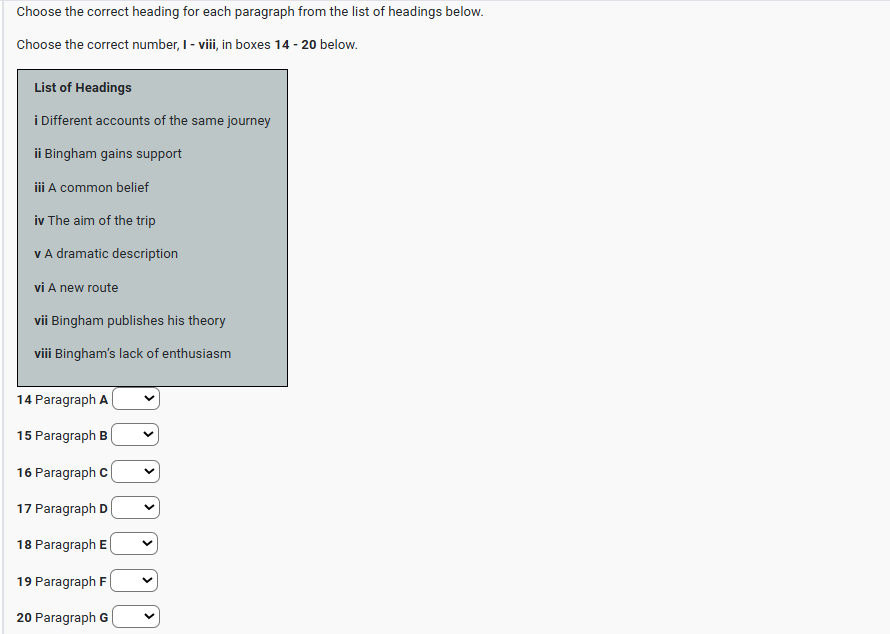
IELTS READING Alexander Henderson practice test has 10 questions belongs to Photography & Art History subject..
Born in Scotland, Henderson emigrated to Canada in 1855 and became a well-known landscape photographer

Alexander Henderson was born in Scotland in 1831 and was the son of a successful Q9 merchant. His grandfather, also called Alexander, had founded the family business, and later became the first chairman of the National Bank of Scotland. The family had extensive landholdings in Scotland.

Besides its residence in Edinburgh, Q1 it owned Press Estate, 650 acres of farmland about 35 miles southeast of the city. The family often stayed at Press Castle, the large mansion on the northern edge of the property, and Alexander spent much of his childhood in the area, playing on the beach near Eyemouth or fishing in the streams nearby.

Even after he went to school at Murcheston Academy on the outskirts of Edinburgh, Henderson returned to Press at weekends. Q2 In 1849 he began a three-year apprenticeship to become an accountant. Although he never liked the prospect of a business career, he stayed with it to please his family. In October 1855, however, he emigrated to Canada with his wife Agnes Elder Robertson and they settled in Montreal.

Henderson learned photography in Montreal around the year 1857 and quickly took it up as a serious amateur. He became a personal friend and colleague of the Scottish-Canadian photographer William Notman. The two men made a photographic excursion to Niagara Falls in 1860 and they cooperated on experiments Q3 with magnesium flares as a source of artificial light in 1865. They belonged to the same societies and were among the founding members of the Art Association of Montreal. Henderson acted as chairman of the association’s first meeting, which was held in Notman’s studio on 11 January 1860.

In spite of their friendship, Q4 their styles of photography were quite different. While Notman’s landscapes were noted for their bold realism, Henderson for the first 20 years of his career produced romantic images, showing the strong influence of the British landscape tradition. His artistic and technical progress was rapid and in 1865 he published his first major collection of landscape photographs. The publication had limited circulation (only seven copies have ever been found), and was called Canadian Views and Studies. The contents of each copy vary significantly and have proved a useful source for evaluating Henderson’s early work.

In 1866, Q5 he gave up his business to open a photographic studio, advertising himself as a portrait and landscape photographer. Q6 From about 1870 he dropped portraiture to specialize in landscape photography and other views. His numerous photographs of city life revealed in street scenes, houses, and markets are alive with human activity, and although his favourite subject was landscape he usually composed his scenes around such human pursuits as farming the land, cutting ice on a river, or sailing down a woodland stream. There was sufficient demand for these types of scenes and others he took depicting the lumber trade, steamboats and waterfalls to enable him to make a living. There was little competing hobby or amateur photography before the late 1880s because of the time-consuming techniques involved and the weight of the Q11 equipment. People wanted to buy photographs as Q10 souvenirs of a trip or as Q12 gifts, and catering to this market, Henderson had stock photographs on display at his studio for mounting, framing, or inclusion in albums.

Henderson frequently exhibited his photographs in Montreal and abroad, in London, Edinburgh, Dublin, Paris, New York, and Philadelphia. He met with greater success in 1877 and 1878 in New York when he won first prizes in the exhibition held by E and H T Anthony and Company for landscapes using the Lambertype process. In 1878 his work won second prize at the world exhibition in Paris.

In the 1870s and 1880s, Henderson travelled widely throughout Quebec and Ontario, in Canada, documenting the major cities of the two provinces and many of the villages in Quebec. He was especially fond of the wilderness and often travelled by canoe on the Blanche, du Lievre, and other noted eastern rivers. He went on several occasions to the Maritimes and in 1872 he sailed by yacht along the lower north shore of the St Lawrence River. Q7 That same year, while in the lower St Lawrence River region, he took some photographs of the construction of the Intercolonial Railway. This undertaking led in 1875 to a commission from the railway to record the principal structures along the almost-completed line connecting Montreal to Halifax. Commissions from other railways followed. In 1876 he photographed bridges on the Quebec, Montreal, Ottawa, and Occidental Railway between Montreal and Ottawa. In 1885 he went west along the Canadian Pacific Railway (CPR) as far as Rogers Pass in British Columbia, where he took photographs of the Q13 mountains and the progress of construction.

Q8 In 1892 Henderson accepted a full-time position with the CPR as manager of a photographic department which he was to set up and administer. His duties included spending four months in the field each year. That summer he made his second trip west, photographing extensively along the railway line as far as Victoria. He continued in this post until 1897 when he retired completely from photography.

When Henderson died in 1913, his huge collection of glass negatives was stored in the basement of his house. Today collections of his work are held at the National Archives of Canada, Ottawa, and the McCord Museum of Canadian History, Montreal.


Easily Get Required Score I am interested in IELTS Pass with Confidence, Dehradun Small Batch Size with Flexible Time, professional faculty.

phone icon
8439000086
8439000087
7055710003
7055710004
IELTS Simulation 323 GMS Road, Near Ballupur Chowk, Dehradun, India
Chat on WhatsApp
email: info at ieltsband7.com


IELTS READING – The concept of intelligence S20AT1

IELTS FREE ACADEMIC ONLINE READING – The concept of intelligence S20AT1 FREE COMPUTER DELIVERED ONLINE TEST IELTS SIMULATION
IELTS Reading The concept of intelligence reading practice test has 10 questions belongs to 🧠 Education & Psychology subjects..

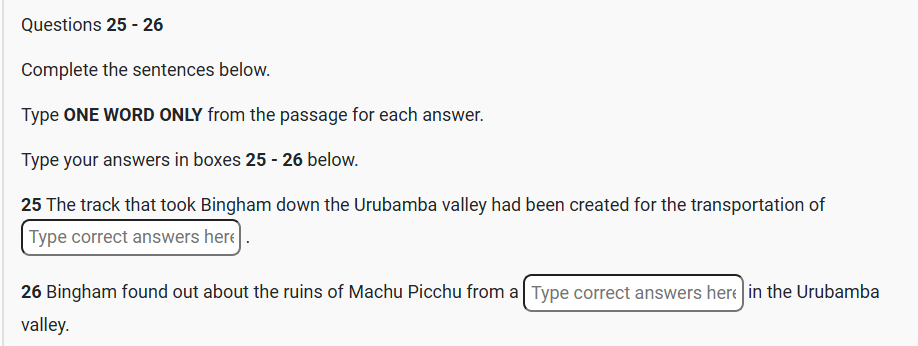
A. Looked at in one way, everyone knows what intelligence is looked at in another way, no one does. In other words, people all have unconscious notions – known as ‘implicit theories’ – of intelligence, but Q2 no one knows for certain what it actually is. This chapter addresses how people conceptualize intelligence,


whatever it may actually be. But why should we even care what people think intelligence is, as opposed only to valuing whatever it actually is? There are at least four reasons people’s conceptions of intelligence matter.

B. First, implicit theories of intelligence drive the way in which people perceive and evaluate their own intelligence and that of others. To better understand the judgments people make about their own and others’ abilities, it is useful to learn about people’s implicit theories. Q4 Q1 For example, parents’ implicit theories of their children’s language development will determine at what ages they will be willing to make various corrections in their children’s speech. More generally, parents’ implicit theories of intelligence will determine at what ages they believe their children are ready to perform various cognitive tasks. Job interviewers will make hiring decisions on the basis of their implicit theories of intelligence. People will decide who to be friends with on the basis of such theories. In sum, knowledge about implicit theories of intelligence is important because this knowledge is so often used by people to make judgments in the course of their everyday lives.

C. Second, the implicit theories of scientific investigators ultimately give rise to their explicit theories. Thus it is useful to find out what these implicit theories are. Implicit theories provide a framework that is useful in defining the general scope of a phenomenon – especially a not-well-understood phenomenon. These implicit theories can suggest what aspects of the phenomenon have been more or less attended to in previous investigations.

D. Third, Q3 implicit theories can be useful when an investigator suspects that existing explicit theories are wrong or misleading. If an investigation of implicit theories reveals little correspondence between the extant implicit and explicit theories, the implicit theories may be wrong. But the possibility also needs to be taken into account that the explicit theories are wrong and in need of correction or supplementation. For example, some implicit theories of intelligence suggest the need for expansion of some of our explicit theories of the construct.

E. Finally, understanding implicit theories of intelligence can help elucidate developmental and cross-cultural differences. As mentioned earlier, Q5 people have expectations for intellectual performances that differ for children of different ages. How these expectations differ is in part a function of culture. For example, expectations for children who participate in Western-style schooling are almost certain to be different from those for children who do not participate in such schooling.

F. I have suggested that there are three major implicit theories of how intelligence relates to society as a whole (Sternberg, 1997). These might be called Hamiltonian, Jeffersonian, and Jacksonian. These views are not based strictly, but rather, loosely, on the philosophies of Alexander Hamilton, Thomas Jefferson, and Andrew Jackson, three great statesmen in the history of the United States.

G. The Hamiltonian view, which is similar to the Platonic view, is that Q10 people are born with different levels of intelligence and that those who are less intelligent need the good offices of the more intelligent to keep them in line, whether they are called government officials or, in Plato’s term, philosopher-kings. Herrnstein and Murray (1994) Q11 seem to have shared this belief when they wrote about the emergence of a cognitive (high-IQ) elite, which eventually would have to take responsibility Q13 for the largely irresponsible masses of non-elite (low-IQ) people who cannot take care of themselves. Left to themselves, the unintelligent would create, as they always have created, a kind of chaos.

H. Q7 The Jeffersonian view is that people should have equal opportunities, but they do not necessarily avail themselves equally of these opportunities and are not necessarily equally rewarded for their accomplishments. People are rewarded for what they accomplish if given equal opportunity. Low achievers are not rewarded to the same extent as high achievers. In the Jeffersonian view, the goal of education is not to favor or foster an elite, as in the Hamiltonian tradition, but rather Q9 to allow children the opportunities to make full use of the skills they have. My own views are similar to these (Sternberg, 1997).

I. The Jacksonian view is that all people are equal, not only as human beings but in terms of their competencies – that one person would serve as well as another in government or on a jury or in almost any position of responsibility. Q8 In this view of democracy, Q12 people are essentially intersubstitutable except for specialized skills, all of which can be learned. In this view, we do not need or want any institutions that might lead to favoring one group over another.

J. Implicit theories of intelligence and of the relationship of intelligence to society perhaps need to be considered more carefully than they have been because they often serve as underlying presuppositions for explicit theories and even experimental designs that are then taken as scientific contributions. Q6 Until scholars are able to discuss their implicit theories and thus their assumptions, they are likely to miss the point of what others are saying when discussing their explicit theories and their data.


Boost Your Score: Practice IELTS Online with IELTS Simulator.

phone icon
8439000086
8439000087
7055710003
7055710004
IELTS Simulation 323 GMS Road, Near Ballupur Chowk, Dehradun, India
Chat on WhatsApp
email: info at ieltsband7.com

IELTS READING – Neuroaesthetics S2AT3

IELTS SIMULATOR READING TEST SET 2 TASK 3 AC – Neuroaesthetics	IELTS SIMULATION
IELTS reading Neuroaesthetics reading practice test has 10 questions belongs to the 🧠 Science & Psychology subject. 

An emerging discipline called neuroaesthetics is seeking to bring scientific objectivity to the study of art, and has already given us a better understanding of many masterpieces. The blurred imagery of Impressionist paintings seems

to stimulate the brain’s amygdala, for instance. Since the amygdala plays a crucial role in our feelings, that finding might explain why many people find these pieces so moving. The discipline of neuroaesthetics aims to bring scientific objectivity to the study of art. Neurological studies of the brain, for example, demonstrate the impact which Impressionist paintings have on our Q31 emotions.

Could the same approach also shed light on abstract twentieth-century pieces, from Mondrian’s geometrical blocks of colour, to Pollock’s seemingly haphazard arrangements of splashed paint on canvas? Sceptics believe that people claim to like such works simply because they are famous. We certainly do have an inclination to follow the crowd. When asked to make simple perceptual decisions such as matching a shape to its rotated image, for example, Q27 people often choose a definitively wrong answer if they see others doing the same. It is easy to imagine that this mentality would have even more impact on a fuzzy concept like art appreciation, where there is no right or wrong answer.

Angelina Hawley-Dolan, of Boston College, Massachusetts, responded to this debate by asking volunteers to view pairs of paintings – either the creations of famous abstract artists or the doodles of infants, chimps and elephants. They then had to judge which they preferred. A third of the paintings were given no captions, while many were labelled incorrectly -volunteers might think they were viewing a chimp’s messy brushstrokes when they were actually seeing an acclaimed masterpiece. In each set of trials, volunteers generally preferred the work of renowned artists, even when they believed it was by an animal or a child. It seems that the viewer can Q28 sense the artist’s vision in paintings, even if they can’t explain why.

Robert Pepperell, an artist based at Cardiff University, creates ambiguous works that are neither entirely abstract nor clearly representational. In one study, Pepperell and his collaborators asked volunteers to decide how powerful they considered an artwork to be, and whether they saw anything familiar in the piece. The longer they took to answer these questions, the more highly they rated the piece under scrutiny, and the greater their neural activity. It would seem that the brain sees these images as puzzles, and the harder it is to decipher the meaning, Q29 the more rewarding is the moment of recognition.

And what about artists such as Mondrian, whose paintings consist exclusively of horizontal and vertical lines encasing blocks of colour? Mondrian’s works are deceptively simple, but eye-tracking studies confirm that they are Q30 meticulously composed, and that simpiy rotating a piece radically changes the way we view it. 

With the originals, volunteers’eyes tended to stay longer on certain places in the image, but with the altered versions they would flit across a piece more rapidly. As a result, the volunteers considered the altered versions less pleasurable when they later rated the work.

In a similar study, Oshin Vartanian of Toronto University asked volunteers to compare original paintings with ones which he had altered by moving objects around within the frame. He found that almost everyone preferred the original, whether it was a Van Gogh still life or an abstract by Miro. Vartanian also found that changing the composition of the paintings reduced activation in those brain areas linked with meaning and interpretation.

And what about artists such as Mondrian, whose paintings consist exclusively of horizontal and vertical lines encasing blocks of colour? Mondrian’s works are deceptively simple, but eye-tracking studies confirm that they are meticulously composed and that simply rotating a piece radically changes the way we view it. 

With the originals, volunteers’eyes tended to stay longer on certain places in the image, but with the altered versions they would flit across a piece more rapidly. As a result, the volunteers considered the altered versions less pleasurable when they later rated the work.

In a similar study, Oshin Vartanian of Toronto University asked volunteers to compare original paintings with ones which he had altered by moving objects around within the frame. He found that almost everyone preferred the original, whether it was a Van Gogh still life or an abstract by Miro. Vartanian also found that changing the composition of the paintings reduced activation in those brain areas linked with meaning and interpretation.

In another experiment, Alex Forsythe of the University of Liverpool analysed the visual intricacy of different pieces of art, and her results suggest that many artists use a key level of detail to please the brain. –> Alex Forsythe of the University of Liverpool believes many artists give their works the precise degree of Q32 complexity which most appeals to the viewer’s brain.

Too little and the work is boring, but too much results in a kind of ‘perceptual overload’, according to Forsythe. What’s more, appealing pieces both abstract and representational, show signs of Q34fractals‘ – repeated motifs recurring in different scales, fractals are common throughout nature, for example in the shapes of mountain peaks or the branches of trees. –> She also observes that pleasing works of art often contain certain repeated Q33 images which occur frequently in the natural world. . 

It is possible that our visual system, which evolved in the great outdoors, finds it easier to process such patterns.

It is also intriguing that the brain appears to process movement when we see a handwritten letter as if we are replaying the writer’s moment of creation. This has led some to wonder whether Pollock’s works feel so dynamic because the brain reconstructs the energetic actions the artist used as he painted. This may be down to our brain’s ‘mirror neurons’, which are known to mimic others’ actions. The hypothesis will Q35 need to be thoroughly tested, however, it might even be the case that we could use neuroaesthetic studies to understand the longevity of some pieces of artwork. 

While the fashions of the time might shape what is currently popular, works that are best adapted to our visual system may be the most likely to linger Q36 once the trends of previous generations have been forgotten.

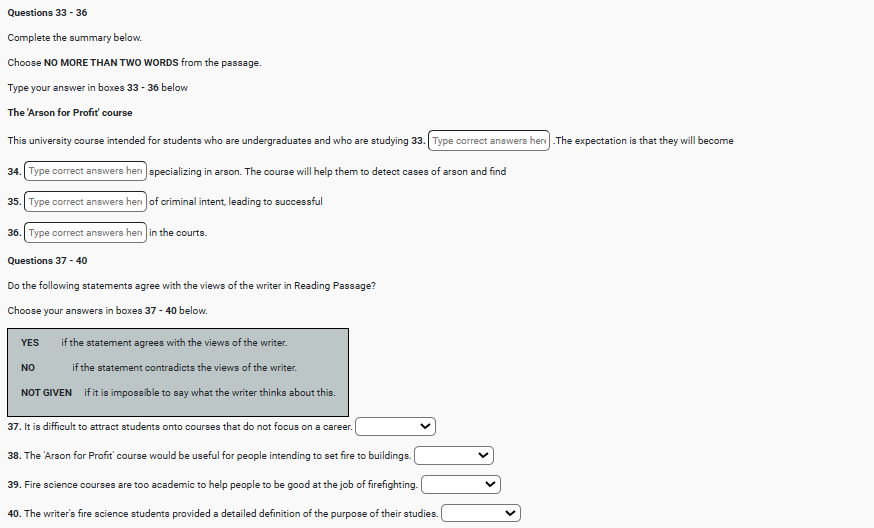
It’s still early days for the field of neuroaesthetics – and these studies are probably only a taste of what is to come. It would, however, be foolish to reduce art appreciation to Q37 a set of scientific laws

We shouldn’t underestimate the importance of the style of a particular artist, Q38 their place in history, and the artistic environment of their time. 

Q40 Abstract art offers both a challenge and the freedom to play with different interpretations. In some ways, it’s not so Q39 different to science, where we are constantly looking for systems and decoding meaning so that we can view and appreciate the world in a new way.


Learn From Experienced Teacher Best IELTS Coaching Dehradun Best IELTS in Dehradun Uttarakhand GMS Road BEST coaching in Dehradun Apply for Class Courses Today Good Results.

phone icon
8439000086
8439000087
7055710003
7055710004
IELTS Simulation 323 GMS Road, Near Ballupur Chowk, Dehradun, India

Chat on WhatsApp
email: info at ieltsband7.com

IELTS READING – THE DEPARTMENT OF ETHNOGRAPHY S51AT1

IELTS Reading THE DEPARTMENT OF ETHNOGRAPHY reading practice test has 10 questions belongs to Anthropology & Museums subject..

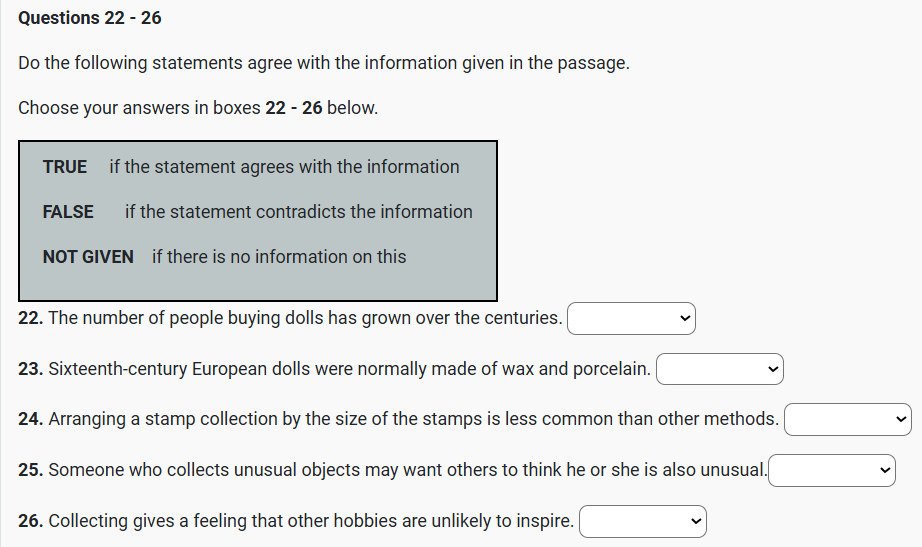
Q2 The Department of Ethnography was created as a separate department within the British Museum in 1946, offer 140 years of gradual development from the original Department of Antiquities. If is concerned with the people of Africa, the Americas, Asia, the Pacific, and parts of Europe. While this includes complex kingdoms, as in Africa, and ancient empires, such as those of the Americas, the primary focus of attention in the twentieth century has been on small-scale societies. Through its collections, the Department’s specific interest is to document how objects are created and used, and to understand their importance and significance to those who produce them. Such objects can include both the extraordinary and the mundane, the beautiful and the banal.

Q1 The collections of the Department of Ethnography include approximately 300,000 artefacts, of which about half are the product of the present century. The Department has a vital role to play in providing information on non-Western cultures to visitors and scholars. To this end, Q3 the collecting emphasis has often been less on individual objects than on groups of material which allow the display of a broad range of o society’s cultural expressions.

Much of the more recent collecting was carried out in the field, sometimes by Museum staff working on general anthropological projects in collaboration with a wide variety of national governments and other institutions. The material collected includes Q7 great technical series – for instance, of textiles from Bolivia, Guatemala, Indonesia, and at areas of West Africa – or of Q8&10 artefact types such as boats. The latter include working examples of coracles from India, reed boars from Lake Titicaca in the Andes, Q10 kayaks from the Arctic, and dug-out canoes from several countries. Q9&11 The field assemblages, such as those from the Sudan, Madagascar, and Yemen, include a whole range of material culture representative of one people. This might cover the necessities of life of an African herdsman or on Q11 Arabian farmer, ritual objects, or even Q9 on occasion airport art. Again, a series of acquisitions might represent a decade’s fieldwork documenting Q12 social experience as expressed in the varieties of clothing and jewellery styles, tents and camel trappings from various Q12 Middle Eastern countries, or in the developing preferences in personal adornment and dress from Papua New Guinea. Particularly interesting are a series of collections which continue to document the evolution of ceremony and of material forms for which the Department already possesses early (if nor the earliest) collections formed after the first contact with Europeans.

The importance of these acquisitions extends beyond the objects themselves. They come to the Museum with documentation of the social context, ideally including photographic records. Such acquisitions have multiple purposes. Most significantly they document for future change. Most people think of the cultures represented in the collection in terms of the absence of advanced technology. In fact, traditional practices draw on a continuing wealth of technological ingenuity. Limited resources and ecological constraints are often overcome by personal skills that would be regarded as exceptional in the West. Of growing interest is the way in which much of what we might see as disposable is, elsewhere, recycled and reused.

With the Independence of much of Asia and Africa after 1945, Q6 if was assumed that economic progress would rapidly lead to the disappearance or assimilation of many small-scale societies. Therefore, it was felt that the Museum should acquire materials representing people whose art or material culture, ritual or political structures were on the point of irrevocable change. This attitude altered with the realisation that marginal communities can survive and adapt In spire of partial integration into a notoriously fickle world economy. Since the seventeenth century, with the advent of trading companies exporting manufactured textiles to North America and Asia, the importation of cheap goods has often contributed to the destruction of local skills and indigenous markets. Q5 On the one hand modern imported goods may be used in an everyday setting, while on the other hand, traditional objects may still be required for ritually significant events. Within this context trade and exchange attitudes are inverted. What are utilitarian objects to a Westerner may be prized objects in other cultures – when transformed by local ingenuity – principally for aesthetic value. In the some way, the West imports goods from other peoples and in certain circumstances categorises them as ‘art’.

Collections act as an ever-expanding database, nor merely for scholars and anthropologists, but for people involved in a whole range of educational and artistic purposes. These include schools and universities as well as colleges of art and design. The provision of information about non-Western aesthetics and techniques, not just for designers and artists but for all visitors, is a growing responsibility for a Department whose own context is an increasingly multicultural European society.


Professional. Easily Get Required Score I am interested in IELTS Pass with Confidence, Dehradun Small Batch Size with Flexible Time, professional faculty.

phone icon
8439000086
8439000087
7055710003
7055710004
IELTS Simulation 323 GMS Road, Near Ballupur Chowk, Dehradun, India
Chat on WhatsApp
email: info at ieltsband7.com