IELTS READING – TV Addiction 2 S54AT3

 IELTS Reading TV Addiction 2 reading practice test has 10 questions belong to Psychology and Society subject..

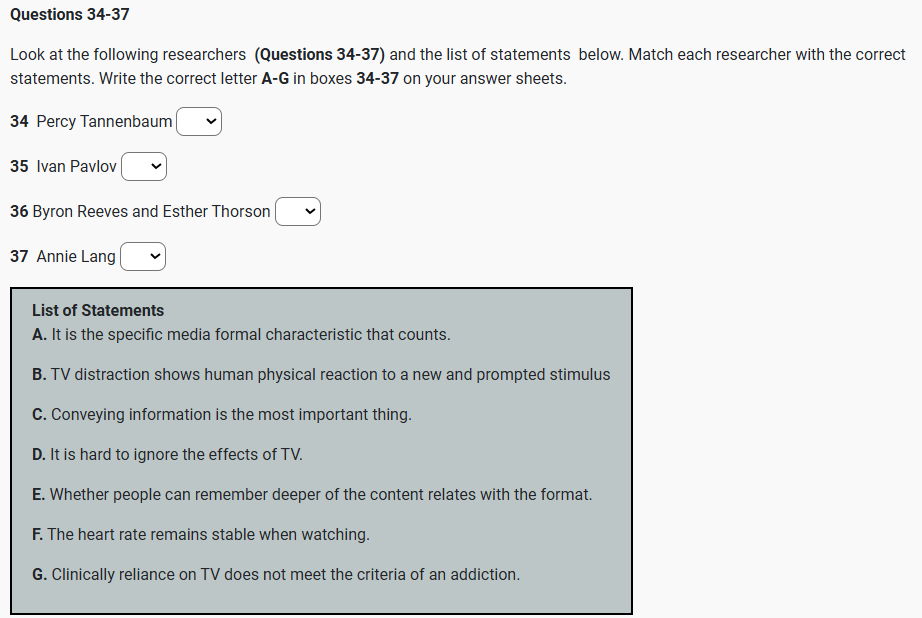
A. Excessive cravings do not necessarily involve physical substances. Gambling can become compulsive; sex can become obsessive. One activity, however, stands out for its prominence and ubiquity—the world’s most Q38 popular pastime, television. Most people admit to having a love-bate relationship with it. They complain about the “boob tube” and “couch potatoes,” then they settle into their sofas and grab the remote control. Parents commonly fret about their children’s viewing (if not their own). Q27 Even researchers who study TV for a living marvel at the medium’s hold on them personallyQ34 Percy Tannenbaum of the University of California at Berkeley has written: “Among life’s more embarrassing moments have been countless occasions when I am engaged in conversation in a room while a TV set is on, and I cannot for the life of me stop from periodically glancing over to the screen. This occurs not only during dull conversations but during reasonably interesting ones just as well.”
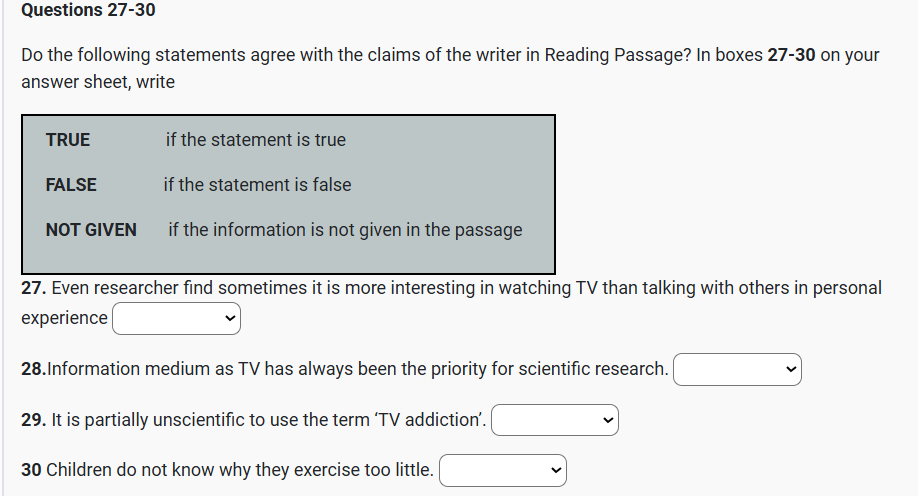
 

B. Q28 Scientists have been studying the effects of television for decades, generally focusing on whether watching violence on TV correlates with being violent in real life. Less attention has been paid to the basic allure of the small screen—the medium, as opposed to the message.

C. Q29 The term “TV addiction” is imprecise and laden with value judgments, but it captures the essence of a very real phenomenon. Psychologists and psychiatrists formally define substance dependence as a disorder characterized by criteria that include spending a great deal of time using the substance; using it more often than one intends; thinking about reducing use or making repeated unsuccessful efforts to reduce use; giving up important social, family or occupational activities to use it; and reporting withdrawal symptoms when one stops using it.
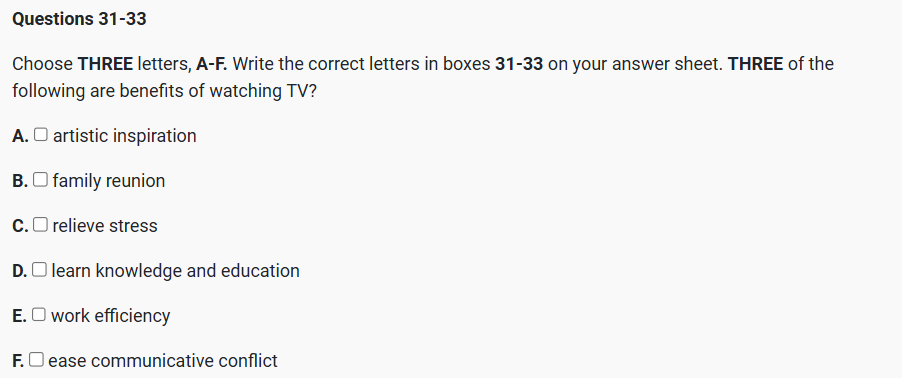
D. All these criteria can apply to people who watch a lot of television. That does not mean that watching television, in itself, is problematic. Television can teach and amuse; it can reach Q31 aesthetic heights; it can provide much needed distraction and escape. The difficulty arises when people strongly sense that they ought not to watch as much as they do and yet find themselves strangely unable to reduce their viewing. Some knowledge of how the medium exerts its pull may help heavy viewers gain better control over their lives.
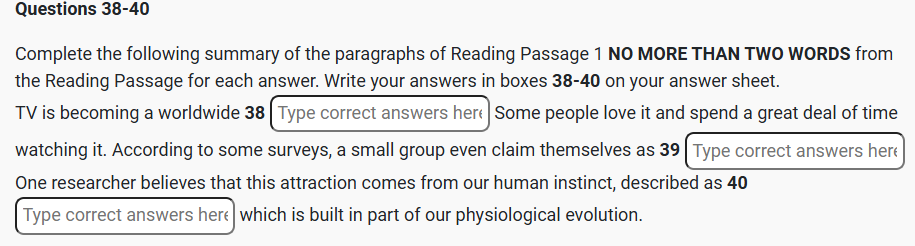
E. The amount of time people spend watching television is astonishing. On average, individuals in the industrialized world devote three hours a day to the pursuit—fully half of their leisure time, and more than on any single activity save work and sleep. At this rate, someone who lives to 75 would spend nine years in front of the tube. To some commentators, this devotion means simply that people enjoy TV and make a conscious decision to watch it. But if that is the whole story, why do so many people experience misgivings about how much they view? In Gallup polls in 1992 and 1999, two out of five adult respondents and seven out of 10 teenagers said they spent too much time watching TV. Other surveys have consistently shown that roughly 10 percent of adults call themselves Q39 TV addicts.

F. Q32 What is it about TV that has such a hold on US? In part, the attraction seems to spring from our biological ‘orienting response.’ Q35 First described by Ivan Pavlov in 1927, the Q40 orienting response is our instinctive visual or auditory reaction to any sudden or novel stimulus. It is part of our evolutionary heritage, a built-in sensitivity to movement and potential predatory threats.

G. Q36 In 1986 Byron Reeves of Stanford University, Esther Thorson of the University of Missouri, and their colleagues began to study whether the simple formal features of television-cuts, edits, zooms, pans, sudden noises—activate the orienting response, thereby keeping attention on the screen. By watching how brain waves were affected by formal features, the researchers concluded that these stylistic tricks can indeed trigger involuntary responses and ‘derive their attention-al value through the evolutionary significance of detecting movement… It is the form, not the content, of television that is unique.’
H. The orienting response may partly explain common viewer remarks such as: “If a television is on, I just can’t keep my eyes off it,” “I don’t want to watch as much as I do, but I can’t help it,” and “I feel hypnotized when I watch television.” In the years since Reeves and Thorson published then pioneering work, researchers have delved deeper. Annie Lang’s research team at Indiana University has shown that heart rate decreases for four to six seconds after an orienting stimulus. Q37 In ads, action sequences, and music videos, formal features frequently come at a rate of one per second, thus activating the orienting response continuously.

I. Lang and her colleagues have also investigated whether formal features affect people’s memory of what they have seen. In one of their studies, participants watched a program and then filled out a score sheet. Increasing the frequency of edits (defined here as a change from one camera angle to another in the same visual scene) improved memory recognition, presumably because it focused attention on the screen. Increasing the frequency of cuts—changes to a new visual scene-had a similar effect but only up to a point. If the number of cuts exceeded 10 in two minutes, recognition dropped off sharply.

J. Q33 Producers of educational television for children have found that formal features can help learning. But increasing the rate of cuts and edits eventually overloads the brain. Music videos and commercials that use rapid intercutting of unrelated scenes are designed to hold attention more than they are to convey information. People may remember the name of the product or band, but the details of the ad itself float in one ear and out the other. The orienting response is overworked. Viewers still attend to the screen, but they feel tired and worn out, with little compensating psychological reward. Our ESM findings show much the same thing.

K. Sometimes the memory of the product is very subtle. Many ads today are deliberately oblique: they have an engaging story line, but it is hard to tell what they are trying to sell. Afterward you may not remember the product consciously. Yet advertisers believe that if they have gotten your attention when you later go to the store you will feel better or more comfortable with a given product because you have a vague recollection of having heard of it.


Learn From Experienced Teacher Best IELTS Coaching Dehradun Best IELTS in Dehradun Uttarakhand GMS Road BEST coaching in Dehradun Apply for Class Courses Today Good Results.

phone icon
8439000086
8439000087
7055710003
7055710004
IELTS Simulation 323 GMS Road, Near Ballupur Chowk, Dehradun, India

Chat on WhatsApp
email: info at ieltsband7.com

IELTS READING – Pottery production in ancient Akrotiri S53AT3

 IELTS Reading Pottery production in ancient Akrotiri reading practice test has 10 questions belongs to Archaeology & Ancient Civilisations subject..

A. Excavations at the site of prehistoric Akrotiri, on the coast of the Aegean Sea, have revealed much about the technical aspects of pottery manufacture, indisputably one of the basic industries of this Greek city. However, considerably less is known about the socio-economic context and the way production was organised.


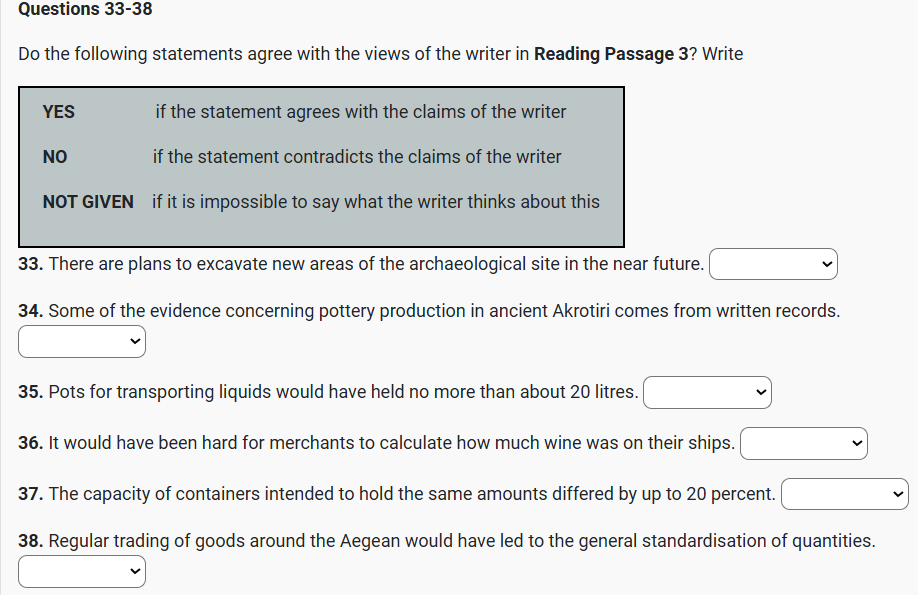
B. The bulk of pottery found at Akrotiri is locally made, and dates from the late fifteenth century BC. It clearly fulfilled a vast range of the settlement’s requirements: more than fifty different types of pots can be distinguished. Q27 The pottery found includes a wide variety of functional types like storage jars, smaller containers, pouring vessels, cooking pots, drinking vessels, and so on, which all relate to specific activities and which would have been made and distributed with those activities in mind. Q28 Given the large number of shapes produced and the relatively high degree of standardisation, it has generally been assumed that most, if not all, of Akrotiri pottery was produced by specialised craftsmen in a non-domestic context. Unfortunately neither the potters’ workshops nor kilns have been found within the excavated area. The reason may be that the ceramic workshops were located on the periphery of the site, which has not yet been excavated. In any event, the ubiquity of the pottery, and the consistent repetition of the same types in different sizes, suggest production on an industrial scale.

C. The Akrotirian potters seem to have responded to pressures beyond their households, namely to the increasing complexity of regional distribution and exchange systems. We can imagine them as full-time craftsmen working permanently in a high production-rate craft such as pottery manufacture, and supporting themselves entirely from the proceeds of then craft. In view of the above, one can begin to speak in terms of mass-produced pottery and the existence of organised workshops of craftsmen during the period 1550— 1500 BC. Yet, how pottery production was organised at Akrotiri remains an open question, as Q34 there is no real documentary evidence. Our entire knowledge comes from the ceramic material itself, and the tentative conclusions which can be drawn from it.

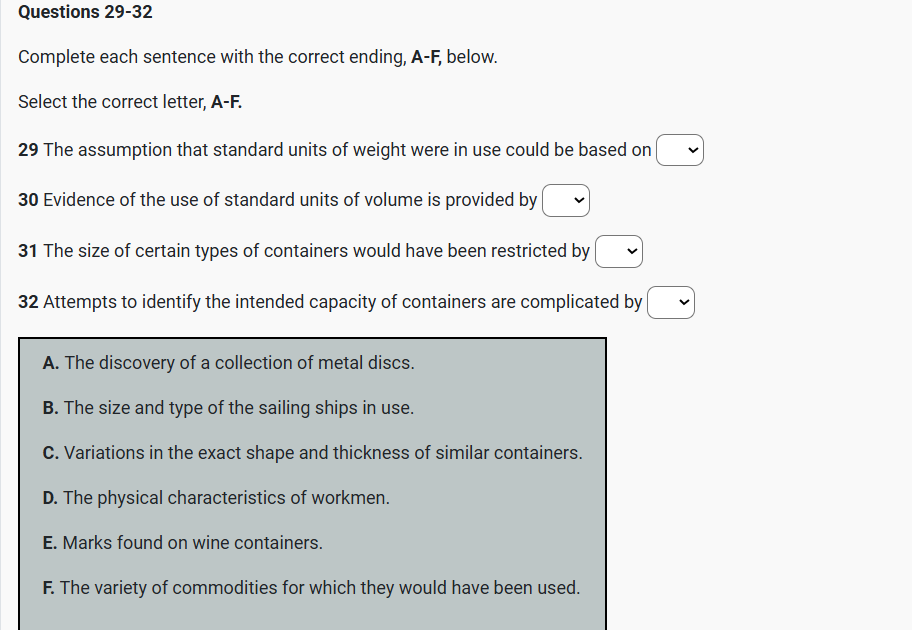
D. The invention of units of quantity and of a numerical system to count them was of capital importance for an exchange-geared society such as that of Akrotiri. In spite of the absence of any written records, the archaeological evidence reveals that concepts of measurements, both of weight and number, had been formulated. Q29 Standard measures may already have been in operation, such as those evidenced by a graduated series of lead weights— made in disc form— found at the siteQ30 The existence of units of capacity in Late Bronze Age times is also evidenced, by the notation of units of a liquid measure for wine on excavated containers.

E. It must be recognised that the function of pottery vessels plays a very important role in determining then characteristics. The intended function affects the choice of clay, the production technique, and the shape and the size of the pots. For example, large storage jars (pithoi) would be needed to store commodities, whereas smaller containers would be used for transport. In fact, Q35 the length of a man’s arm limits the size of a smaller pot to a capacity of about twenty litresQ31 that is also the maximum a man can comfortably carry.

F. The various sizes of container would thus represent standard quantities of a commodity, which is a fundamental element in the function of exchange. Akrotirian Q36 merchants handling a commodity such as wine would have been able to determine easily the amount of wine they were transporting fiom the number of containers they carried in then ships, since the capacity of each container was known to be 14-18 litres. (We could draw a parallel here with the current practice in Greece of selling oil in 17 kilogram tins.)

G. We may therefore assume that the shape, capacity, and, sometimes decoration of vessels are indicative of the commodity contained by them. Since individual transactions would normally involve different quantities of a given commodity, a range of ‘standardised’ types of vessel would be needed to meet traders’ requirements.

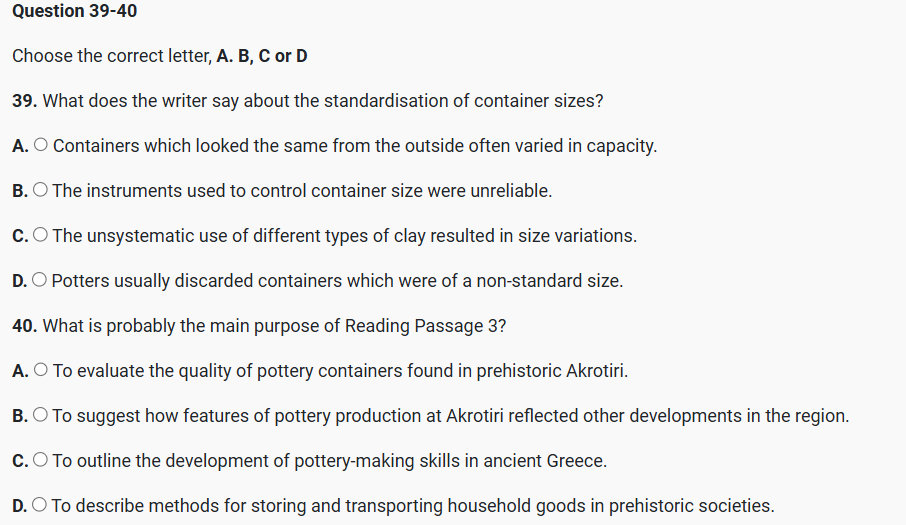
H. In trying to reconstruct systems of capacity by measuring the volume of excavated pottery, a rather generous range of tolerances must be allowed. It mind, and tried to reproduce them using a specific type and amount of clay. However, Q32 it would be quite difficult for them to achieve the exact size required every time, without any mechanical means of regulating symmetry and wall thickness, and some potters would be more skilled than others. In addition, variations in the repetition of types and size may also occur because of unforeseen circumstances during the throwing process. For instance, instead of destroying the entire pot if the clay in the rim contained a piece of grit, a potter might produce a smaller pot by simply cutting off the rim. Q39 Even where there is no noticeable external difference between pots meant to contain the same quantity of a commodity, differences in their capacity can actually reach one or two litresQ37 In one case the deviation from the required size appears to be as much as 10-20 percent.

I. The establishment of Q38 regular trade routes within the Aegean led to increased movement of goods; consequently a regular exchange of local, luxury and surplus goods, including metals, would have become feasible as a result of the advances in transport technology. Q38 The increased demand for standardised exchanges, inextricably linked to commercial transactions, might have been one of the main factors which led to the standardisation of pottery production. Thus, the whole network of ceramic production and exchange would have depended on specific regional economic conditions, and would reflect the socio-economic structure of prehistoric Akrotiri.


Boost Your Score: Practice IELTS Online with IELTS Simulator.

phone icon
8439000086
8439000087
7055710003
7055710004
IELTS Simulation 323 GMS Road, Near Ballupur Chowk, Dehradun, India
Chat on WhatsApp
email: info at ieltsband7.com

IELTS READING – The future never dies? S53AT2

 IELTS Reading The future never dies? reading practice test has 10 questions belongs to Innovation & Future Studies  subject..

The prospects for humanity and for the world as a whole are somewhere between glorious and dire. It is hard to be much more precise.

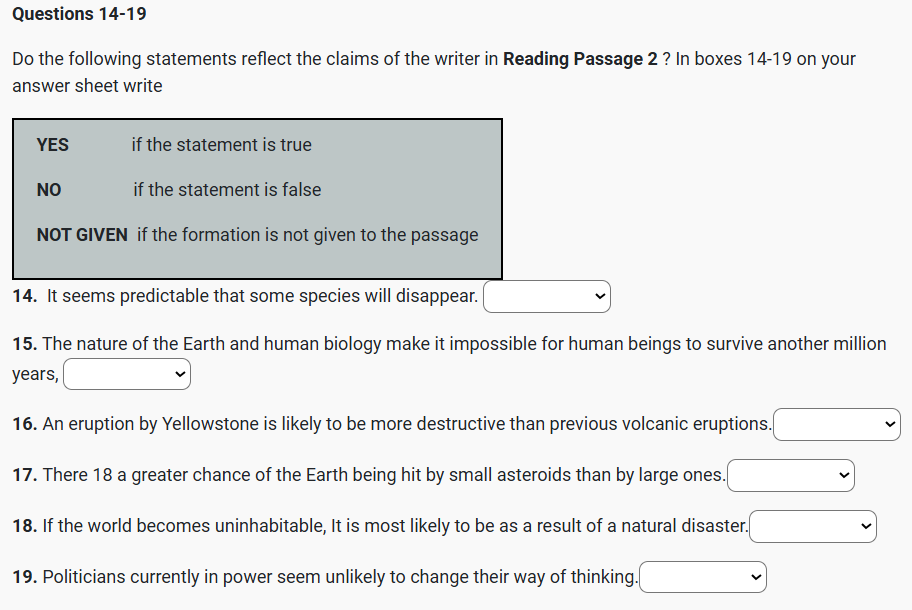
A. By ‘glorious’ I mean that our descendants – all who are born on to this Earth could live very comfortably and securely, and could continue to do so for as long as the Earth can support life, which should be for a very long time indeed. We should at least be thinking in terms of the next million years. Furthermore, our descendants could continue to enjoy the company of other species – establishing a much better relationship with them than we have now. Other animals need not live in constant fear of us. Q14 Many of those fellow species now seem bound to become extinct, but a significant proportion could and should continue to live alongside US. Such a future may seem ideal, and so it is. Yet I do not believe it is fanciful. There is nothing in the physical fabric of the Earth or in our own biology to suggest that this is not possible.


B. ‘Dire’ means that we human beings could be in deep trouble within the next few centuries, living but also dying in large numbers in political terror and from starvation, while huge numbers of our fellow creatures would simply disappear, leaving only the ones that we find convenient – chickens, cattle – or that we can’t shake off, like flies and mice. I’m taking it to be self-evident that glory is preferable.

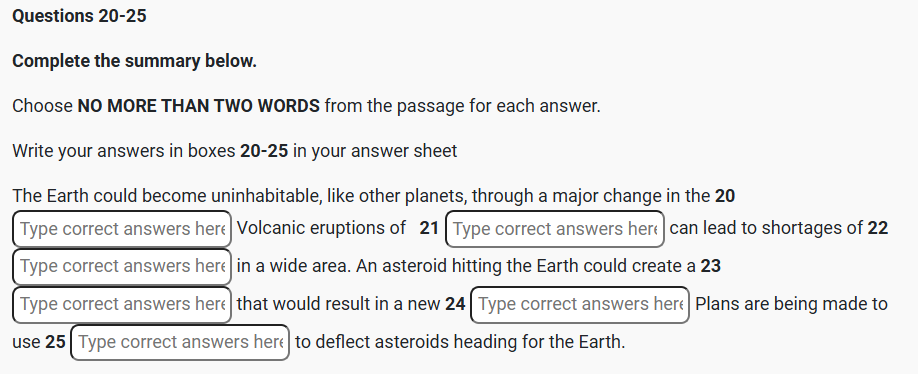
C. Our future is not entirely in our own hands because the Earth has its own rules, is part of the solar system and is neither stable nor innately safe. Other planets in the solar system are quite beyond habitation, because their Q20 temperature is far too high or too low to be endured, and ours, too, in principle could tip either way. Even relatively unspectacular changes in the atmosphere could do the trick. The core of the Earth is hot, which in many ways is good for living creatures, but every now and again, the Q21 molten rock bursts through volcanoes on the surface. Among the biggest volcanic eruptions in recent memory was Mount St Helens, in the USA, which threw out a cubic kilometre of ash – fortunately in an area where very few people live. In 1815, Tambora (in present-day Indonesia) expelled so much ash into the upper atmosphere that climatic effects seriously harmed Q22 food production around the world for season after season. Entire civilisations have been destroyed by volcanoes.

D. Yet nothing we have so far experienced shows what volcanoes can really do. Yellowstone National Park in the USA occupies the caldera (the crater formed when a volcano collapses) of an exceedingly ancient volcano of extraordinary magnitude. Modem surveys show that its centre is now rising. Q16 Sometime in the next 200 million years, Yellowstone could erupt again, and when it does, the whole world will be transformed. Yellowstone could erupt tomorrow. But there’s a very good chance that it will give US another million years, and that surely is enough to be going on with. It seems sensible to assume that this will be the case.

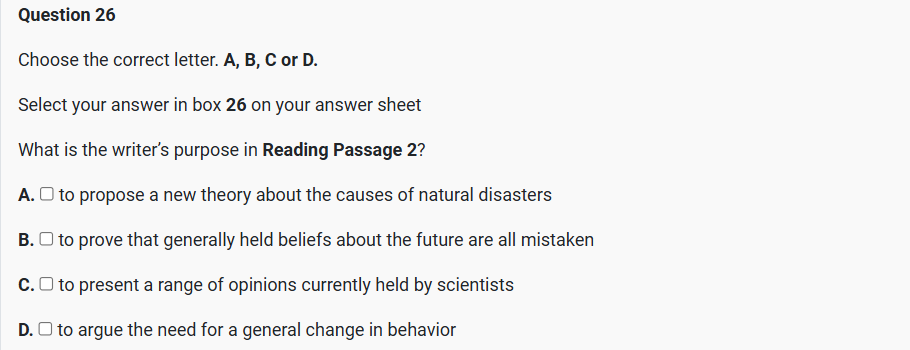
E. The universe at large is dangerous, too: in particular, we share the sky with vast numbers of asteroids, and every now and again, they come into our planet’s atmosphere. An asteroid the size of a small island, hitting the Earth at 15,000 kilometres an hour (a relatively modest speed by the standards of heavenly bodies), would strike the ocean bed like a rock in a puddle, send a Q23 tidal wave around the world as high as a small mountain and as fast as a jumbo jet, and propel us into an Q24 ice age that could last for centuries. There are plans to head off such disasters (including Q25 rockets to push approaching asteroids into new trajectories), but in truth, it’s down to luck.

F. On the other hand, the archaeological and the fossil evidence shows that no truly devastating asteroid has struck since the one that seems to have accounted for the extinction of the dinosaurs 65 million years ago. So again, there seems no immediate reason for despair. Q15 The Earth is indeed an uncertain place, in an uncertain universe, but with average luck, it should do us well enough. If the world does become inhospitable in the next few thousand or million years, then it will probably be our own fault. In short, despite the underlying uncertainty, our own future and that of our fellow creatures is very much in our own hands.

G. Given average luck on the geological and the cosmic scale, the difference between glory and disaster will be made, and is being made, by politics. Certain kinds of political systems and strategies would predispose US to long-term survival (and indeed to comfort and security and the pleasure of being alive), while others would take us more and more frenetically towards collapse. The broad point is, though, that we need to look at ourselves – humanity – and at the world in general in a quite new light. Our material problems are fundamentally those of biology. We need to think, and we need our politicians to think, biologically. Do that, and take the ideas seriously, and we are in with a chance. Ignore biology and we and our fellow creatures haven’t a hope.


Learn From Experienced Teacher Best IELTS Coaching Dehradun Best IELTS in Dehradun Uttarakhand GMS Road BEST coaching in Dehradun Apply for Class Courses Today Good Results.

phone icon
8439000086
8439000087
7055710003
7055710004
IELTS Simulation 323 GMS Road, Near Ballupur Chowk, Dehradun, India
Chat on WhatsApp
email: info at ieltsband7.com

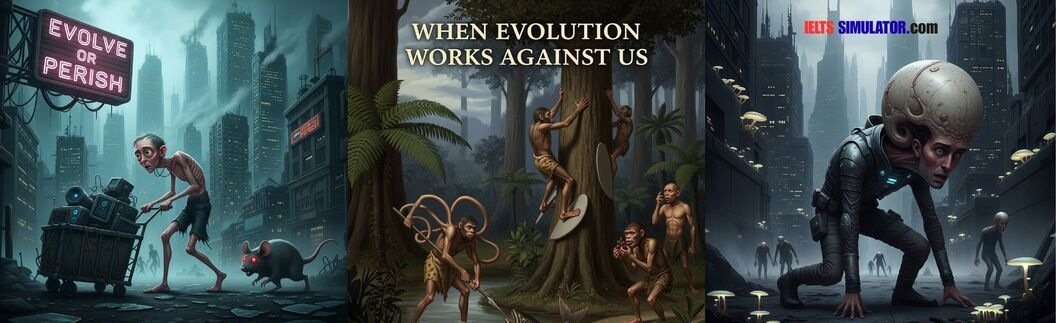
IELTS READING – WHEN EVOLUTION WORKS AGAINST US S52AT3

IELTS Reading WHEN EVOLUTION WORKS AGAINST US reading practice test has 10 questions belongs to Biology & Evolution subject..

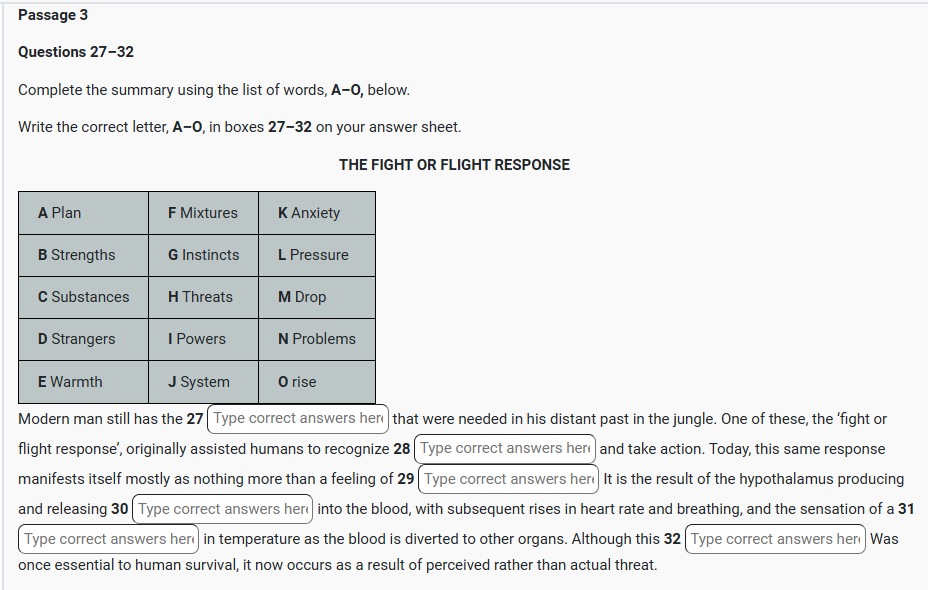
Life has changed in just about every way since small tribes of hunter-gatherers roamed the earth armed with nothing but spears and stone tools. We now buy our meat from the supermarket rather than stalking it through the jungle; houses and high-rises shelter us at night instead of caves. But despite these changes, some very basic responses linger on. The short, Q29 sharp feeling of heightened awareness that sweeps through us when a stranger passes in a dark alley is no different, physiologically speaking, from the sensation our ancestors experienced when they were walking through the bushes and heard a dry twig snap nearby. It’s called the ‘fight or flight’ response, and it helps us to identify dangerous situations and act decisively by, as the name suggests, mustering our strength for a confrontation or running away as fast we can.


This shift to survival mode is often popularly described as a sudden unease, a sense that a situation is ‘off’ or ‘not right’. However, the sense is actually the outcome of an incredibly complex mind-body process which involves the brain’s ‘fear centre’, Q30 the hypothalamus, advising the sympathetic nervous Q32 system and the adrenal-cortical system to work, at first separately, and then together, to blend a potent mix of hormones and chemicals and secrete them into the bloodstream. Our heartbeat rises, along with our respiratory rate. Skin feels cold (hence the ‘shiver’ down the spine) as blood supply is redirected to the larger muscles required for a physical confrontation or a hasty retreat. The ability to concentrate on issues of minor importance also suffers, as the brain tends to prioritise ‘big picture’ thinking at this time.

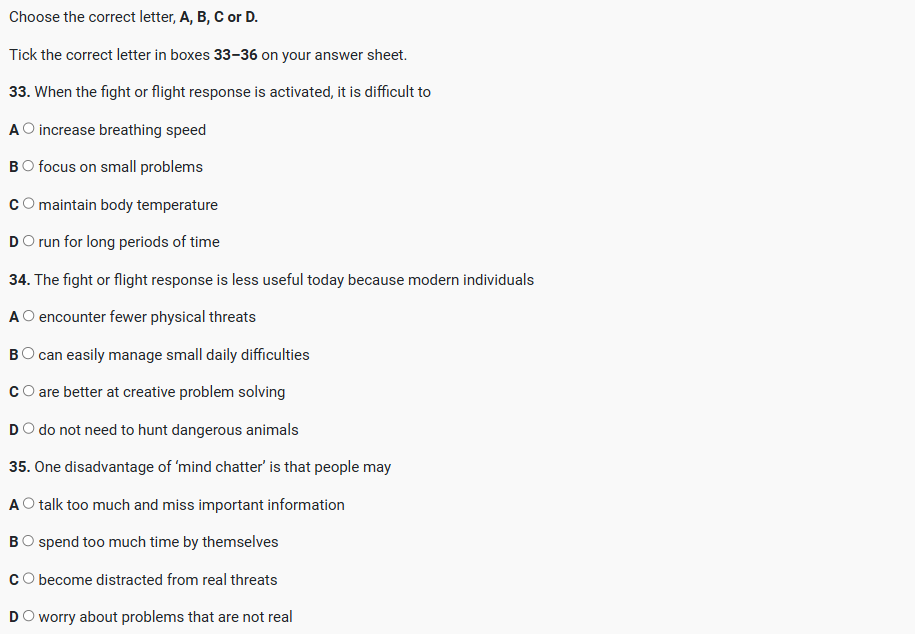
Without this Q27 instinctive response, the human race would never have survived, but at present it is often more of a hindrance than a help. Although instances of physical Q28 threats have decreased over the years, activation of the fight or flight response has actually increased, largely in response to mental frustrations. This poses a problem, however, because the fight or flight mechanism functions most helpfully as a response to something that can cause bodily harm, such as a falling tree or a wild animal, rather than in response to a fulminating boss, a traffic jam, or a spouse who has not returned a phone call. During these instances of mental distress, the physical manifestations of fight or flight, such as an inability to think rationally and calmly, can actually exacerbate the problem. A similar case of an evolutionary development overstaying its welcome is the example of ‘mind chatter’. Mind chatter is the ceaseless train of scattered thoughts and self-talk that occupies our mind, ensuring we are always ‘switched on’, searching for danger and threats. This would have been a boon for a solitary caveman on a three-hour hunting expedition, but in a modern world already overloaded with sensory input, it causes us to fret about non-existent predicaments and occasionally needlessly triggers the fight or flight response.

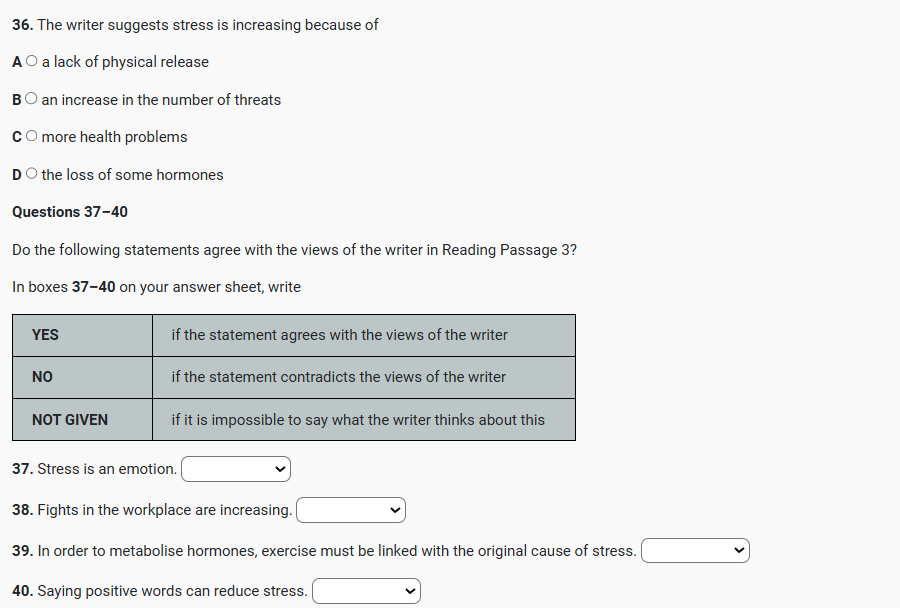
These twin forces, mind chatter, and the fight or flight response, have combined to wreak havoc on the modern psyche and have led to a spike in what Q37 some studies have suggested is a cause of up to eighty percent of all illness today: stress. Stress, erroneously considered by many to be a mere feeling, is actually a physiological condition resulting from a cumulative accrual of certain hormones in the body, hormones that can help us in quick, sharp doses, but which are toxic if they are not properly metabolised. Q39 Metabolism of these potentially toxic hormones relies on physical exertion, which originally evolved as part of the fight or flight process – hormone release was usually followed by physical exertion (fighting or running), which returned the body to a state of balance. In present day encounters, however, the vital element of physical exertion is missing: a resentful employee cannot punch his co-worker, for example, and a frustrated driver is unable to simply ram his way through a packed intersection.

What can be done to restore the balance? Stress researcher Neil F. Neimarck, perhaps not surprisingly, recommends physical exercise as one useful strategy. Fortunately, the brain is not clever enough to realise that this exercise is completely unrelated to the original stress stimulus, and in this way we can effectively ‘fool’ our bodies into metabolising stress hormones by punching a boxing bag instead of the person who annoyed us in the first place. Another option is the ‘relaxation response’, discovered by Harvard cardiologist Herbert Benson. Benson found that certain behaviours, such as deep breathing, meditation, and the repetition of simple, affirmative phrases, acted as an antidote to mind chatter and the fight or flight responses, calming the nervous system and inducing a relaxed state of mind and body instead. Integrating these methods into our lives will be important if the cycle of stress accumulation that is so endemic in modern.

Western society is to be stopped.


Best Results Easily Get Required Score IELTS Exam Dates Available, Small Batch Size with Flexible Time, Professional.

phone icon
8439000086
8439000087
7055710003
7055710004
IELTS Simulation 323 GMS Road, Near Ballupur Chowk, Dehradun, India
Chat on WhatsApp
email: info at ieltsband7.com