IELTS READING – Traditional Cooking Stoves S5GT3
IELTS SIMULATOR ONLINE IELTS READING EASY DEMO - Traditional Cooking Stoves S5GT3 FREE COMPUTER DELIVERED ONLINE IELTS SIMULATION Best BAND7 IELTS Dehradun IELTS online simulator IELTS BAND 7 Coaching Classes
IELTS READING Traditional Cooking Stoves: an overview of designs for improving them Reading Practice Test has 10 Questions.. 

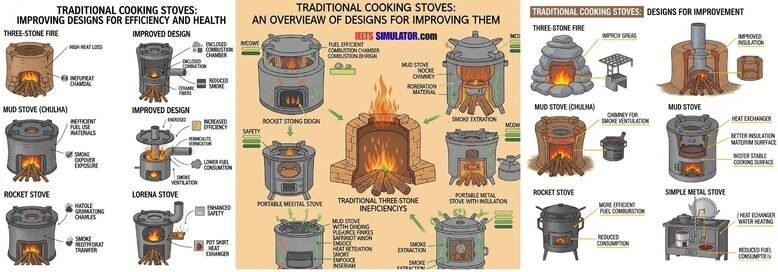
1. A large number of people in the world still use wood as the main source of heat for cooking. Many of these people use ‘three stone’ open fires, and although these have the benefit of being very cheap to make, they are inefficient to use. In addition, Q1 cooking over an open fire exposes people to wood smoke, which irritates their eyes and lungs and makes them susceptible to respiratory diseases. There is also a risk of burns, as the fire has no protection around it. Finally, using wood for cooking contributes to deforestation, in particular around cities and towns, where the concentrated use of wood puts pressure on the surrounding land.
📖Attempt Free Reading Test..


2. Improvements in stove design can bring a number of advantages. Improved stoves allow fuel to burn more efficiently, so getting more heat to the cooking pots, and reducing the amount of wood required to cook a meal. Typically they use between 25% and 60% less wood than open fires. Increased combustion also reduces the amount of smoke that is produced. Q2 Q8 People save time as they need to collect less firewood – a task which usually falls to women and children. The extra time allows women to take up other activities, including earning extra money, and allows children more time for education. Also, family members are reported to be more willing to help with the cooking once they have a smoke-free place in which to work.
3. There are various levels of improvement which can be made. Efficient wood combustion depends on an adequate supply of air reaching all the areas where the wood is burning. Q3 Hot gases tend to rise, creating a draught that draws in more air, so adding a Q12 chimney improves this draught. A Q13 grate to supply air under the fuel is a second improvement. The next step separates the combustion process from heat transfer to the cooking pots. For example, the ‘Rocket’ stove concept uses a vertical combustion chamber, where the wood burns in air, with a horizontal air and fuel inlet at the bottom. Q9 At the top of the combustion chamber, the hot gases are forced to flow through a narrow gap around the cooking pot, so that heat is transferred very efficiently to the pot.

The next improvement is to make sure that the hot gases are burned completely. This is achieved by enlarging the combustion chamber, and introducing a secondary supply of air to allow full combustion.
4. Depending on what they are made from, Q4 stoves can be more or less expensive to make. Steel or cast iron allows accurate manufacture of stove parts, but is expensive. Fired clay parts can be expensive, if they need to be made by trained potters, but are usually cheaper than steel. Mud is traditional for some stoves, but must be formed of the right mix of materials. Concrete can also be used for some stove parts as it can be cast into pre-determined shapes, but it is more expensive than mud. Natural waste, such as rice husk or wood ash, can be used to insulate the stoves and reduce heat loss.
5. Q10 Some stove designs use charcoal as their main fuel rather than wood. Q5 While charcoal is cleaner to burn than wood, and easier to transport and store, about 75% of the original energy in the wood is lost when charcoal is made. Other stoves use agricultural residues (nut shells, straw) as a fuel. Some stoves can use these in their loose form, but most rely on briquetting – compression of the loose material into denser blocks. Charcoal made from agricultural residues can also be bound into briquettes if a small proportion of clay is used as a binder.
6. Programmes to introduce improved stoves are rarely successful unless they fit with the preferred local cooking practices. For example, in Latin America, many people prefer a Lorena or block style wood-stove as they prefer to cook standing up. Q6 This type of stove is made of a solid block of material, with combustion and heat transfer chambers built into it, so the cooking pots and cooking plate are at waist height. In India, many people squat to cook, so the chula style is preferred. This is also a block style stove, but the cooking level is below knee height.
In parts of Africa, people tend to cook outside so prefer to use a jiko, a portable stove without a chimney. Traditionally, jikos use charcoal, but some can also burn wood. The combustion chamber has a pot support, so the pot can be placed directly above the combustion gases. In Asia, similar stoves are called bucket stoves. If such a stove is used indoors, smoke pollution can be reduced by placing it under a hood connected to a chimney.

7. There are over one hundred known organisations involved in the development and extension of improved stoves, in many different countries. However, since many stove programmes are in the informal sector, there is no central record of how many improved stoves have been constructed altogether. Q7 Some programmes have installed many thousands of stoves, while others are very local. Some operate subsidy schemes that allow people to afford improved stoves. Alternatively, programmes may train people to make their own stoves from local materials. Q11 The designs may not be quite as efficient as stoves made by technicians, but people can use and maintain their own stoves without relying too much on outside help. Finally, many stove programmes are part of wider rural development projects, offering improvements in health and economic status for rural people.

📖Attempt Free Reading Test..


Easily Get Required Score I am interested in IELTS Pass with Confidence, Dehradun Small Batch Size with Flexible Time, professional faculty.

phone icon
8439000086
8439000087
7055710003
7055710004
IELTS Simulation 323 GMS Road, Near Ballupur Chowk, Dehradun, India

Chat on WhatsApp
email: info at ieltsband7.com

IELTS READING – A career in journalism S5GT2

IELTS SIMULATOR ONLINE IELTS READING EASY DEMO - A career in journalism S5GT2 FREE COMPUTER DELIVERED ONLINE IELTS SIMULATION Best BAND7 IELTS Dehradun IELTS online simulator IELTS BAND 7 Coaching Classes
IELTS READING A career in journalism Reading Practice Test has 10 Questions belongs to the

Employment & Career Guidance belongs..

How do I get into journalism?

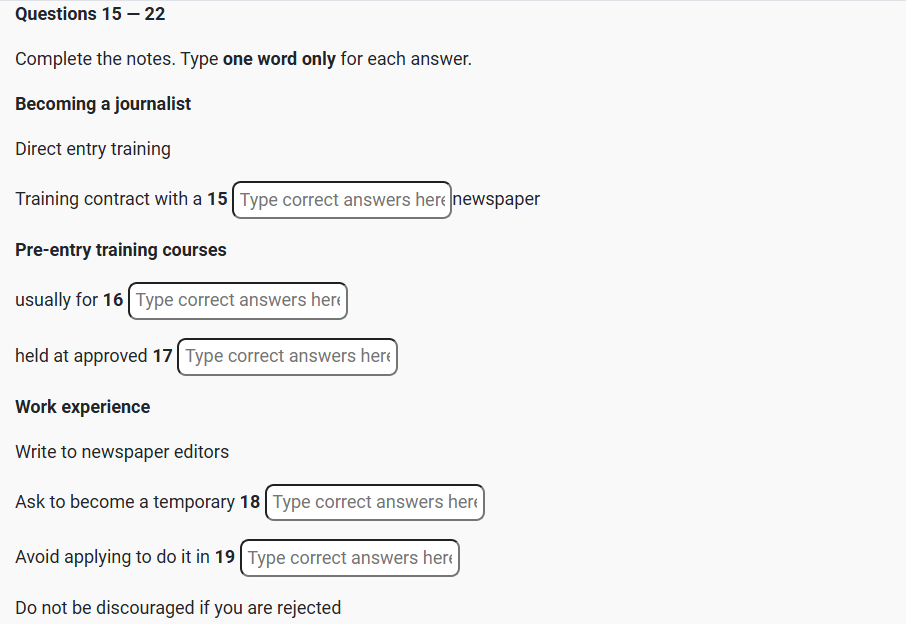
Trainees come into the industry by a variety of routes. Some are recruited directly by a newspaper in their Q1 local area and carry out their basic training under the terms of a training contract. This is known as direct entry.

📖Attempt Free Reading Test..


However, the majority of trainees are recruited after attending vocational education and training courses. These are normally for Q2 graduates. Such courses are generally run by colleges accredited by the National Council for the Training of Journalists. This route is known as Q3 pre-entry.

Some colleges will grant places to people on pre-entry courses only if they have already had a work experience placement at a newspaper. Therefore it would be sensible for you to write to a number of local newspaper editors to ask if they will allow you to join their team of reporters as an observer for a few days. Explain why you think you would make a good reporter and try to pick a time other than July, when pressure on work experience places is at its greatest. You should try to be the Q4 applicant who stands out as the most committed to newspaper journalism, and the most able. But do not be put off if you receive Q5 rejection letters, as there is strong competition for places. Editors appreciate and respect determination and persistence.

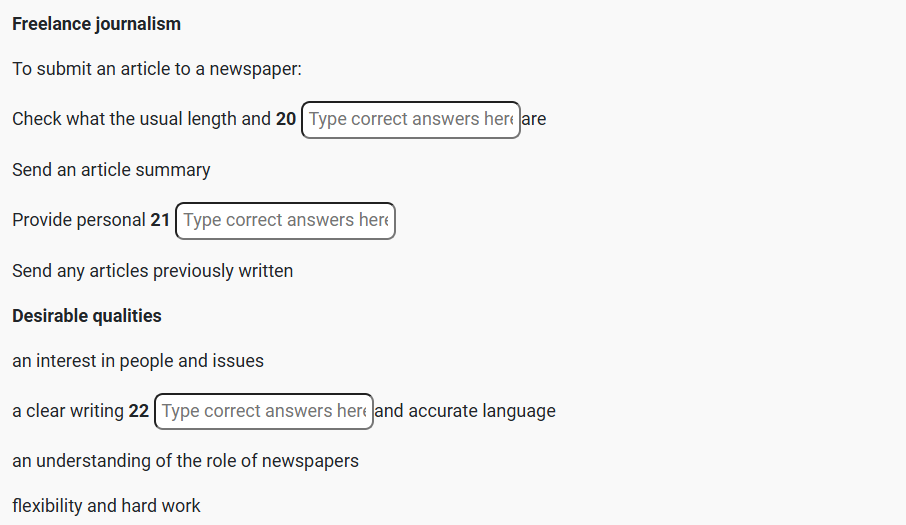
Many people ask about becoming freelance journalists. To begin with, you must know the paper you’re hoping to write for; the article should be approximately the same number of words normally employed by the Q6 editorial column in that paper, and on one of the topics that are most likely to be used. Approach the editor in writing. Send a written synopsis of your article, enclosing some Q7 information about yourself and, if possible, some other articles you have had printed, whether in your local paper or in your student magazine.

What qualities do newspaper editors look for?

To convince an editor that you are worth appointing you will need to be able to demonstrate:

• an interest in people

• an interest in current affairs

• an ability to write in a Q8 style which is easy to understand

• good spelling, grammar and punctuation

• an appreciation of the part newspapers play in the community and society

• a willingness to accept irregular hours, and work under pressure to meet deadlines.

Staff Training and Development: Scheme of Assistance

The Company encourages the professional development of its staff and will provide assistance under this scheme to enable them to obtain approved qualifications, to undertake approved courses of study or to attend approved conferences.

Assistance will normally be given where:

a) the qualification, course or conference is relevant to the role currently being carried out by the individual and

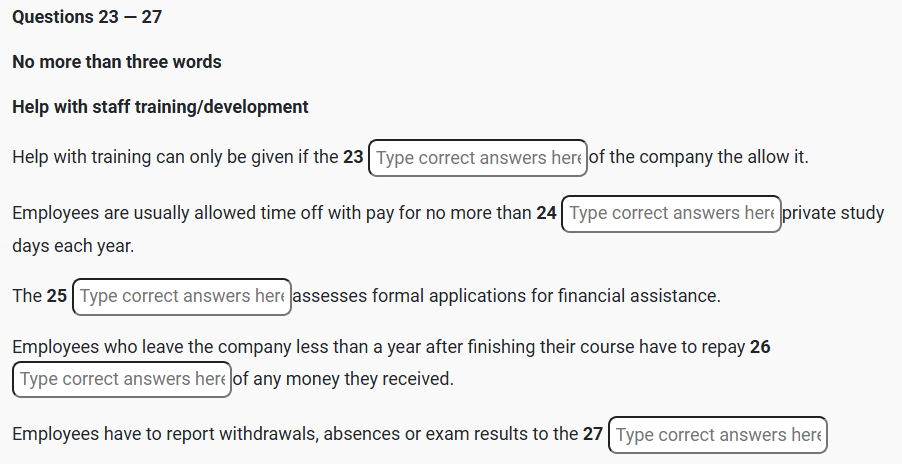
b) the company’s Q9 operational requirements permit such assistance to be given.

Some or all of the following forms of assistance may be given at the discretion of the Head of Department:

Time off

•where it is not possible for an employee to undertake training outside working hours, release from work for up to two days per week

•paid time off during normal working hours to sit examinations or attend short courses or conferences

•paid individual study leave to be taken at agreed times, and not normally to exceed Q10 5 days per annum

Financial assistance

• towards the cost of tuition and examination fees

• a contribution towards the cost of learning materials of up to £150 or 50% of the actual cost (whichever is the lesser amount)

• any relevant travel or accommodation costs up to a maximum of £150 p.a.

Requests for assistance should be made on the relevant application form, which can be obtained from the Personnel Administrator, and once completed and signed by your Head of Department, should be forwarded for consideration by the Q11 Finance Committee.

Assistance will be given on the condition that:

a) individuals shall reimburse the Company Q12 50% of any financial assistance given under the scheme if they leave the Company within 1 year of obtaining a qualification or completing a course of study, and 25% if they leave the Company within 2 years

b) individuals shall reimburse the full cost of any financial assistance given under this scheme if they fail to complete the course of study, or fail to attend a conference for reasons that are not acceptable

c) individuals shall notify the Q13 Personnel Administrator promptly if they drop out of a course of study, or fail to attend a conference. They should also provide information concerning the results of any examination taken.

📖Attempt Free Reading Test..


Small Batch Size, Flexible Time and Professional IELTS Teacher Best IELTS coaching classes IDP certified British Council trained and CELTA certified experienced trainer.

phone icon
8439000086
8439000087
7055710003
7055710004
IELTS Simulation 323 GMS Road, Near Ballupur Chowk, Dehradun, India
Chat on WhatsApp
email: info at ieltsband7.com

IELTS READING – LOCAL SUMMER ACTIVITIES S5GT1

IELTS SIMULATOR ONLINE IELTS READING EASY DEMO - LOCAL SUMMER ACTIVITIES S5GT1 FREE COMPUTER DELIVERED ONLINE IELTS SIMULATION Best BAND7 IELTS Dehradun IELTS online simulator IELTS BAND 7 Coaching Classes
IELTS READING LOCAL SUMMER ACTIVITIES Reading Practice Test has 10 Questions belongs to Leisure & Tourism subject..

A

Sunday 25th May

Dawn chorus experience

6 am Meet in Respryn car park.

📖Attempt Free Reading Test..


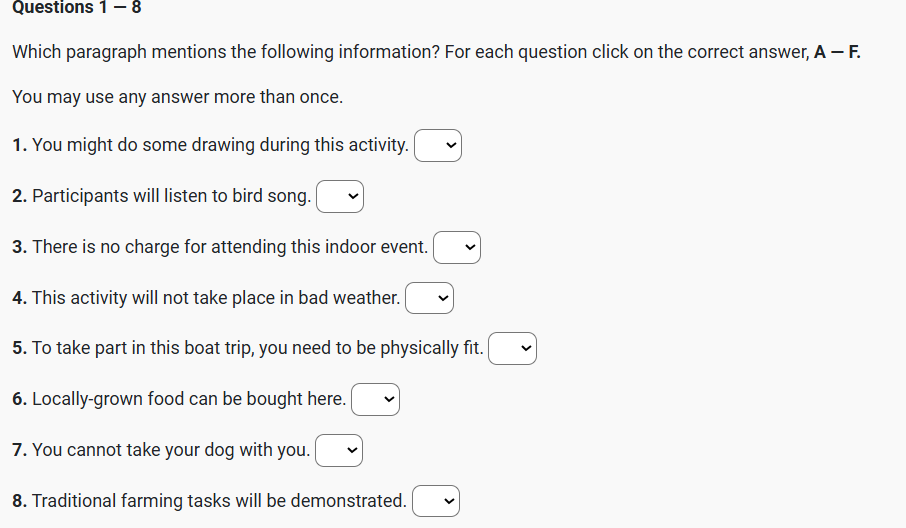
Q2 Riverside and woodland walk in Respryn Nature Reserve to hear the spring dawn chorus. With luck we might see breeding dipper, kingfisher and pied flycatcher. Bring warm, waterproof clothing in case of wet weather, drinks, and binoculars.

B

Sunday 22nd June

Smallholders’ country fair and market

Pencarrow House and Gardens, Bodmin

Q6 Garden produce and plants from the surrounding countryside. Q8 Rural skills and crafts, including brass band, dog show, dog agility, sheep herding and shearing. Games and fun for the children activities.

For more details call 01840 250586.

C

Saturday 28th June

St George’s Island

10.00 am-12.30 pm. Transport by boat leaving promptly from the Lifeboat Station, East Looe seafront.

Gentle walk and talk by an expert on the wonderful and diverse bird life that visits the island. Wear suitable footwear and clothing, bring food and drink.

Cost £7.50. Booking is essential, on 07933 765581. Q4 Trip may be cancelled in the event of strong winds or heavy rain.

D

Monday 30th June

Exploring local ponds and rivers

2-4 pm. Meet at car park opposite Kit Farm.

Come and find out about all kinds of creatures living in water. Q1 Children under 16 to be accompanied at all times by an adult. Q7 Please bring sun cream, sun hat, sketch pad and pencils – but no pets. Nothing to pay, but booking is advisable (01872 468323).

E

Thursday 3rd July

Fowey estuary

10 am. Meet at White cross car park.

A unique opportunity to explore the beautiful estuary of the Fowey. Light and stable Canadian canoes have plenty of space. Full instructions and equipment provided. No previous experience necessary, though Q5 you must be used to strenuous exercise! Approx 4 hours.

Adults £25; Children £20. Book on 01208 265220.

F

Saturday 12th July

Craft fair and coffee morning

9.30am-12.30pm. Millbrook Village Hall

Variety of stalls selling wooden toys and puzzles, jewellery, hand-painted silk scarves, textiles, silks, ceramics and soaps. All made by hand in the local area.

Q3 Free entry. Disabled access.

More details at www.roymarg.com

Closure of leisure facilities

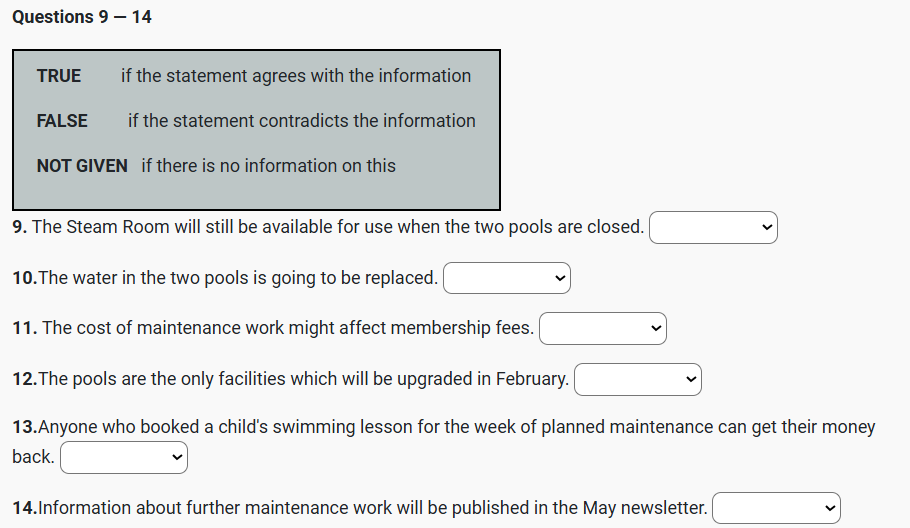
I am writing to inform you about planned maintenance work.

Both the Kids Pool and the Toddlers Pool will be closed from Monday 2nd February, for approximately one week. The 25-metre Pool will remain open during this period, as will the Gymnasium and Squash Courts. However, due to being in the area which has to be cordoned off for safety reasons, Q9 the Steam Room will be inaccessible too. The maintenance work is as follows:

• Clean 2 filters and replace 7 tonnes of filter sand;

Q10 Completely empty the Kids Pool and the Toddlers Pool and refill with fresh water;

• Replace broken tiles where necessary.

Q11 The cost of maintenance work might affect membership fees. NOT GIVEN.

Our objective is to re-open these facilities on Monday 9th February at 7.00am. However, members are advised to telephone or check our website to confirm that the work has been completed on schedule.

This work will cost the club in the region of £7,000 and will significantly Q12 improve the water quality.We will also take the opportunity to make some improvements to both male and female changing rooms. However, as this does not involve structural work, and can be done in stages, it will not be necessary to close these.

Q13 Any scheduled swimming lessons which have to be cancelled during the closure period can be either reimbursed or re-arranged. Please inform staff at Reception of your preference, and they will make the necessary arrangements.

We plan to carry out the same maintenance process with the 25-metre pool in June. Q14 Further details about arrangements for this will appear in our Members’ Newsletter in May.

This work is essential, and we will endeavour to keep the disruption to a minimum. Meanwhile please accept our apologies for any inconvenience.

📖Attempt Free Reading Test..


Learn From Experienced Teacher Best IELTS Coaching Dehradun Best IELTS in Dehradun Uttarakhand GMS Road BEST coaching in Dehradun Apply for Class Courses Today Good Results.

phone icon
8439000086
8439000087
7055710003
7055710004
IELTS Simulation 323 GMS Road, Near Ballupur Chowk, Dehradun, India
Chat on WhatsApp
email: info at ieltsband7.com

IELTS READING – Mass appeal of the manta rays S4GT5

IELTS SIMULATOR ONLINE IELTS READING EASY DEMO - Mass appeal of the manta rays S4GT5 FREE COMPUTER DELIVERED ONLINE IELTS SIMULATION
IELTS READING Mass appeal of the manta rays Reading Practice Test has 10 Questions.. 

A I am underwater, face to face with a large flat fish which I recognise immediately as being a manta ray. For an instant I look straight into its gaping mouth and see the row of small, flattened teeth in its lower jaw. Close on its tail comes another manta ray, and another and another. The manta rays are unaffected by my being there, cruising past in a leisurely fashion without seeming to expend any great effort.

📖Attempt Free Reading Test..

B From above, the manta rays are great black silhouettes that fishermen called ‘devil fish’, because of the curious horn-like fins hanging down near their mouths. But looking into their eyes you get a sense of their peaceful nature. Unlike stingrays, mantas don’t have venomous spines in their tails, and unlike many fish species they seem to enjoy human company. Once, over-enthusiastically, Q2 I swim towards a manta. I am just a few inches away when it senses me. To my surprise, the whole fish twitches in alarm and shoots off, perhaps fearing that I will touch it. I feel ashamed to have given it a fright.

C Q3 I have come to Hanifaru, a small lagoon next to an uninhabited island in the Maldives, especially to see manta rays. These great harmless creatures congregate here during the south-west monsoons between May and November and, if the tides and winds are right, enter a shallow cul-de-sac in the reef to hunt for plankton, their main source of nutrition. On certain days the bay can attract more than 100 mantas. I have seen many manta rays on dives around the world, though not in these numbers.

D Guy Stevens is my guide, a British marine biologist who has been studying the mantas for the past five years. Q1 Based at the nearby Four Seasons resort, Q4 he has identified more than 2,000 individual manta rays, photographing and cataloguing them according to their distinctive skin patterns. Each day we make the 40-minute boat journey from the resort to Hanifaru. Q5 Feeding events, as Guy calls them, are never guaranteed, but, during the season, hotel guests can sign up for ‘manta alerts’. If Guy and his research assistants spot significant manta activity, the guests will be brought by fast speedboat to the lagoon to snorkel. Q6 When feeding, the mantas of Hanifaru tend to stay near the surface, making them accessible to snorkellers just as much as divers. They seem not to mind the human competition in this quite small space, and indeed they are often joined by other rays and even giant whale sharks, which feed on the same Q10 plankton.

E Word among the diving community about the possibility of finding a mass of manta rays at Hanifaru has slowly been spreading over the past year. Outside the shallow lagoon I can see five large safari boats – live-aboard cruisers that take divers around the best underwater sites in the Maldives. Q7 It is something that Guy has been monitoring closely. ‘Word is out that Hanifaru is a top manta spot,’ he explains, ‘and although the government has declared the bay a “protected area”, we still don’t have any regulations in force to limit the number of people in the water at any one time.’

F During my stay, the resort received a visit from the then-president of the Maldives, Mohamed Nasheed. Since coming to power in 2008, he had made his interest in the marine environment and concerns about climate change well known. In 2009 he held an underwater cabinet meeting, urging other world leaders to act decisively to combat climate change. The protection of wildlife areas such as Hanifaru was clearly one of his objectives, and I asked him why he took such an interest. ‘Maldivians have lived with the reefs and their fish life since long before there were tourists,’ he said. ‘And while tourist dollars are good for our country, the sea and its produce are even more vital to my people. I have to balance what tourists want to see with preserving the marine environment – and in some cases, like Hanifaru, those objectives coincide.’

Q8 Mohamed Nasheed succeeded in persuading certain other countries to take steps to protect the environment. NOT GIVEN. 

G On several dives I am lucky enough to get close to the mantas, sometimes at underwater ‘cleaning stations’. Here, the mantas come in small numbers, or individually, to pause above a coral outcrop and wait while small fish pick at their skin, removing Q11 parasites. Adapted for fast swimming with their flattened bodies, they can accelerate rapidly with a twitch of their Q12 wings. They gaze at human swimmers with a kind of knowing calm, something people often remark on when they try to capture the emotion they experience after seeing them. The manta rays have the biggest Q13 brain of any fish,’ Guy explains, ‘and some manta researchers are convinced that mantas can recognise individual people underwater.’

H I return to the lagoon over the course of several days and learn more from Guy about his hopes for the future. Q9 ‘People can visit this place, but I want to be sure that they don’t harass the mantas by touching them or crowding them out while they’re feeding. We’re working to get a full-time ranger station and some kind of permit system to limit the number of boats that can enter the lagoon each day.’

📖Attempt Free Reading Test..


Learn From Experienced Teacher Best IELTS Coaching Dehradun Best IELTS in Dehradun Uttarakhand GMS Road BEST coaching in Dehradun Apply for Class Courses Today Good Results.

phone icon
8439000086
8439000087
7055710003
7055710004
IELTS Simulation 323 GMS Road, Near Ballupur Chowk, Dehradun, India
Chat on WhatsApp
email: info at ieltsband7.com