Unlock the Benefits of IELTS Listening

Access our library of Listening practice audio in MP3 format for on-the-go listening, and PDFs for offline study sessions. Download MP3 and download PDF file for offline practice. 

IELTS LISTENING – COURSE SELECTION & DISSERTATION PLANNING S61T3

 IELTS listening COURSE SELECTION & DISSERTATION PLANNING listening practice test has 10 questions belongs to the Education & Academic Planning  subject..

Tutor: Hi Marco, come in.

Marco: Thanks. I’ve got a bit stuck trying to select courses for next semester. Could you help me, please?
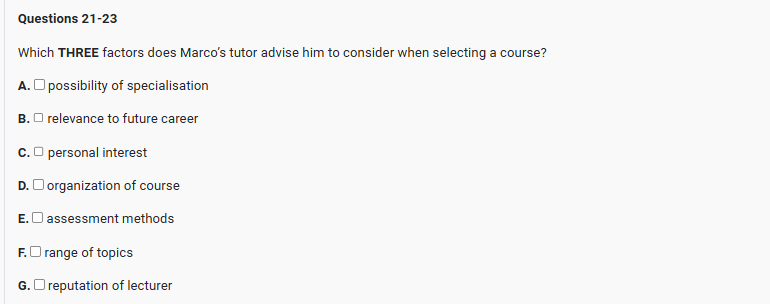
Tutor: Of course. Sit down. First of all, most people just go for the areas of business that they’re interested in, but – even if something doesn’t look very stimulating – it’s important that you can use it Q21 once you get a job. It’s not much good choosing areas that aren’t going to be helpful later on.

Marco: Right. I want to go into management, so I’ll need to think about that. And should I start specialising in a particular area yet?

Tutor: I don’t think that’s wise, at this stage. It’s better to aim for a wide variety of subjects, especially as management covers so many possibilities. You shouldn’t be limiting your choices for later on.

Marco: Yes I see.

Tutor: You should also look at how the course is made up – will you have regular seminars and tutorials, for example, as well as lectures?

Marco: OK. Some of the lecturers are quite big names in their fields, aren’t they? Should I aim to go to their courses?

Tutor: Well remember that the lecturers who aren’t well-known may still be very good teachers! I’d say we have a consistently high standard of teaching in this department, so you don’t need to worry about it.

Marco: Good. Well, that’s a great help.

Tutor: Now last time we met, you mentioned doing Team Management, didn’t you?

Marco: That’s right. I’m still quite keen on the idea.

Tutor: The trouble is that because of changes in the content of various courses, Q24 Team Management overlaps with the Introduction to Management course you took in your first year. So what you’d learn from it would be too little for the amount of time you’d have to spend on it.

Marco: I’ll drop that idea, then. Have you had a chance to look at the outline I wrote for my finance dissertation? I left it in your pigeonhole last week.

Tutor: Yes. Why exactly do you want to write a dissertation, instead of taking the finance modules? It’ll be pretty demanding.

Marco: Well, I’m quite prepared to do the extra work, because I’m keen to Q25 investigate something in depth, instead of just skating across the surface. I realise that a broader knowledge base may be more useful to my career, but I’m really keen to do this.

Tutor: Right. Well, I had a quick look through your outline, and the first thing that struck me was that you’ll have to be careful how you set about it, as the way you’ve organised Q26 it seems unnecessarily complex. The data that you want to collect and analyse is Q27 potentially valuable, but you’ll need to narrow down the subject matter to make the whole thing manageable.

Marco: OK, I’ll have another look at it. I was talking to Professor Briggs about it yesterday, and I got some more ideas then. For part of the dissertation I was thinking of trying to persuade finance managers from three or four companies to let me ask them about their company finances. If not I think I’ll have to change to another topic.

Tutor: Well go ahead then. I could give you some names.

Marco: Thanks.

Tutor: Now let’s talk about practicalities. Your dissertation must be finalised by the end of May, so you should aim to finish the first draft by the end of Q28 March. Is that feasible?

Marco: Yes, it shouldn’t be a problem. I’ll need to register for the dissertation, won’t I? Is that with the Registrar’s Department?

Tutor: No, it’s internal to this department, so you just need to let the Q29 secretary know. Do that as soon as you’re sure you’re going to write the dissertation.

Marco: OK.

Tutor: Then to analyse your statistics, you’re going to need some suitable software. If I were you, I’d drop into the Q30 computer office and ask them for a copy.

Marco: Right. So if I revise my outline, can I…


Boost Your Score: Practice IELTS Online with IELTS Simulator.

phone icon
8439000086
8439000087
7055710003
7055710004
IELTS Simulation 323 GMS Road, Near Ballupur Chowk, Dehradun, India

Chat on WhatsApp
email: info at ieltsband7.com

IELTS LISTENING – THEATRE ROYAL PLYMOUTH FESTIVAL S61T2

IELTS listening THEATRE ROYAL PLYMOUTH FESTIVAL listening practice test has 10 questions belongs to the Leisure & Entertainment subject..

Good evening everyone I’m glad you could all make this planning meeting for what promises to be the biggest and most colourful free rock festival ever held in the southeast! So whether you’re a performer, a craft exhibitor, or an artist, we all extend a big welcome to you.

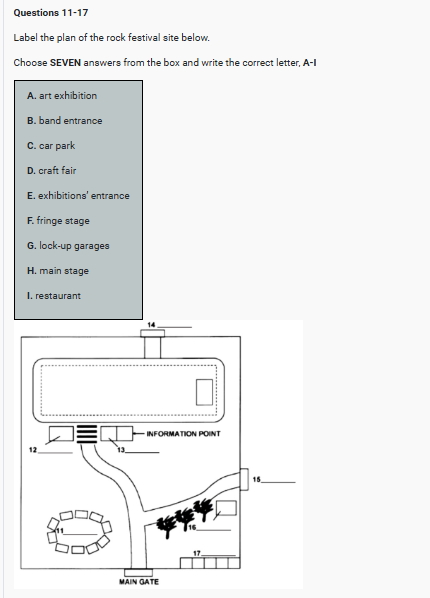
Could we turn first to the plan so I can familiarise you with the layout of the site – which as you know is an old football stadium – we’re really lucky to have so much space this year. You can see the main gate at the bottom of the plan – have you found it? – that’s where most visitors will enter. It’s also the entrance for those taking part in the Q11 craft fair: we’ve set the stalls just inside the gate on the left, in a circle.

If you walk straight ahead from the gate along the path without turning right, you’ll come to some steps up to the football stadium. On the left of the steps is the Q12 Fringe Stage. This is for alternative artists – they include folk singers, poets, and other acts which are more suited to a smaller stage – and they should also enter by the main gate. On the opposite side of the steps is a Q13 restaurant, and adjoining that is the main festival information point. Here you can get extra programmes and up-to-the-minute information about events, and you can discuss any last-minute problems – although we hope everything will be running smoothly when the festival opens.

Right, coming back to the plan, you go up the stairs to the stadium. The Q14 entrance for the rock bands is on the far side, and on your right is the main stage, which will have powerful illumination and amplification throughout the weekend. There will probably be TV vehicles adjacent – that’s in this area only – for recording purposes.

If you look at the outside of the plan, you can see a third gate for Q15 exhibitors opening onto a side path. A little way down the path, before you get to the trees, is the building where the Q16 Art Exhibition’s being housed. Then finally there’s just one more building marked on your plan – quite near the main gate. It’s divided into Q17 lock-up garages. So I hope you now feel quite familiar with the main festival area.

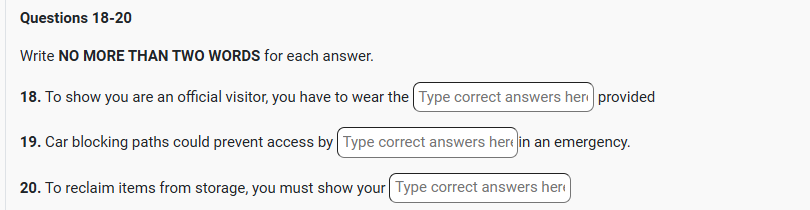
We also hope that you’ll have received your welcome pack. In it, you should find two parking tickets for yourself and anyone assisting you, an Q18 arm band to indicate that you are an official visitor, one of our brilliant yellow badges with the new festival logo, a festival programme, and several sheets of information that we’d ask you to study carefully before the event.

Please could you note that all setting up of stalls, displays and so on should be completed by 9.30 a.m. and that unfortunately, we won’t be able to allow any vehicles to enter the festival area after that time. Yes, it’s a big site – but even a few vehicles parked in the wrong place can block the paths. With crowds of people – and we are expecting several thousand – this can merely be a nuisance; but if there’s an emergency and access for Q19 an ambulance is blocked, the situation will become not just annoying but also dangerous. And don’t forget it could be your mother or your child who needs help.

Several exhibitors and craftspeople have asked us if any provision can be made for overnight storage of tables, chairs, and display items rather than having to take them home and bring them again. We’re pleased to say that a limited amount of space has been made available in the building near the main gate. You’ll be issued with a Q20 yellow ticket to reclaim your property – similar to the red parking tickets, so do check you bring the right one! – but please understand that this is entirely at your own risk as we can take no responsibility for items lost or damaged.

I think that’s all I have to say at this point but thank you all for your attention!


Boost Your Score: Practice IELTS Online with IELTS Simulator.

phone icon
8439000086
8439000087
7055710003
7055710004
IELTS Simulation 323 GMS Road, Near Ballupur Chowk, Dehradun, India
Chat on WhatsApp
email: info at ieltsband7.com

IELTS LISTENING – THEATRE ROYAL PLYMOUTH S61T1

 IELTS listening THEATRE ROYAL PLYMOUTH listening practice test has 10 questions belongs to the Leisure & Entertainment subject.

Woman: Hello, Theatre Royal Plymouth.

Man: Oh hello – I’d like to make a booking, please.

Woman: Yes. What is it you want to see?

Man: The Impostor.

Woman: Right. And which day did you want to come?

Man: Friday the 25th.

Woman: Just a moment and I’ll check availability on the computer. Oh, sorry, we’re fully booked for that performance.

Man: Oh dear. What about the following day then?

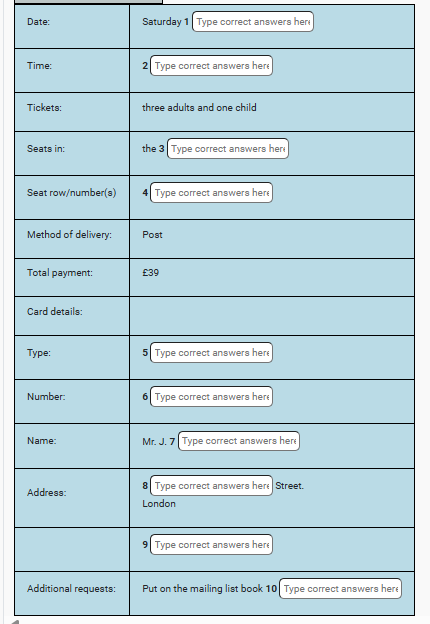
Woman: The Q1 26th? Yes, that’s OK. We’ve got two performances on that day, one at 3.30 and one at Q2 7.00. Which would you prefer?

Man: Oh, the later one, please.

Woman: How many people?

Man: Well, there are four of us.

Woman: Are there any concessions, any children?

Man: I’m not sure. My daughters are 15 and 12. Do they get concessions?

Woman: Only the 12-year-old I’m afraid. So that’s one child and three adults. Any idea where you’d like to sit? Stalls or circle?

Man: Er…

Woman: Tickets for the stalls are a bit more expensive – £12 for adults and £8.50 for children. The circle costs £10.50 and £6.50.

Man: Do you get a good view from Q3 the circle?

Woman: Oh, yes. And in fact we’ve got some seats left at the front if you’d like those.

Man: Right, we’ll go for those then.

Woman: Right. That’s seats Q4 A21 to 24 then. They’re very good seats.

Man: That sounds fine.

Woman: So let’s see. That comes to? 38 altogether for the tickets. How do you want to collect them? Shall I put them in the post? They’d be sent today by first class mail, and there’d be an additional charge of £1 to cover postage and administration. Or do you want to get them from the box office yourself?

Man: Oh yes. Could you send them please?

Woman: No problem. That’ll be £39 altogether. Could I just take your card details? What kind of card is it? Visa? Switch?

Man: Q5 Mastercard.

Woman: OK. And the number?

Man: It’s Q6 3290 5876 4401 2899.

Woman: 28 double 9. OK. And the name on the card please?

Man: It’s Mr. J Q7 Whitton – W-H-I-double-T-O-N.

Woman: N for ‘never’ or M for ‘mother’?

Man: N for ‘never’.

Woman: Thank you. And now, I’ve nearly finished, but I just need your address and postcode.

Man: Yes. It’s Q8 42 South Street.

Woman: OK. Is that Plymouth?

Man: London.

Woman: And the postcode?

Man: It’s Q9 SW2 5GE.

Woman: That’s fine then. The tickets should be with you tomorrow. Is there anything else I can do for you?

Man: Yes. I was wondering if I could get regular information about what’s on.

Woman: Certainly. I can just add your name to our mailing list. Would that be OK?

Man: That would be very good. Yes please. Oh, and there is something else, sorry. One of our group is hard of hearing and I’ve heard that you can supply special Q10 headphones.

Woman: That’s right. As long as you tell us in advance, we can always do that. I’ll book those for you now, and you can just collect them from the box office before the show.

Man: Thanks very much for your help.

Woman: No problem. Thank you for calling.

Man: Thank you. Bye.


 Learn From Experienced Teacher Best IELTS Coaching Dehradun Best IELTS in Dehradun Uttarakhand GMS Road BEST coaching in Dehradun Apply for Class Courses Today Good Results.

phone icon
8439000086
8439000087
7055710003
7055710004
IELTS Simulation 323 GMS Road, Near Ballupur Chowk, Dehradun, India
Chat on WhatsApp
email: info at ieltsband7.com

IELTS LISTENING – THE SECRET GARDEN S60T3

 IELTS listening THE SECRET GARDEN listening practice test has 10 questions belongs to the Leisure & Entertainment subject.

Tutor: Hello Lorna, Ian. Glad you could make it. You’re the only two who put your names down for this literature tutorial so let’s get started, shall we? I want to run over some aspects of the novel, Q21 The Secret Garden, with you before the test next week. Be sure to take some notes and ask questions if you need to.

Ian: Hey Lorna, have you got a spare pen?

Lorna: Sure, here you are.

Tutor: Okay, so, the story follows two key characters – you should refer to them as protagonists – who go by the names of Mary Lennox and Colin Craven. The story is set shortly after the turn of Q22 the twentieth century, and the narrative tracks the development of the protagonists as they learn to overcome their own personal troubles together.

Lorna: That’s quite a common storyline, isn’t it?

Tutor: Yes, you’re right, Lorna. So, what can you tell me about the character of Mary?

Lorna: Well, in the beginning she is an angry, rude child who is orphaned after a cholera outbreak and forced to leave India and move to the United Kingdom to her uncle’s house in Yorkshire.

Tutor: That’s right – and there she meets Colin who spends his days in an isolated room, believing himself to be permanently crippled with no hope of ever gaining the ability to Q23 walk. The two strike up a friendship and gradually learn – by encouraging each other – that they can both become healthy, happy, and fulfilled in life.

Ian: Will we need to remember a lot of these details for the exam?

Tutor: Just the basic outline. Examiners don’t want to read a plot summary – they know what the book is about. Focus on narrative techniques instead, such as point of view.

Lorna: What’s that mean?

Tutor: It’s all about how we see the story. This story, for example, is written from the perspective of what is called an “omniscient narrator”. Omniscient means all-knowing. So, as readers we get to see how all the characters feel about things, what they like and don’t like, and what their Q24 motivations are in the story.

Ian: Won’t it be hard to write a technical analysis? After all, it’s a kids’ book.

Tutor: Well, it was initially pitched at adults you know, but over the years it has become seen as a more youth-orientated work. And you’re right in a sense – the simple vocabulary and absence of foreshadowing make the story very easy to follow and ideally suited for children. But that doesn’t mean there isn’t much to analyse. Look at the symbolism, for instance.

Lorna: Symbols are things, right? Material things – like objects – that stand for Q25 abstract ideas.

Tutor: Absolutely, yes. And the author uses many of them. There’s the robin redbreast, for example, which symbolises the wise and gentle nature that Mary will soon adopt – note that the robin is described as “not at all like the birds in India”. Q26 Roses are used as well – as a personal symbol for Mistress Craven – you’ll see they’re always mentioned alongside her name. And Mistress Craven’s portrait can also be interpreted as a symbol of her spirit.

Ian: Are symbols just another name for motifs?

Tutor: No, motifs are a bit different. They don’t have as direct a connection with something the way that a symbol does. Motifs are simply recurring elements of the story that support the mood.

Lorna: Are there any in this novel?

Tutor: Yes, two very important ones. The Garden of Eden is a motif. It comes up a few times in connection with the garden of the story. And then you’ve got the role that secrets play in the story. In the beginning, everything is steeped in secrecy, and slowly the characters share their secrets and in the process move from Q27 darkness to lightness, metaphorically, but also in the case of Colin, quite literally. His room in the beginning has the curtains drawn, and he appears at the end in the brightness of the garden.

Ian: Anything else we need to know about?

Tutor: Yes. Nearly all novels explore universal concepts that everyone has experienced – things like love, family, loneliness, and friendship. These are called themes. The Secret Garden has a few themes that all centre on the idea of connections. The novel explores, for example, the way that Q28 health can determine and be determined by our outlook on life. As Colin’s health improves, so too do his perceptions of his strength and possibility. The author also examines the link between our Q29 environment and our physical and emotional prosperity. The dark, cramped rooms of the manor house stifle the development of our protagonists; the garden and natural environments allow them to blossom, just as the flowers do. Finally, this book looks at connections between individuals, namely Mary and Colin. This necessity of Q30 human companionship is the novel’s most significant theme – because none of their development as individuals would have occurred without their knowing each other. Well, that about sums it up, I think.

Lorna: That’s a great help, thanks.

Ian: Yes, thanks very much.


Boost Your Score: Practice IELTS Online with IELTS Simulator.

phone icon
8439000086
8439000087
7055710003
7055710004
IELTS Simulation 323 GMS Road, Near Ballupur Chowk, Dehradun, India
Chat on WhatsApp
email: info at ieltsband7.com