Access our library of Listening practice audio in MP3 format for on-the-go listening, and PDFs for offline study sessions. Download MP3 and download PDF file for offline practice.
IELTS LISTENING Helpline Details listening practice test has 10 questions belong to the informal meeting.
Hello, everybody and welcome to this informal meeting about the University Helpline. The Helpline was set up 10 years ago by the Students Union and it aims to provide new students to the university with a service that they can use if they need information about practical areas of student life that they’re unfamiliar with.
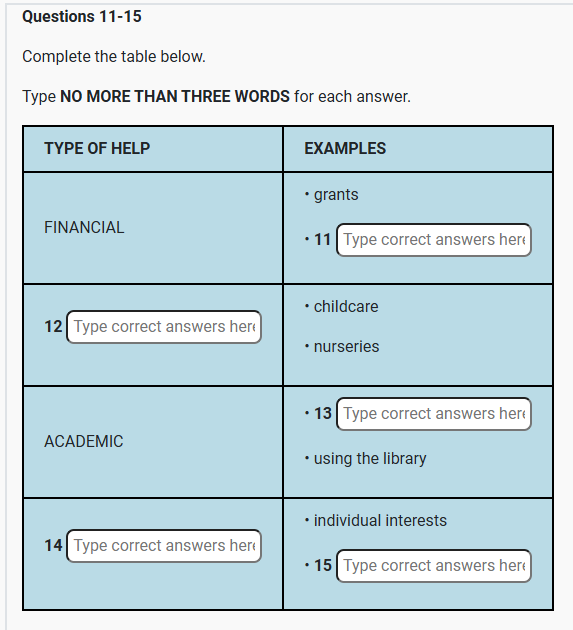
Let me give you some examples of the type of help we can offer. We can provide information on financial matters; for example, you may feel that your grant is insufficient to see you through college life or you may have some queries regarding the Q11tuition fees you’re paying if you’re an overseas student. In both cases, the Helpline would be able to go through things with you and see what the outcome might be.
Another area we can help with is what we generally term the ‘Q12domestic area‘ things such as childcare and the availability of nursery provision, for example, come under this. Then there’s ‘academic’ issues that may arise while you’re in the early stages of your course that you may not know what to do about. You may wish to know more about Q13essay deadlines, for example, or how to use the library there are all kinds of questions you will find yourself asking and not knowing where to get quick answers from. The helpline would be able to provide these. The last example I’ve given here is simply termed ‘social’ and yes, there is a lot of Q14social life here! But you may have a particular interest you wish to pursue or you may wish to participate in Q15outings or trips if you don’t know many people at the moment.
Let me give you some details so that you know where to go and who to see if you want to pay us a visit. Generally you’ll see our Helpline officer Jackie Q16Kouachi that’s K-O-U-A-C-H-I. Jackie is a full-time employee of the Student Union and she works in the Student Welfare office that’s the office that deals with all matters related to student welfare and it’s located at 13 Marshall Road.
I have some maps here for those of you who haven’t been there yet. If you wish to ring the office the number is 326 99 40. That’s Q173269940. The office is open between 9.30 and 6 o’clock on weekdays and from Q1810 to 4 on Saturdays and there’ll be somebody there usually Jackie or myself between those times. If you want to make Q19an appointment you can phone or call at the office in person. Please note that it may not be possible for anyone to see you straight away particularly if it’s a busy time lunchtime for example and you may have to go on the Q20waiting list and then come back later.
IELTS LISTENING Programme of Activities for First Day listening practice test has 10 questions belong to the Campus Facilities.
RECEPTIONIST: Sorry to keep you waiting. Well, firstly, let me give you this booklet. It tells you a bit more about the school, the courses and the social activities we offer. Now, on the first page, there’s an outline of this morning’s activities. There, you see? The program starts at 10 o’clock.
Try not to be late as it’s a very full day.
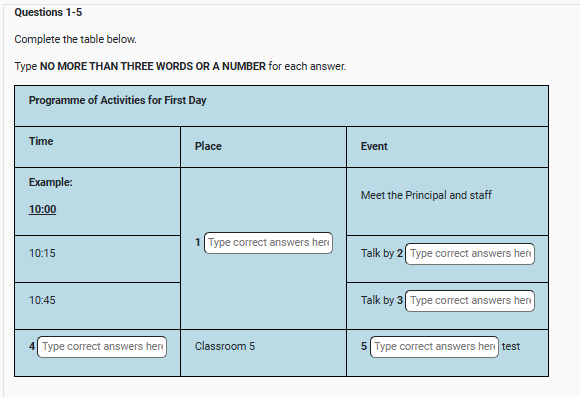
At 10 o’clock, all the new students will gather in Q1the Main Hall to meet the principal and the rest of the staff. In fact, you spend most of the morning in the Main Hall.
RECEPTIONIST: I’ll show you in a minute. Just let me quickly run through this morning’s events first and then I’ll explain how to get there.
STUDENT: Yes, okay.
RECEPTIONIST: Right. Where were we? Yes, so, the Principal’s talk will last about 15 minutes and then Q2the Director of Studies will talk to you for half an hour about the courses and the different requirements for each. After that, Q3the Student Advisor will tell you about the various services and activities we offer to students. Any questions?
STUDENT: So, all of this is in the Main Hall?
RECEPTIONIST: That’s right. And then you’ll go next door to Classroom five at Q4eleven o’clock.
STUDENT: What happens there?
RECEPTIONIST: You’ll have a test.
STUDENT: Test? I don’t like the sound of that. What sort of test?
RECEPTIONIST: Oh, it’s nothing to worry about. It’s just a Q5placement test to help us find your level of English so that we can put you in the right class. It won’t last long.
STUDENT: But how do I find the Main Hall?
RECEPTIONIST: Right; if you look on the back of the booklet I gave you, you’ll see a map of the school. Let me show you. Look: you came in through the Main Entrance, here, and now we’re here at Reception. Now, to get to the Main Hall, you walk on to the end of this corridor in front of you and then you turn left. Walk along past the Language Laboratory and then pass the Q6Library, which is next to the Language Lab, on the same side, and facing you is the Q7Main Hall, at the end of the corridor. You can’t miss it.
STUDENT: So, it’s next to the Library, in fact.
RECEPTIONIST: Yes, that’s right.
STUDENT: I should be able to find that. And do you have a Q8Computer Laboratory?
RECEPTIONIST: Yes, we do.
STUDENT: Could you tell me where that is?
RECEPTIONIST: Certainly, yes. You go down to the end of this corridor again but, this time, don’t turn left; turn right, away from the Main Hall. The Computer Lab is immediately on your right. Okay?
STUDENT: And where’s the staff room, in case I need to find the teacher at some stage?
RECEPTIONIST: TheQ9staff room is near the main entrance, on the left over there, just opposite the Reception desk. In a day or two, I’m sure you’ll find your way around very easily.
STUDENT: Oh, one last thing. Is there a Q10student common room?
RECEPTIONIST: Oh yes, I forgot to mention that. It’s this area here, very close to where we are now, to the right of the Reception desk as you come in the main entrance. There’s tea and coffee facilities there.
IELTS listening People with back painlistening practice test has 10 questions belongs to the Medical Advice.
ANNOUNCER: Today’s Health Counsel is presented by Paula Clayburg, who is the chief Counsellor at Liverpool’s famous pain clinic – The Wilton Clinic. Paula…
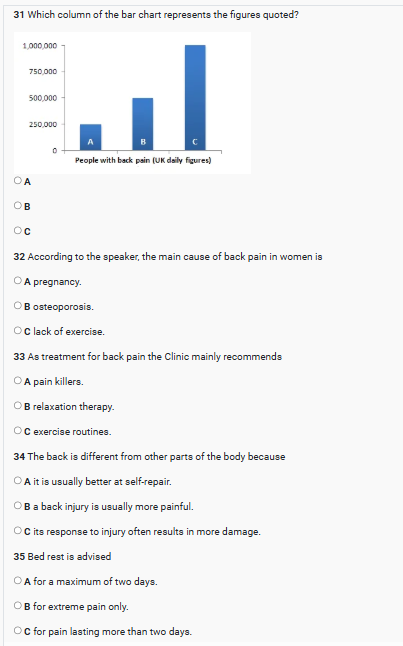
PAULA CLAYBURG: Do you know what Prince Charles, Seve Ballesteros and Elizabeth Taylor have in common? They all suffer from chronic back pain. In fact, bad backs are one of the most common health problems today, affecting people in all walks of life. The most recent available figures show that about a Q31quarter of a million people are incapacitated with back pain every day.
And many sufferers don’t know the cause or the solution to their problem. The majority of our patients at the clinic tend to be women. They are especially vulnerable because of pregnancy but also because of Q32osteoporosis, which I personally believe to be the major cause of problems for women. I have many women patients who say they have completely given up exercise because the pain makes them so miserable. But of course, that starts up a vicious circle. Bed rest, giving up exercise and pain killers are traditional responses to back pain but, although there are many excellent drugs on the market, at our clinic we are beginning to realise the unique benefits of Q33relaxation therapy. Other specialists in the field make a strong case for certain types of exercise, but in our experience, they are easily mishandled and can lead to more harm than good.
Now, let’s look at some of the reasons why back pain is developing into such a unique menace. In general, the body is pretty good at self-repair. A strain or a blow to a limb, though painful at the time, generally resolves itself. But the body’s Q34response to back injury can be very counterproductive. When pain strikes, we attempt to keep the back as immobile as possible, which makes the muscles tense up. Research shows that they often go into spasm, which causes further twisting of the spine. A vicious circle is underway. The second mistake we often make when stricken with extreme back pain is to go to bed and stay there. Although at the clinic we recognise that a short rest in bed can be helpful… Q35up to two days… any longer makes our back muscles become weaker and unable to hold up our spine. The pain, therefore, becomes worse.
Another problem is being overweight. Anyone a stone or more overweight who already has back pain is not doing himself any favours: though it won’t actually set it off in the first place, the weight will increase the strain and Q36make things worse. The British diet could be partially to blame for the increase in back pain: over the last ten years, the average weight of men has risen by 11 lbs and of women by 9 lbs. So much for the causes and aggravations of pain. But what can we do to help?
There are many ways in which simple day-to-day care can make all the difference. The first point to watch of course is ‘weight’. If you are overweight, a diet will make all the difference. Also, studies have shown that just one hour sitting in a slouched position can strain ligaments in the back which can take months to heal. At the clinic, we have come to the conclusion that the major cause of the problem is not with the design of chairs, as some have suggested, but in the way we sit in them. It can be useful to get special orthopaedic chairs, but remember the most important improvement should be in our posture.
Another enemy of your back is, of course, your beds. If your bed doesn’t give enough support, back muscles and ligaments work all night trying to correct spinal alignment, so you wake up with a tired aching back. Try out an Q37orthopaedic mattress or a spring slatted bed. Research shows that both can be beneficial for certain types of back pain.
Another hazard for your back are the shock waves which travel up your spine when you walk, known as heel strike. A real find for our patients has been the Q38shock-absorbing shoe insert. A cheap but very effective solution. And you might be better off Q39avoiding shoes with heels higher than 1 and 1/2 inches. Though absolutely flat shoes can be a solution for some, others find their posture suffers. Finally a word about the state-of-the-art relief – the TENS machine -a small battery-powered gadget which delivers subliminal electrical pulses to the skin. Our experience indicates that your money is Q40better spent on the more old-fashioned remedies.
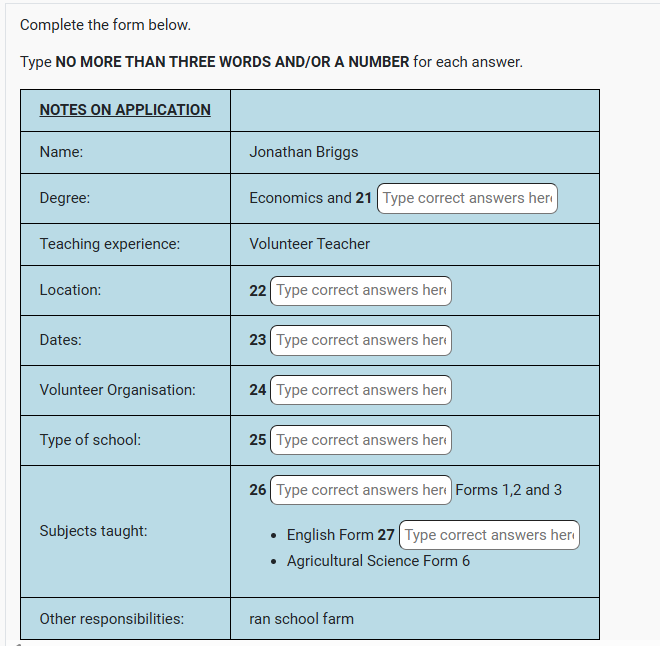
TUTOR: Right. Well, Jonathan, as we explained in your letter, in this part of the interview we like to talk through your application form… your experience to date, etc. …and then in the second part you go for a group interview.
JB: Group interview… yes, I understand…
TUTOR: So… your first degree was in Economics?
JB: Yes, but I also did Q21Politics as a major strand.
TUTOR: And you graduated in 1989. And I see you have been doing some teaching…
JB: Yes. I worked as a volunteer teacher in Q22West Africa. I was there for almost three years in total from Q231990 to… umm… 1992.
TUTOR: How interesting. What organisation was that with?
JB: It’s not one of the major ones. It’s called Q24Teach South.
TUTOR: Oh, right. Yes, I have heard of it. It operates in several African countries, doesn’t it? And what kind of school was it?
JB: A rural co-operative.
TUTOR: Oh, a Q25rural co-operative, how interesting… and what did you teach?
JB: A variety of things in different years… ummm… I did… with Forms 1 to 3 mainly Q26Geography and some English with Form Q275. Then in my final year, I took on some Agricultural Science with the top year… that’s Form 6.
TUTOR: Right. Quite a variety then…
JB: I also ran the school farm.
TUTOR: How interesting!
TUTOR: …And how did you find the whole experience?
JB: I’ll be honest with you. At the end of the first year I really wanted to leave and come home.
TUTOR: Why was that?
JB: Well… I was Q28very homesick at first and missed my family…
TUTOR: Umm… I can quite understand that.
JB: …and I also found it frustrating to have so few teaching resources, but I did decide to stay and in the end I extended my tour to a third year.
TUTOR: Right. Things must have looked up then?
JB: Yes. We set up a very successful project breeding cattle to sell locally.
TUTOR: Really?
JB: And then after a lot of hard work we finally got funds for new farm buildings.
TUTOR: And you wanted to see things through?
JB: Uh-huh.
TUTOR: And is that why you want to train to teach Geography?
JB: Yes. I’ve had a couple of jobs since then but I now realise I like teaching best. And I chose Geography because… because it is my Q29favourite subject… and also because I think it has so Q30many useful applications.
TUTOR: Well… you certainly have had some interesting work experience. I’ll ask you now to go on to the next stage of…
Boost Your Score: Practice IELTS Online with IELTS Simulator Prepare for IELTS Effectively Using IELTS Simulator Ace the IELTS: Try Realistic Practice on IELTS Simulator IELTS Simulator: Online Practice to Improve Your IELTS Score Rocky Bay field trip listening practice test has 10 questions belongs to the Leisure & Entertainment subject. Prepare for IELTS IELTS Test International Experienced Teacher Best Training By CELTA Trainer. Best Results Easily Get Required Score IELTS Exam Dates Available, Small Batch Size with Flexible Time, Professional. Easily Get Required Score I am interested in IELTS Pass with Confidence, Dehradun Small Batch Size with Flexible Time, professional faculty. Learn From Experienced Teacher Best IELTS Coaching Dehradun Best IELTS in Dehradun Uttarakhand GMS Road BEST coaching in Dehradun Apply for Class Courses Today Good Results. Small Batch Size, Flexible Time and Professional IELTS Teacher Best IELTS coaching classes IDP certified British Council trained and CELTA certified experienced trainer. Easily Get Required Score Tel:8439000086 Tel:8439000087 Tel:7055710003 Tel:7055710004 Tel:7055710009






 Another problem is being overweight. Anyone a stone or more overweight who already has back pain is not doing himself any favours: though it won’t actually set it off in the first place, the weight will increase the strain and