Unlock the Benefits of IELTS Listening

Access our library of Listening practice audio in MP3 format for on-the-go listening, and PDFs for offline study sessions. Download MP3 and download PDF file for offline practice. 

IELTS LISTENING – Expedition Across Attora Mountains S42T2

IELTS SIMULATOR ONLINE ACADEMIC LISTENING - Expedition Across Attora Mountains S42AT2 FREE COMPUTER DELIVERED ONLINE IELTS SIMULATION
IELTS listening Expedition Across Attora Mountains listening practice test has 10 questions belong to the Travel & Adventure. 

INTERVIEWER: A dream came true in 1995, when over 96 days of the spring and summer, an expedition of four men undertook what they believe to have been the first and only complete end-to-end crossing of Morocco’s Attora mountains. I talked to Charles Owen, the leader of the expedition group, about the trip.

🎧Attempt Free Listening Test…

⬇️  Download Free PDF

Charles, how much planning went on beforehand?

CHARLES: Well, as you know, I run these walking trips across the mountains for tourists, and over the years, I’ve collected maps and other data to prepare what I call a Q11route book‘ for this trip and this book basically shows the route across the mountains that we took.

INTERVIEWER: You actually broke records while you were out there, didn’t you?

CHARLES: Mmm. Yes, it was Q12 900 miles in total and we managed to climb 32 peaks that were over 3000 metres high, including Toubkal, which is, of course, the highest in Q13 North Africa. We weren’t actually out to make a name for ourselves – it just happened really.

INTERVIEWER: What was the. weather like?

CHARLES: Q14 It got us right from day one and we were pretty taken aback really to find that it rained on quite a number of days, and so we were forced to start re-planning our route almost from the outset. One of the obvious problems is the heavy snow which blocks the mountain passes, so you have to make considerable detours. When we were on the way to Imilchil, for example, the snow forced us into a northern bypass which was new to us, Q15 but anyway, either way, we would have been rewarded because we fell upon amazing, high meadows, huge gorgeous, and wonderful snow-capped mountains. The scenery was as fine as any we saw on the trip and that was how it was every time – having to take another pass was never a disappointment.
INTERVIEWER: It was in many ways a special trip. wasn’t it?

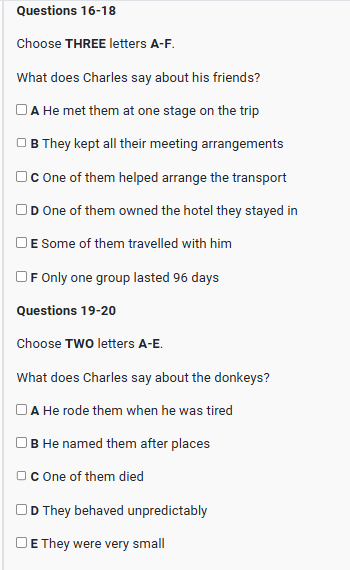
CHARLES: Q16 Yes, yes . . . we’d arranged to meet up with friends at various points on the journey. I mean this was actually one of the purposes of the trip . . . and we managed to keep all these dates, which is amazing really considering the detours we made. Q17 An old friend acted as a sort of transport organiser for everyone and the Hotel Ali in Marrakech was a good social base – I’d really recommend it, although I can’t remember who runs it. Q18 Anyway, groups of friends actually joined us for three-week stints, and others just linked up with us. Some, whom we hadn’t met before the trip at all, tagged on for short bursts – people from the area – who just came along for the ride. But outside the major visitor areas like Toubkal we only met one other group of travellers like ourselves in the whole 96 days.

INTERVIEWER: Were there any bad moments?

CHARLES: We took two, I must say, long-suffering donkeys with us to help transport water and tents and things. Q19 I suppose if we were to do it all again we’d probably hire donkeys along the way. Taza and Tamri, as we called them after the last places in the trip, well, Q20 they made quite a unique journey between them, and . . . but it was continuously demanding for them. On both the really high summits, they took diversions that were quite out of character and I can only assume that it must have been due to tiredness.

INTERVIEWER: Well, thank you . . . And Charles has put together a video about this journey and continues to lead groups to the Attora mountains, so if you want further information . . .

🎧Attempt Free Listening Test…

Boost Your Score: Practice IELTS Online with IELTS Simulator.

phone icon
8439000086
8439000087
7055710003
7055710004
IELTS Simulation 323 GMS Road, Near Ballupur Chowk, Dehradun, India

Chat on WhatsApp
email: info at ieltsband7.com

IELTS LISTENING – Bilingualism S45T4

IELTS listening Bilingualism listening practice test has 10 questions belongs to the Lecture & Academic Talk type. 

When we look at theories of education and learning we see a constant shifting of views, as established theories are questioned and refined or even replaced, and we can see this very clearly in the way that attitudes towards bilingualism have changed.

🎧Attempt Free Listening Test…

⬇️  Download Free PDF

Let’s start with a definition of bilingualism, and for our purposes today, we can say it’s the ability to communicate with the same degree of Q31 proficiency in at least two languages. Now, in practical terms this might seem like a good thing – something we’d all like to be able to do. However, early research done with children in the USA in fact suggested that being bilingual interfered in some way with Q32 learning and with the development of their mental processes, and so in those days bilingualism was regarded as something to be avoided, and parents were encouraged to bring their children up as monolingual – just speaking one language. But this research, which took place in the early part of the twentieth century, is now regarded as unsound for various reasons, mainly because it didn’t take into account other factors such as the children’s Q33 social and economic backgrounds.

Now, in our last lecture we were looking at some of the research that’s been done into the way children learn, into their cognitive development, and in fact we believe now that the relationship between bilingualism and cognitive development is actually a Q34 positive one – it turns out that cognitive skills such as problem solving, which don’t seem at first glance to have anything to do with how many languages you speak, are better among bilingual children than monolingual ones.

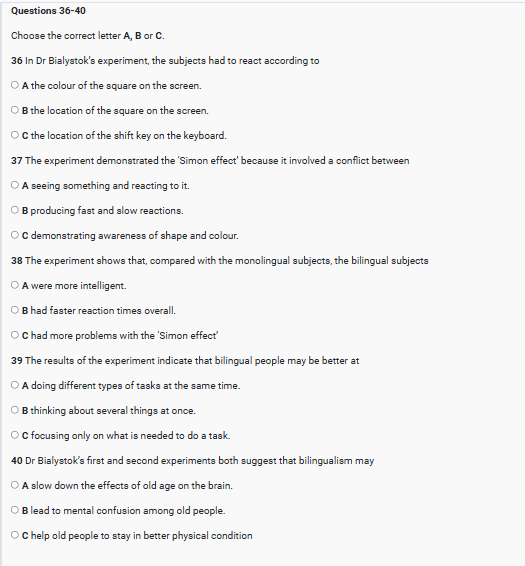
And quite recently there’s been some very interesting work done by Ellen Bialystok at York University in Canada, she’s been doing various studies on the effects of bilingualism and her findings provide some evidence that they might apply to Q35 adults as well, they’re not just restricted to children.

So how do you go about investigating something like this? Well, Dr. Bialystok used groups of monolingual and bilingual subjects, aged from 30 right up to 88 for one experiment, she used a computer program which displayed either a red or a blue square on the screen. The coloured square could come up on either the left-hand or the right- hand side of the screen. If the square was blue, the subject had to press the left ‘shift’ key on the keyboard and if the square was red they had to press the right shift key. So they didn’t have to react at all to the actual position of the Q36 square on the screen, just to the colour they saw. And she measured the subjects’ reaction times by recording how long it took them to press the shift key, and how often they got it right.

What she was particularly interested in was whether it took the subject longer to react when a square lit up on one side of the screen – say the left, and the subject had to press the shift key on the right hand side. She’d expected that it would take more processing time than if a square lit up on the left and the candidates had to press a left key.

This was because of a phenomenon known as the ‘Simon effect’, where, basically the brain gets a bit confused because of conflicting demands being made on it – in this case seeing something on the right, and Q37 having to react on the left and this causes a person’s reaction times to slow down.

The results of the experiment showed that the bilingual subjects Q38 responded more quickly than the monolingual ones. That was true both when the squares were on the ‘correct’ side of the screen, so to speak, and – even more so – when they were not. So, bilingual people were better able to deal with the Simon effect than the monolingual ones.

So, what’s the explanation for this? Well, the result of the experiment suggests that bilingual people are better at ignoring information which is irrelevant to the task in hand and just Q39 concentrating on what’s important. One suggestion given by Dr Bialystok was that it might be because someone who speaks two languages can suppress the activity of parts of the brain when it isn’t needed in particular, the part that processes whichever language isn’t being used at that particular time.

Well, she then went on to investigate that with a second experiment, but again the bilingual group performed better, and what was particularly interesting, and this is I think why the experiments have received so much publicity, is that in all cases, the performance gap between monolingual and bilinguals actually increased with age – which suggests that bilingualism protects the mind against decline, so in some way the life-long experience of managing two languages may prevent some of the negative Q40 effects of aging. So that’s a very different story from the early research.

So what are the implications of this for education…

🎧Attempt Free Listening Test…

Boost Your Score: Practice IELTS Online with IELTS Simulator.

phone icon
8439000086
8439000087
7055710003
7055710004
IELTS Simulation 323 GMS Road, Near Ballupur Chowk, Dehradun, India
Chat on WhatsApp
email: info at ieltsband7.com

IELTS LISTENING – Project On Work Placement S45T3

IELTS listening Project On Work Placement listening practice test has 10 questions belongs to the Academic discussion & tutorial. 

Dr. Green: Good afternoon, Dave, come on in and take a seat.

Dave: Hi, Dr. Green, thanks

Dr. Green: Hang on a minute, I’ll just find the first draft of your project paper and we can have a look at it together. Now, yours is the one on Work Placement, isn’t it?

Dave: Yeah, that’s right.

Dr. Green: So what made you choose that for your project?

🎧Attempt Free Listening Test…

⬇️  Download Free PDF

Dave: Well, l suppose it was because sending students off to various companies for work experience seems to be such a typical part of educational courses these days – I mean, even school kids get to do it. But I felt everyone just Q21 kind of assumes it’s a good thing and l guess I wanted to find out if that’s the case.

Dr. Green: But you don’t look at schools or colleges, right? You’ve stuck to Q22 university placement schemes.

Dave: Yeah, well, I quickly found that I had to limit my research, otherwise the area was just too big. Do you think that was OK?

Dr. Green: I think it’s very sensible, especially as the objectives might be very different. So how many schemes did you look at?

Dave: Well, I sent out about 150 questionnaires altogether – you know, 50 of each to university authorities, students, and companies, and I got responses from Q23 15 educational institutions, and.. er, 30 students in 11 individual companies.

Dr. Green: Great, that sounds like a good sample. And who did you send your company questionnaires to?

Dave: Well, the idea was to have them done by the students’ Q24 Line Managers, but sometimes they were filled in by the Human Resources manager or even the owner of the company.

Dr. Green: Right. I didn’t find a full list anywhere, so I think it’s very important to provide that, really. You can put it as an appendix at the back.

Dave: Right. I’ve got a record of all the Q25 respondents so that’ll be easy. I hope other things were OK. I mean I’ve already put such a lot of work into this project, identifying the companies and so on.

Dr. Green: Oh, I can tell I think you’ve done a good job overall.

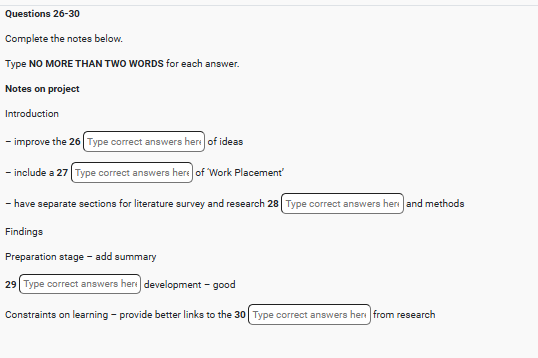
Dr. Green: I thought your questionnaires were excellent, and you’d obviously done lots of background reading, but there were a few problems with the introduction. First of all, I think you need to make some slight changes to the Q26 organisation of your information there, at present, it’s a bit confused.

Dave: OK. What did you have in mind?

Dr. Green: Well, you write quite a bit about Work Placement in general, but you never explain what you mean by the term.

Dave: So you think I should give a Q27 definition?

Dr. Green: Exactly. And the introduction is the place to do it. And then look, you start talking about what’s been written on the topic – but it’s all a bit mixed up with your own project.

Dave: So do you think it would be better to have two sections there like, a survey of the literature as the introduction and then a separate section on the Q28 aims of my research? 

Dr. Green: I do. You can include your methods for collecting data in the second section too. It would be much dearer for your reader… you know, establish the background first, then how your work relates to it, it would flow quite nicely then.

Dave: Yes, I see what you mean

Dr. Green: Anyway, moving on I like the way you’ve grouped your findings into three main topic areas

Dave: Well, it became very obvious from the questionnaires that the preparation stage was really important for the whole scheme to work. So I had to look at that first. And I found a huge variation between the different institutions, as you saw.

Dr. Green: I was wondering if you could give a summary at the end of this stage of what you consider to be the best practice you found, I think that would be very helpful…

Dave: Right, I’ll just make a note of that. What did you think of my second set of findings – on Q29 Key Skills development?  For me, this is the core of my whole project really…

Dr. Green: And you’ve handled it very well. I wouldn’t want you to make any changes – you’ve already got a nice final focus on good practice there.

Dave: Thanks.

Dr. Green: Right, now I think the last part, which deals with the reasons why students don’t learn…

Dave: What? The constraints on learning chapter? 

Dr. Green: Yes. that’s the one I think you need to refer to the Q30 evidence from your research a bit more closely here. You know, maybe you could illustrate it with quotations from the questionnaires, or even use any extracts from a student ‘diary’ if you can. And refer back to what you’ve written about good practice…

🎧Attempt Free Listening Test…

 Best Results Easily Get Required Score IELTS Exam Dates Available, Small Batch Size with Flexible Time, Professional. Easily Get Required Score I am interested in IELTS Pass with Confidence, Dehradun Small Batch Size with Flexible Time, professional faculty.

phone icon
8439000086
8439000087
7055710003
7055710004
IELTS Simulation 323 GMS Road, Near Ballupur Chowk, Dehradun, India
Chat on WhatsApp
email: info at ieltsband7.com

IELTS LISTENING – The British Library S45T2

 IELTS listening The British Library listening practice test has 10 questions belong to the Academic Monologue & Guided Tour.

Tony Walters: Good afternoon, ladies and gentlemen, and welcome to your very own tour of the British Library on this lovely afternoon. My name is Tony Walters and I’m your guide for today. Could I please see your tickets for the guided tour?

🎧Attempt Free Listening Test…

⬇️  Download Free PDF

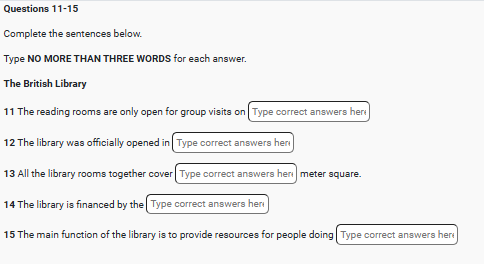
I’d also like to remind you that any tickets bought today do not include a visit to the reading rooms. I’m afraid we don’t do visits on Fridays – or any weekday during working hours, so as not to disturb the readers. But if you do want to see those rooms, the only day there are tours is on Q11 Sundays. So, I don’t want anyone to be disappointed about that today. OK? Thank you. Right. We’ll start with a brief introduction. As many of you know, this is the United Kingdom’s National Library and you can see that this is a magnificent modern building. It was first designed by Sir Colin St John Wilson in 1977, and inaugurated by Her Majesty the Queen more than twenty years later, in Q12 1998.

As you can see, the size is immense and the basements alone have 300 kilometres of shelving – and that’s enough to hold about 12 million books. The total floor space here is Q13 100,000 square metres and, as I’ll show you, the library houses a huge range of facilities and exhibition spaces, and it has a thousand staff members based here in the building – so, you can appreciate the scale of our operation.

In fact, this was the biggest publicly-funded building constructed in the United Kingdom last century. It is still funded by the Q14 government as a national institution, of course, and it houses one of the most important collections in the world. The different items come from every continent and span almost 3000 years.

The library isn’t a public library, though – you can’t just come in and join and borrow any of the books. Access to the collections is limited to those involved in carrying out Q15 research, so it’s really a huge reference library for that purpose, and anyone who wants to consult any materials that are kept here can formally apply to use the library reading rooms.

Right, well, here we are, standing at the Meeting Point on the lower ground floor just to the right of the Main Entrance. I’ve given you all a plan of the building so that we can orientate ourselves and get an idea of where we’ll be going. Now outside the Main Entrance, you’ll see the wide Piazza with the stunning sculpture of Newton.

The sculptor was Paolozzi, but it’s based on the famous image by William Blake – and it’s definitely worth a closer look. On the other side of the Piazza from the statue is the Q16 Conference Centre, which is used for all kinds of international conventions – we’ll take a quick look inside at the end of our tour.

Looking ahead of us now, you’ll see that we’re standing opposite the staircase down to the basement where you’ll find the cloakroom, and to the left of that, we have the Q17 information desk where you can find out about any current exhibitions, the times of the tours and anything you need to know – if you don’t have a tour guide. As you can see, on this lower ground floor we also have a Q18 bookshop – that’s the area over to the left of the main entrance. You’ll be free to browse there when we get back to the ground floor.

Now,opposite the main entrance on this floor we have the open stairs leading up to the upper ground floor. And at the top of them, in the middle of the upper ground floor, you can see a kind of glass-sided tower that rises all the way up through the ceiling and up to the first floor. This is called the Q19 King’s Library – it’s really the heart of the building – it was built to house the collection that was presented to the nation in 1823 by the King. You can see it from every floor above ground. When we go up there, you’ll find the library’s Treasures Gallery on the left. Can you find it on your plan? That’s the exciting one, so we’ll be visiting that first, but we’ll also take a look at the Q20 stamp display situated behind it, on the way to the cafe – a lot of people miss that. The Cafeteria runs along the back of the floor and, in the right-hand corner, you’ll find the lifts and toilets… ha, always good to locate them. The other main area on that floor is the Public Access Catalogue section and I’ll show you how that operates when we get up there…

🎧Attempt Free Listening Test…

Best Results Easily Get Required Score IELTS Exam Dates Available, Small Batch Size with Flexible Time, Professional. Easily Get Required Score I am interested in IELTS Pass with Confidence, Dehradun Small Batch Size with Flexible Time, professional faculty.

phone icon
8439000086
8439000087
7055710003
7055710004
IELTS Simulation 323 GMS Road, Near Ballupur Chowk, Dehradun, India
Chat on WhatsApp
email: info at ieltsband7.com