Unlock the Benefits of IELTS Listening

Access our library of Listening practice audio in MP3 format for on-the-go listening, and PDFs for offline study sessions. Download MP3 and download PDF file for offline practice. 

IELTS LISTENING – The effects of environmental change on birds S24T4

 IELTS listening The effects of environmental change on birds listening practice test has 10 questions belongs to the Environmental Science / Academic Lecture subject.

OK, so we’ve been looking at how man-made changes in our environment can affect wildlife. Now I’ll discuss a particular example. Let’s take a look at mercury. Mercury’s one of the 120 or so elements that make up all matter, and it has the symbol Hg. It’s a shiny, silvery substance. You may have seen it in old-fashioned thermometers, but it’s not used much for domestic purposes now because it’s highly toxic.

🎧Attempt Free Listening Test…
⬇️  Download Free PDF

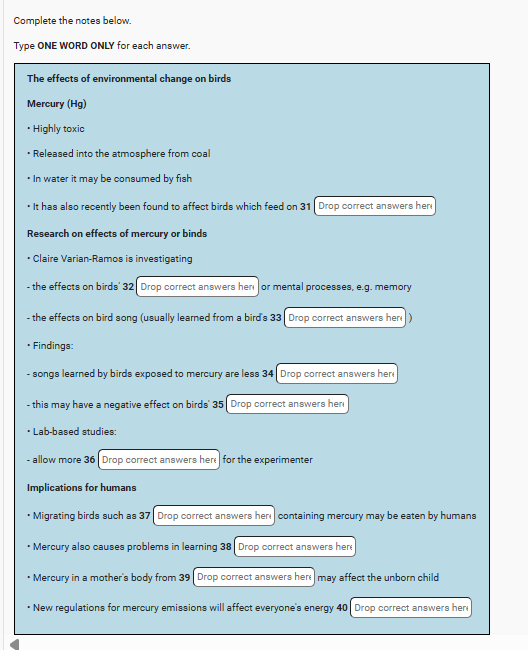
But the problem is that the amount of mercury in the environment’s increasing. The main reason for this is the power plants used to produce electricity. The main source of energy that most of them use is still coal, and when it’s burned it releases mercury into the atmosphere. Some of this gets deposited into lakes and rivers, and if it’s ingested by a fish it’s not excreted, it stays in the fish’s body and it enters the food chain. So it’s been known for some time that birds which eat fish may be affected, but Q31 what wasn’t known until quite recently is that those that eat insects can also be affected.

So a woman called Claire Varian-Ramos is doing some research on how this is affecting birds.

And rather than looking at how many birds are actually killed by mercury poisoning, she’s looking for more subtle sub-effects. And Q32 these may be to do with the behaviour of the birds, or with the effect of mercury on the way their brain works, so whether it leads to problems with memory, for example. And she’s particularly focusing on the effects of mercury on bird song. Q33 Now. the process of song learning happens at a particular stage in the birds’ development, and what you may not know is that a young bird seems to acquire this skill by listening to the songs produced by its father, rather than by any other bird.

And Varian-Ramos has already found in her research that Q34 if young male birds are exposed to mercury. if they eat food contaminated with mercury. then the songs they produce aren’t as complex as those produced by other birds. So quite low-level exposure to mercury is likely to have an impact on male birds in a natural situation, because it can mean that they’re less attractive to female birds, and so Q35 it can affect their chances of reproduction.

Now the way she’s carrying out this research is worth thinking about. She’s using a mixture of studies using birds kept in laboratories, and studies carried out outdoors in the wild. Q36 The lab-based studies have the advantage that you don’t get all the variables you would in a natural setting. so the experimenter has a much higher level of control, and that means they can be more confident about their results in some ways. And of course they don’t have to worry about going out and finding the birds in order to observe them.

So what are the implications here for humans? Well, Q37 because many birds are migratory, they may be transporting mercury far from contaminated sites. For example, it’s been found that ducks who’d been feeding at a contaminated site were later shot by hunters over a thousand kilometres away, and presumably eaten. But these birds likely had mercury levels high enough to warrant concern for human consumption.

In addition, going back to song learning by birds, we saw that this may be affected by mercury contamination. Well, Q38 we also know that in humans, mercury causes developmental delays in the acquisition of language, and in fact, this process is very similar in the brain regions it involves and even the genes that are involved. But mercury contamination has other important implications for humans as well. Q39 It’s now known that an unborn child can be affected if the food eaten by its mother contains high levels of mercury, and these effects can be quite substantial.

In the end, it comes down to whether more value is placed on human economic well-being or environmental well-being. Q40 It’s true there are new regulations for mercury emissions from power plants, but these will need billions of dollars to implement, and increase costs for everyone. Some argue that’s too much to pay to protect wildlife. But as we’ve seen, the issues go beyond that, and I think it’s an issue we need to consider very carefully.

🎧Attempt Free Listening Test…

Boost Your Score: Practice IELTS Online with IELTS Simulator.

phone icon
8439000086
8439000087
7055710003
7055710004
IELTS Simulation 323 GMS Road, Near Ballupur Chowk, Dehradun, India

Chat on WhatsApp
email: info at ieltsband7.com

IELTS LISTENING – THE HORTON CASTLE SITE S24T3

IELTS listening THE HORTON CASTLE SITE listening practice test has 10 questions belongs to the Historical / Cultural Visit subject. 

NATALIE: Dave, I’m worried about our case study. I’ve done a bit of reading, but I’m not sure what’s involved in actually writing a case study – I missed the lecture where Dr. Baker talked us through it.

DAVE: OK, well it’s quite straightforward. We’ve got our focus – that’s tourism at the Horton Castle site. And you said you’d done some reading about it.

NATALIE: Yes, I found some articles and made notes of the main points.

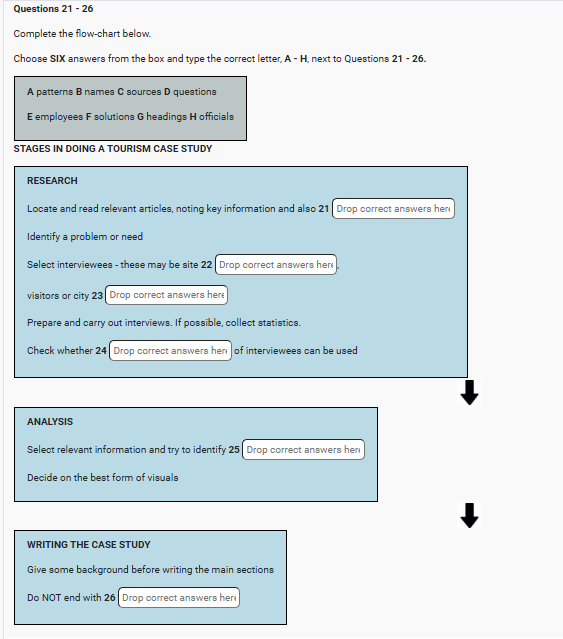
DAVE: Q21 Did you remember to keep a record of where you got the information from?

🎧Attempt Free Listening Test…

⬇️  Download Free PDF

NATALIE: Sure. I know what a pain it is when you forget that.

DAVE: OK, so we can compare what we’ve read. Then we have to decide on a particular problem or need at our site. And then think about who we’re going to interview to get more information.

NATALIE: OK. So who’d that be? Q22 The people who work there? And presumably some of the tourists too?

DAVE: Yes, both those groups. So we’ll have to go to the site to do that, I suppose. But we might also do some of our interviewed away from the site – Q23 we could even contact some people here in the city, like administrators involved in overseeing tourism.

NATALIE: OK. So we’ll need to think about our interview questions and fix times and places for the meetings. It’s all going to take a lot of time.

DAVE: Mmm. And if we can, we should ask our interviewees if they can bring along some numerical data that we can add to support our findings.

NATALIE: And photographs?

DAVE: I think we have plenty of those already. Q24 But Dr. Baker also said we have to establish with our interviewees whether we can identify them in our case study. or whether they want to be anonymous.

NATALIE: Oh, I wouldn’t have thought of that. OK, once we’ve got all this information, I suppose we have to analyse it.

DAVE: Yes, put it all together and choose what’s relevant to the problem we’re focusing on. and Q25 analyse that carefully to find out if we can identify any trends or regularities there. That’s the main thing at this stage, rather than concentrating on details or lots of facts.

NATALIE: OK. And then once we’ve analysed that, what next?

DAVE: Well, then we need to think about what we do with the data we’ve selected to make it as clear as possible to our readers. Things like graphs, tables, or charts.

NATALIE: Right.

DAVE: Then the case study itself is mostly quite standard; we begin by presenting the problem, and giving some background, then go through the main sections, but the thing that surprised me is that Q26 in a normal report we’d end with some suggestions to deal with the problem or need we identified, but in a case study we end up with a question or a series of questions to our readers, and they decide what ought to be done.

NATALIE: Oh, I hadn’t realised that.

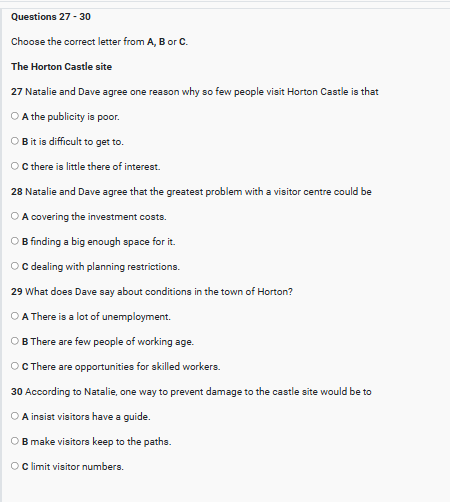
NATALIE: So basically, the problem we’re addressing in our case study of the Horton Castle site is why so few tourists are visiting it. And we’ll find out more from our interviews, but I did find one report on the internet that suggested that one reason might be because as far as transport goes, access is difficult.

DAVE: I read that too, but that report was actually written ten years ago when the road there was really bad. but that’s been improved now. And Q27 I think there’s plenty of fascinating stuff there for a really good day out. but you’d never realise it from the castle website – maybe that’s the problem.

NATALIE: Yes. it’s really dry and boring.

DAVE: I read somewhere a suggestion that what the castle needs is a visitor centre. So we could have a look for some information about that on the internet. What would we need to know?

NATALIE: Well, who’d use it for a start? It’d be good to know what categories the visitors fell into too, like school parties or retired people, but I think we’d have to talk to staff to get that information.

DAVE: OK. And as we’re thinking of suggesting a visitor centre we’d also have to look at potential problems. I mean, obviously it wouldn’t be cheap to set up.

NATALIE: No. but it could be a really good investment. Q28 And as it’s on a historical site it’d need to get special planning permission. I expect. That might be hard.

DAVE: Right, especially as the only possible place for it would be at the entrance, an d that’s right in front of the castle.

NATALIE: Mmm.

DAVE: But it could be a good thing for the town of Horton. At present, it’s a bit of a ghost town. Q29 Once they’ve left school and got any skills or qualifications, the young people all get out as fast as they can to get jobs in the city. and the only people left are children and those who’ve retired.

NATALIE: Right. Something else we could investigate would be the potential damage that tourists might cause to the castle site, I mean their environmental impact. At present the tourists can just wander round wherever they want, Q30 but if numbers increase, there might have to be some restrictions, like sticking to marked ways. And there’d need to be guides and wardens around to make sure these were enforced.

DAVE: Yes, we could look at that too. OK, well …

🎧Attempt Free Listening Test…

Learn From Experienced Teacher Best IELTS Coaching Dehradun Best IELTS in Dehradun Uttarakhand GMS Road BEST coaching in Dehradun Apply for Class Courses Today Good Results.

phone icon
8439000086
8439000087
7055710003
7055710004
IELTS Simulation 323 GMS Road, Near Ballupur Chowk, Dehradun, India
Chat on WhatsApp
email: info at ieltsband7.com

IELTS LISTENING – FITNESS HOLIDAYS S24T2

 IELTS listening Fitness Holidays listening practice test has 10 questions belongs to the Travel & Leisure subject.

In this session in your training day we’re going to look at some of the more specialised holidays we offer at BC Travel. Now, the travel business is very competitive and it’s important to be aware of how the market’s changing and developing. In terms of age groups, Q11 the over 65s are an important market, and one that’s increasing steadily year on year. The fewest holidays are taken by the 31 to 42-year-olds, and that figure shows no sign of rising.

🎧Attempt Free Listening Test…

⬇️  Download Free PDF

The biggest market at present is still the youngest group, the 16 to 30s, but this group’s also seen the biggest drop over the last few years, Q12 whereas there’s a noticeable growth in the number of holidays taken by the 55 to 64-year-olds. As far as the 43 to 54-year-olds are concerned, bookings there are steady, but I have to say we haven’t seen the increase we expected.

One trend we’re noticing with nearly all age groups is the growing popularity of holidays in which clients do some kind of specialised activity. I’m not talking here about adventure holidays, where clients take part in high-risk activities like white water rafting just for the thrill of it. Activity holidays usually involve rather less high-risk sports or things like art and music. they’re not necessarily cheaper than ordinary holidays, often the opposite, in fact. But Q13 they do often take place outside the main tourist centres, which gives an opportunity for clients to find out more about the local people and customs, and many say this is one of the most positive features of these holidays. Of course, they offer the chance to develop a new skill or talent, Q14 but clients often say that more than this, it’s the chance to create lasting relationships with other like-minded people that’s the main draw.

Let me give you some examples of BC Travel activity holidays. Our painting holidays take place in four different centres in France and Italy and they’re very popular with clients of all abilities from beginners onwards. Q15 We’ve got an excellent team of artists to lead the classes – some of them have been with us from the start, and five additional ones will be joining us this year so that we can offer a greater number of classes in each centre.

As far as cooking holidays are concerned. I know a Q16 lot of agents offer holidays where clients cook redoes related to one particular country. usually the one they’re staving in. but we focus on dishes from a great many different ones. Apart from that you’ll find the usual emphasis on good quality, organic ingredients – that’s more or less a given nowadays – and there are generally some meat-free recipes included.

Our photography holidays take place in a wide range of countries from Iceland to Vietnam, and clients have the opportunity to see some stunning scenery. Groups are small, no more than eight. Q17 so clients can have one-on-one tuition during the holiday. and excursions are arranged with fully-trained guides. At the end of each holiday, an exhibition is held of the photographs taken so that clients can see one another’s work and receive valuable feedback
from the tutor.

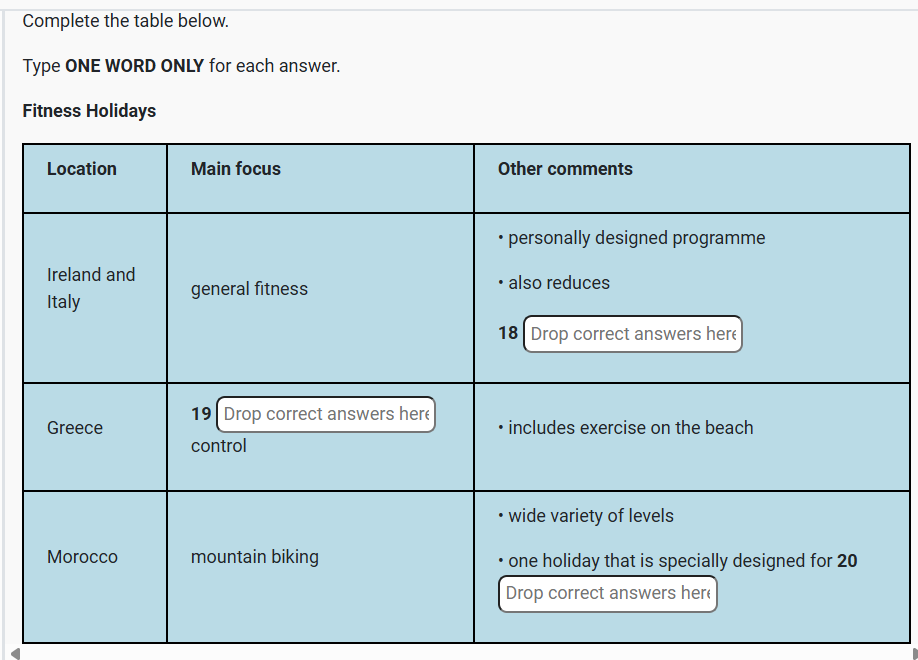
 Finally, let me tell you about our .fitness holidays. In Ireland and Italy, we run one-week general fitness classes for all ages and levels of fitness. Clients start the course with a consultation with a trainer, and together they draw up an individual programme. As well as improving general fitness, Q18 clients find that they end up losing much of the stress they’ve built up in their daily lives.

Q19 In Greece, we have a two-week holiday for clients who want to do something about their weight. This has all the features you’d expect, like a personalised diet programme. but one of its most popular features is that the exercise classes are all held on the beach. People say it’s far preferable to being in a gym.

finally, we offer several holidays in Morocco. One very popular one is the mountain biking holiday. Bikes are provided and there are different routes according to people’s ability. Q20 We offer one which is tailored to the needs of families, which is particular popular.

OK, so that’s about all the time I have today, so thank you very much …

🎧Attempt Free Listening Test…

 Easily Get Required Score I am interested in IELTS Pass with Confidence, Dehradun Small Batch Size with Flexible Time, professional faculty.

phone icon
8439000086
8439000087
7055710003
7055710004
IELTS Simulation 323 GMS Road, Near Ballupur Chowk, Dehradun, India
Chat on WhatsApp
email: info at ieltsband7.com


IELTS LISTENING – Four business values S22T4

IELTS SIMULATOR FREE GERERAL TRAINING ONLINE LISTENING - Four business values S1AT4 FREE COMPUTER DELIVERED ONLINE TEST IELTS SIMULATION
IELTS listening Four business values listening practice test has 10 questions belongs to the Business / Academic Lecture subject.

In public discussion of business, we take certain values for granted. Today I’m going to talk about four of them: collaboration. hard work, creativity, and excellence. Most people would say they’re all ‘good things’.

🎧Attempt Free Listening Test…

⬇️  Download Free PDF

I’m going to suggest that’s an over-simple view. The trouble with these values is that they’re theoretical concepts, removed from the reality of day-to-day business.

Q31 Pursue values by all means. but be prepared for what may happen as a result. They can actually cause damage. which is not at all the intention.

Business leaders generally try to do the right thing. But Q32 all too often the right thing backfires. if those leaders adopt values without understanding and managing the side effects that arise. The values can easily get in the way of what’s actually intended. OK. So the first value I’m going to discuss is Er, let me give you an example. Q33 On a management training course I once attended. we were put into groups and had to construct a bridge across a stream. using building blocks that we were given. The rule was that everyone in the team had to move at least one building block during the construction. This was intended to encourage teamwork. But it was really a job best done by one person. Q34 The other teams tried to collaborate on building the structure. and descended into confusion. with everyone getting in each other’s way. Our team leader solved the challenge brilliantly. She simply asked everyone in the team to move a piece a few centimeters. to comply with the rule. and then let the person in the team with an aptitude for puzzles like this build it alone. We finished before any other team. My point is that the task wasn’t really suited to team working. so why make it one?

Teamwork can also lead to inconsistency – a common cause of poor sales. Q35 In the case of a smartphone that a certain company launched, one director wanted to target the business market. and another demanded it was aimed at consumers. The company wanted both directors to be involved. so gave the product a consumer-friendly name. but marketed it to companies. The result was that it met the needs of neither group. It would have been better to let one director or the other have his way, not both. Now industriousness or hard work. It’s easy to mock people who say they work hard: after all. a hamster running around in a wheel is working hard – and getting nowhere. Of course, Q36 hard work is valuable. but only when properly targeted. Otherwise, it wastes the resources that companies value most – time and energy. And that’s bad for the organisation. There’s a management model that groups people according to four criteria: clever, hard-working. stupid and lazy. Q37 Here “lazy’ means having a rational determination not to carry out unnecessary tasks. It doesn’t mean trying to avoid work altogether. Most people display two of these characteristics. and the most valuable people are those who are both clever and lazy: they possess intellectual clarity, and they don”t rush into making decisions. They come up with solutions to save the time and energy spent by the stupid and hard-working group. Instead of throwing more man-hours at a problem. the clever and lazy group looks for a more effective solution.

Next we come to creativity. This often works well – creating an attention-grabbing TV commercial, for example, might lead to increased sales. But it isn’t always  a good thing. Some advertising campaigns are remembered for their creativity, without having any effect on sales. Q38 This happened a few years ago with the launch of a chocolate bar: subsequent research showed that plenty of consumers remembered the adverts. but had no idea what was being advertised. The trouble is that the creator derives pleasure from coming up with the idea, and wrongly assumes the audience for the campaign will share that feeling. A company that brings out thousands of new products may seem more creative than a company that only has a few, but it may be too creative. and make smaller profits.

Q39 Creativity needs to be targeted. to solve a problem that the company has identified. Just coming up with more and more novel products isn’t necessarily a good thing. And finally, excellence. We all know companies that claim they ‘strive for excellence’. but it takes a long time to achieve excellence. In business, being first with a product is more profitable than having the best product. A major study of company performance compared pioneers – that is, companies bringing out the first version of a particular product – with followers, the companies that copied and improved on that product. Q40 The study found that the pioneers commanded an average market share of 29 percent. while the followers achieved less than half that. only 13 percent – even though their product might have been better. Insisting on excellence in everything we do is time-consuming, wastes energy, and leads to losing out on opportunities. Sometimes, second-rate work is more worthwhile than excellence. ‘Make sure it’s excellent’ sound like a good approach to business, but the ‘ just ­ get-started’ approach is likely to be more successful.

🎧Attempt Free Listening Test…

Boost Your Score: Practice IELTS Online with IELTS Simulator.

phone icon
8439000086
8439000087
7055710003
7055710004
IELTS Simulation 323 GMS Road, Near Ballupur Chowk, Dehradun, India
Chat on WhatsApp
email: info at ieltsband7.com