Unlock the Benefits of IELTS Listening

Access our library of Listening practice audio in MP3 format for on-the-go listening, and PDFs for offline study sessions. Download MP3 and download PDF file for offline practice. 

IELTS LISTENING – Paper on Public Libraries S22T3

IELTS SIMULATOR GENERAL TRAINING ONLINE LISTENING - Paper on Public Libraries S1AT3 COMPUTER DELIVERED ONLINE TEST IELTS SIMULATION
IELTS listening Paper on Public Libraries  listening practice test has 10 questions belongs to the Library / Information Services subject. 

TRUDIE: OK, Stewart. We need to start planning our paper on public libraries. Have you thought of an angle yet?

STEWART: Well, there’s so much we could look into. How libraries have changed over the centuries, for instance, or how different countries

🎧Attempt Free Listening Test…

⬇️  Download Free PDF

organize them. What do you think, Trudie?

TRUDIE: Q21 Maybe we should concentrate on this country, and try and relate the changes in libraries to external developments, like the fact that far more people can read than a century ago, and that the local population may speak lots of different languages.

STEWART: We could include something about changes in the source of funding, too.

TRUDIE: Yes, but remember we’re only supposed to write a short paper, so it’s probably best if we don’t go into funding in any detail.

STEWART: Right. Well, shall we just brainstorm a few ideas, to get started?

TRUDIE: OK. We obviously need to look at the impact of new technology, particularly the internet. Now that lots of books have been digitalized, people can access them from their own computers at home.

STEWART: And if everyone did that, libraries would be obsolete.

TRUDIE: Yes.

STEWART: Q22 But the digitalized books that are available online for free are mostly out of copyright, aren’t they?  And copyright in this country lasts for 70 years after the author dies. So you won’t find the latest best-seller or up-to-date information.

TRUDIE: That’s an important point. Anyway, I find it hard to concentrate when I’m reading a long text on a screen. I’d much rather read a physical book. And it takes longer to read on a screen.

STEWART: Oh, I prefer it. I suppose it’s just a personal preference.

TRUDIE: Mm. I expect that libraries will go on evolving in the next few years. Some have already become centers where community activities take place, like local clubs meeting there. I think that’ll become even more common.

STEWART: I’d like to think so, and that they’ll still be serving their traditional function, but I’m not so sure. There are financial implications, after all. Q23 What I’m afraid will happen is that books and magazines will all disappear. and there’ll just be rows and rows of computers. They won’t look anything like the libraries we’re used to.

TRUDIE: Well, we’ll see. I’ve just had an idea. Why don’t we make an in-depth study of our local public library as background to our paper?

STEWART: Yes, that’d be interesting, and raise all sorts of issues. Let’s make a list of possible things we could ask about, then work out some sort of structure. Q24 For instance. um. we could interview some of the staff, and find out whether the library has its own budget. or if that’s controlled by the local council.

TRUDIE: And what their policies are? I know they don’t allow food, but I’d love to find out what types of noise they ban – there always seems to be a lot of talking, but never music. I don’t know if that’s a policy or it just happens.

STEWART: Ah, I’ve often wondered. Q25 Then there are things like how the library is affected by employment laws. I suppose there are rules about working hours. facilities for staff and so on.

TRUDIE: Right. Q26 Then there are other issues relating to the design of the building and how customers use it. Like what measures does the library take to ensure their safety? They’d need floor coverings that aren’t slippery, and emergency exits, for instance.

STEWART: Oh, and another thing – Q27 there’s the question of the kind of insurance the library needs to have. in case anyone gets injured. Yes, that’s something else to find out. You know something I’ve often wondered?

TRUDIE:  What’s that?

STEWART: Well, you know they’ve got an archive of local newspapers going back years? Well, Q28 next to it they’ve got the diary of a well-known politician from the late 19th century. I wonder why it’s there. Do you know what his connection was with this area?

TRUDIE: No idea. Let’s add it to our list of things to find out. Oh, I’ve just thought – Q29 you know people might ask in the library about local organisations. like sports clubs? Well. I wonder if they keep a database, or whether they just look online.

STEWART: Right. Q30 I quite fancy finding out what the differences are between a library that’s open to the public and one that’s part of a museum. for example – they must be very different.

TRUDIE:     Mmm. Then something else I’d like to know is …

🎧Attempt Free Listening Test…

Easily Get Required Score I am interested in IELTS Pass with Confidence, Dehradun Small Batch Size with Flexible Time, professional faculty.

phone icon
8439000086
8439000087
7055710003
7055710004
IELTS Simulation 323 GMS Road, Near Ballupur Chowk, Dehradun, India

Chat on WhatsApp
email: info at ieltsband7.com


IELTS LISTENING – TALK TO NEW KITCHEN ASSISTANTS S22T2

 IELTS listening Talk to new kitchen assistants  listening practice test has 10 questions belongs to the Training / Workplace subject.

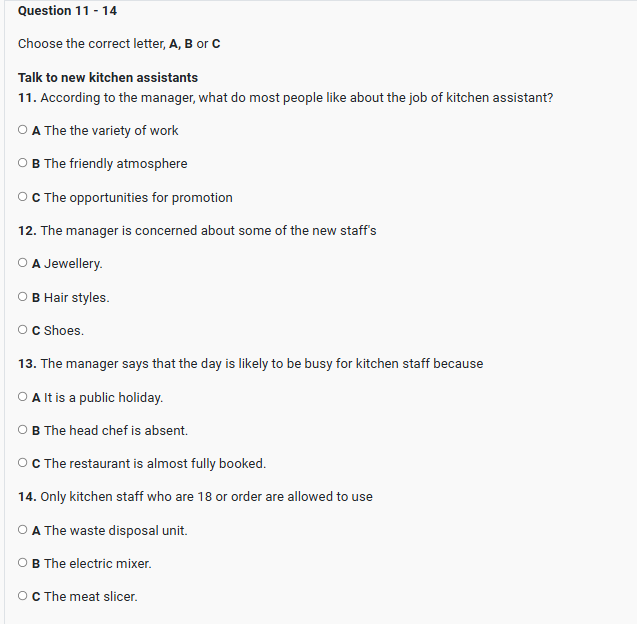
Good morning everyone. My name’s Jay Parkinds and I’m the restaurant manager. And I understand that none of you’ve had any previous experience as kitchen assistants. Well, you might be feeling a bit nervous now, but most of our kitchen assistants say they enjoy the work. OK. they might get shouted at sometimes, but it’s nothing personal, and Q11 they’re pleased that they have so many different things to do. which means they never get bored. And I’ll tell you straight away that if you do well, we might think about moving you up and giving you some more responsibility.

🎧Attempt Free Listening Test…

⬇️  Download Free PDF

Right, well, you’ve all shown up on time, which is an excellent start. Now I’m glad to see none of you have unsuitable footwear, so that’s good – you need to be careful as the floors can get very wet and slippery. Those of you with long hair have got it well out of the way, Q12 but some of you’ll need to remove your rings and bracelets – just put them somewhere safe for today, and remember to leave them at home tomorrow, as they can be a safety hazard.

Q13 Now it’s going to be a busy day for you all today – we don’t have get tables free for this evening, and only a few for lunch. Fortunately, we’ve got our Head Chef back – he was away on holiday all last week which meant the other chefs had extra work. Now, I’ll tell you a bit more about the job in a minute but first, some general regulations. For all of you, whatever your age, there’s some equipment you mustn’t use until you’ve been properly trained, like the waste disposal system for example, for health and safety reasons. Q14 Then I think there are two of you here who are under 18 – that’s Emma and Jake, isn’t it? Right. so for you two. the meat slicer is out of bounds. And of course, none of you are allowed to use the electric mixer until you’ve been shown how it works.

Now you may have heard that this can be a stressful job, and I have to say that can be true. You’ll be working an eight-hour day for the first week, though you’ll have the chance to do overtime after that as well if you want to. But however long the hours are, you’ll get a break in the middle. Q15 Q16 What you will find is that you’re on your feet all day long, lifting and carrying. so if you’re not fit now you soon will be! You’ll find you don’t have much chance to take it easy – when someone tells you to do something you need to do it straight away – but at least we do have a very efficient air conditioning system compared with some kitchens.

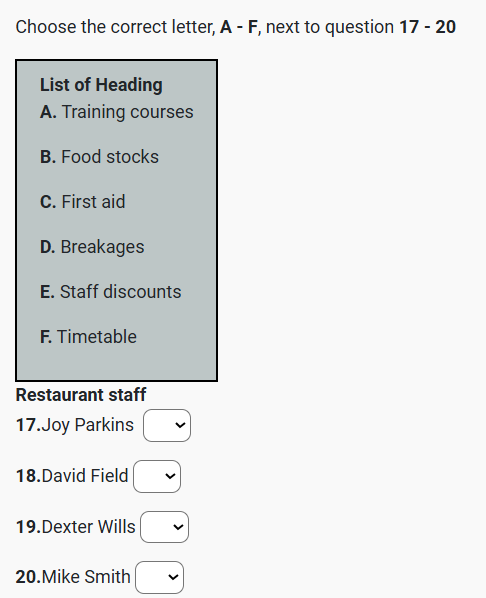
Now let me tell you about some of the people you need to know. So as I said. Q17 I’m Joy Parkins and I decide who does what during the day and how long they work for. I’ll be trying to get you to work with as many different people in the kitchen as possible so that you learn while you’re on the job. Q18 One person whose name you must remember is David Field. If you injure yourself at all. even if it’s really minor, you must report to him and he’ll make sure the incident is recorded and you get the appropriate treatment. He’s trained to give basic treatment to staff himself, or he’ll send you off somewhere else if necessary. Q19 Then there’s Dexter Wills – he’s the person you need to see if you smash a plate or something like that. Don’t just leave it and hope no one will notice – it’s really important to get things noted and replaced or there could be problems later. Q20 And finally. there’s Mike Smith. He’s the member of staff who takes care of all the stores of perishables, so if you notice we’re getting low in flour or sugar or something. make sure you let him know so he can put in an order.

OK, now the next thing …

🎧Attempt Free Listening Test…

Easily Get Required Score I am interested in IELTS Pass with Confidence, Dehradun Small Batch Size with Flexible Time, professional faculty.

phone icon
8439000086
8439000087
7055710003
7055710004
IELTS Simulation 323 GMS Road, Near Ballupur Chowk, Dehradun, India
Chat on WhatsApp
email: info at ieltsband7.com

IELTS LISTENING – Family Excursions S22T1

IELTS listening FAMILY EXCURSIONS   listening practice test has 10 questions belongs to the Travel & Leisure subject. 

TC EMPLOYEE: Hi. Can I help you?

VISITOR: I’d like to find out if you have any excursions suitable for families.

TC EMPLOYEE: Sure. How about taking your family for a cruise? Example We have a steamship that takes passengers out several times a day – it’s over 100 years old.

🎧Attempt Free Listening Test…

⬇️  Download Free PDF

VISITOR: That sounds interesting. How long is the trip?

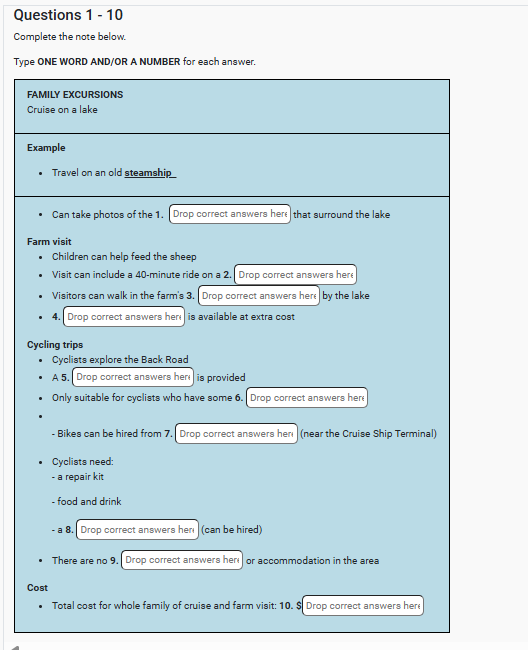
TC EMPLOYEE: About an hour and a half. Q1 And don’t forget to take pictures of the mountains. They’re all around you when you’re on the boat and they look fantastic.

VISITOR: OK. And I assume there’s a cafe or something on board?

TC EMPLOYEE: Sure. How old are your children?

VISITOR: Er, my daughter’s fifteen, and my son’s seven.

TC EMPLOYEE: Right. Well, there are various things you can do once you’ve crossed the lake, to make a day of it. One thing that’s very popular is a visit to the Country Farm. You’re met off the boat by the farmer and he’ll take you to the holding pens, where the sheep are kept. Children love feeding them!

VISITOR: My son would love that. He really likes animals.

TC EMPLOYEE: Well, Q2 there’s also a 40-minute trek round the farm on a horse, if he wants.

VISITOR: Do you think he’d manage it? He hasn’t done that before.

TC EMPLOYEE: Sure, It’s suitable for complete beginners.

VISITOR: Ah, good.

TC EMPLOYEE: And again, visitors are welcome to explore the farm on their own, as long as they take care to close dates and so on. Q3 There are some very beautiful gardens along the side of the lake which also belong to the farm – they’ll be just at their best now. You could easily spend an hour or two there.

VISITOR: OK. Well that all sounds good. Q4 And can we get lunch there?

TC EMPLOYEE: You can, and it’s very good. though it’s not included in the basic cost. You pay when you get there.

VISITOR: Right.

VISITOR: So is there anything else to do over on that side of the lake?

TC EMPLOYEE: Well, what you can do is take a bike over on the ship and then go on a cycling trip. There’s a trail there called the Back Road – you could easily spend three or four hours exploring it. and the scenery’s wonderful. Q5 They’ll give you a map when you get your ticket for the cruise – there’s no extra charge.

VISITOR: What’s the trail like in terms of difficulty?

TC EMPLOYEE: Quite challenging in places. It wouldn’t be suitable for your seven-year-old. Q6 It needs someone who’s got a bit more experience.

VISITOR: Hmm. Well, my daughter loves cycling and so do I, so maybe the two of us could go, and my wife and son could stay on the farm. That might work out quite well. But we don’t have bikes here… is there somewhere we could rent them?

TC EMPLOYEE: Yes, there’s a place here in the city. Q7 It’s called Ratchesons.

VISITOR: I’ll just make a note of that – er, how do you spell it?

TC EMPLOYEE: R-A-T-C-H-E-S-O-N-S. It’s just by the cruise ship terminal.

VISITOR: OK.

TC EMPLOYEE: You’d also need to pick up a repair kit for the bike from there to take along with you, and you’d need to take along a snack and some water – it’d be best to get those in the city.

VISITOR: Fine. That shouldn’t be a problem. And Q8 I assume I can rent a helmet from the bike place?

TC EMPLOYEE: Sure, you should definitely get that. It’s a great ride, but you want to be well prepared because Q9 it’s very remote – you won’t see get shops round there, or anywhere to stay, so you need to get back in time for the last boat.

VISITOR: Yeah. So what sort of prices are we looking at here?

TC EMPLOYEE: Let’s see, that’d be one adult and one child for the cruise with farm tour, that’s $117, and an adult and a child for the cruise only so that’s $214 dollars altogether. Oh, wait a minute, how old did you say your daughter was?

VISITOR: Fifteen.

TC EMPLOYEE: Then I’m afraid Q10 it’s $267 because she has to pay the adult fare, which is $75 instead of the child fare which is $22 – sorry about that.

VISITOR: That’s OK. Er, so how do …

🎧Attempt Free Listening Test…

Boost Your Score: Practice IELTS Online with IELTS Simulator.

phone icon
8439000086
8439000087
7055710003
7055710004
IELTS Simulation 323 GMS Road, Near Ballupur Chowk, Dehradun, India
Chat on WhatsApp
email: info at ieltsband7.com

IELTS LISTENING – The hunt for sunken settlements and ancient shipwrecks S21T4

IELTS SIMULATOR ONLINE ACADEMIC LISTENING EASY DEMO – The hunt for sunken settlements and ancient shipwrecks S21AT4 FREE COMPUTER DELIVERED ONLINE IELTS SIMULATION
 IELTS Listening The hunt for sunken settlements and ancient shipwrecks listening practice test has 10 questions belongs to the History / Academic lecture subject.

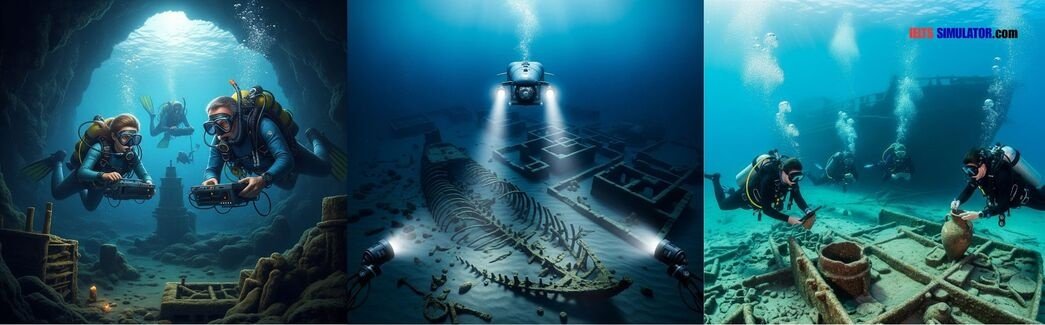
Archaeology: In today’s class, I’m going to talk about marine Archaeology, the branch of archaeology focusing on human interaction with sea lakes and rivers. It’s the study of ships, cargoes, and shipping facilities on other physical remains. I’ll give you an example. Then go on to show how this type of research is being transformed by the use of the latest technology.


🎧Attempt Free Listening Test…

⬇️  Download Free PDF


At least jam was a village on the coast of the eastern Mediterranean, which seems to have been thriving until around seven thousand BC. The residents kept cattle, caught fish and stored grain. They had wells for fresh water. Many of their houses were built around a courtyard and were constructed of stone. The village contained an impressive monument. Seven half-tonne stones standing in a semi-circle around the Q31 spring that might have been used for ceremonial purposes at Lidiane may have been destroyed swiftly by a tsunami

or climate change may have caused glasses to melt on ancient sea levels to rise, flooding the village gradually. Whatever the cause, it now lies ten metres below the surface of the Mediterranean, buried under sand at the bottom of the sea. It’s being described as the largest and best-preserved prehistoric settlement ever found on the seabed. For marine archaeologists, Atlit Yam is a treasure trove.

Research on the building’s Q32 tools and the human remains has revealed how the bustling village once functioned and even what diseases some of its residents suffered from. But of course, this is only one small village, one window into a lost world. For a fuller picture, researchers need more sunken settlements, but the hard part is finding them. Underwater research used to require divers to find shipwrecks or artefacts. But in the second half of the twentieth century, various types of underwater vehicles were developed, some ancient controlled from a ship on the surface and some of them autonomous, which means they don’t need to be operated by a person, autonomous underwater vehicles or AUVs. These are used in the oil industry, for instance, to create Q33 maps of the sea bed before rigs and pipelines are installed

to navigate. They use senses such as compasses. And so no. Until relatively recently they were very expensive and so Q34 heavy that they had to be launched from a large vessel with a winch. But the latest AUVs, are much easier to manoeuvre.

They could be launched from the shore or a small ship, and they’re much cheaper, which makes them more ancient and accessible to research teams. They’re also very sophisticated. They can communicate with each other on DH, for example, work out the most efficient way to survey a site or to find a particular object on the sea bed

field tests show the approach can work. For example, in a trial in twenty fifteen three, a UV has searched for Rex but Marty Mummy, off the coast of Sicily.

The site is the final resting place of an ancient Roman ship, which sank in the sixth century While ferrying prefabricated Q35 marble elements for the construction of an early church, the AUVs mapped the area in detail, finding other ships carrying columns of the same material.

Creating an Internet in the sea for a U visa to communicate is no easy matter. Wi-fi networks on land use electromagnetic waves, but in water, these will only travel a few centimetres. Instead, a more complex mix of technologies is required for short distances. They share data using Q36 light, while acoustic waves were used to communicate over long distances. But more creative solutions are also being developed, where an AUV working on the seabed offloads data to a second AUV, which then surfaces on beams the data home to the research team using a satellite.

There’s also a system that enables AUVs to share information from seabed scans and other data. So even a UV surveying the seabed finds an intriguing object. It can share the coordinates of the object that is, its position with a nearby, AUV that carries superior Q37 cameras. And arrange for that a UV to make a closer inspection of the object.

Marine archaeologists are excited about the huge potential of these AUVs for their discipline. One site where they’re going to be deployed is the Gulf of Barati off the Italian coast in nineteen seventy for a two-thousand-year-old Roman vessel was discovered here in eighteen metres of water when it sank. It was carrying Q38 medical goods in wooden or tin receptacles.

Its cargo gives us insight into the treatments available all those years ago, including tablets that are thought to have been dissolved to form a cleansing liquid for the Q39 eyes Other Roman ships went down nearby by taking their cargoes with um, some held huge pots made of terra cotta. Some were used for transporting cargoes of olive oil. The others held Q40 wine. In many cases, it’s only these containers that remain, while the wooden ships have been buried under silt on the seabed. 

🎧Attempt Free Listening Test…

Boost Your Score: Practice IELTS Online with IELTS Simulator.

phone icon
8439000086
8439000087
7055710003
7055710004
IELTS Simulation 323 GMS Road, Near Ballupur Chowk, Dehradun, India
Chat on WhatsApp
email: info at ieltsband7.com