Unlock the Benefits of IELTS Listening

Access our library of Listening practice audio in MP3 format for on-the-go listening, and PDFs for offline study sessions. Download MP3 and download PDF file for offline practice. 

IELTS LISTENING-History of Gothic Architecture S67T4
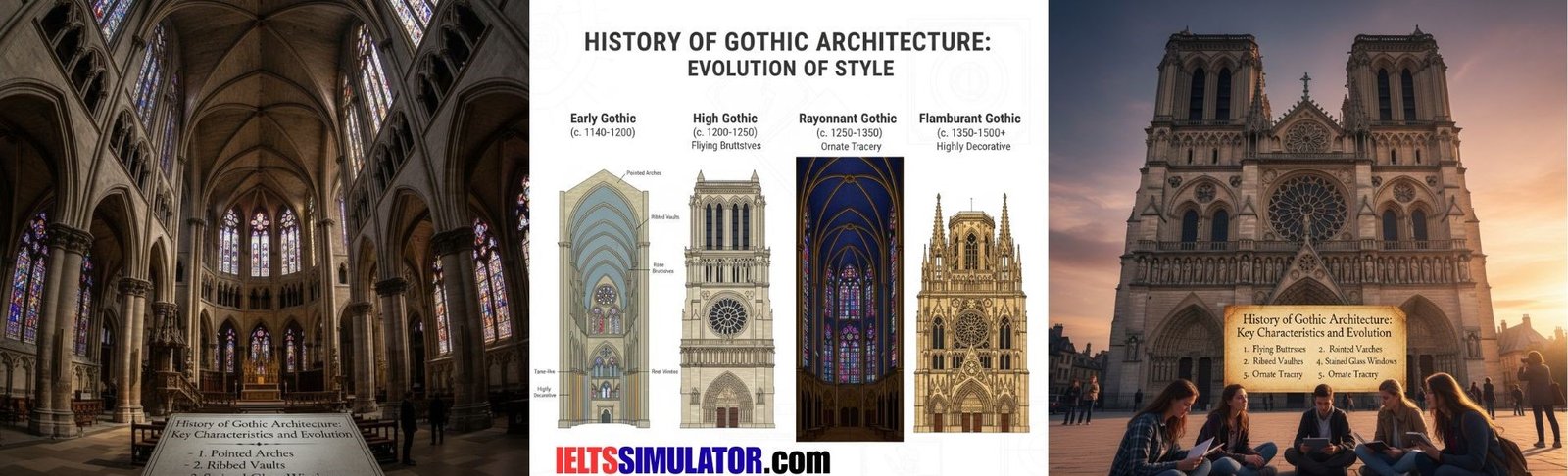
 IELTS listening History of Gothic Architecture listening practice test has 10 questions belongs to the Art & Architecture subject..

You will hear a university lecturer talking about the history of architecture. The houses of Parliament must be among the best-known sites of London, if not the world. Thousands of visitors flocked to the capital to have their photos taken with this iconic building, to hear the famous bells of the Westminster Times, and to hear the largest bell, Big Ben, as it strikes the hour. The building itself seems to be rooted in Britain’s ancient past, but it is, in fact, a much more recent Victorian example of how medieval architecture inspired contemporary design internationally in a movement referred to as the Gothic Revival.

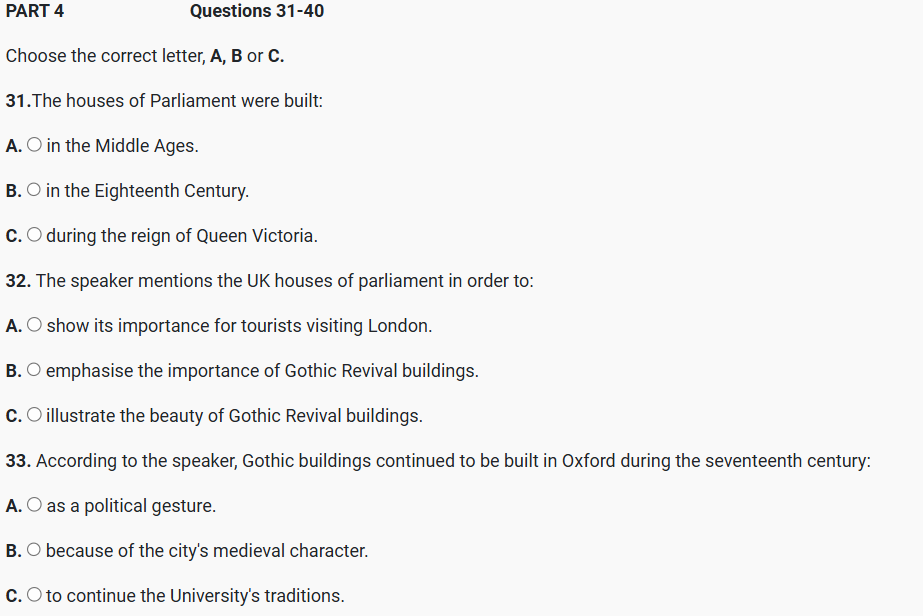
The term Gothic refers to the style of architecture used in Europe from the 12th century to the 16th century, most importantly churches and cathedrals. After falling out of favour for about a hundred years, the style was reborn during the 18th century as the Gothic Revival.
The exception to this, however, was the famous university town of Oxford, described as England’s most medieval city.
After the 17th century English Civil War, Oxford remained fiercely loyal to the king against the victorious parliamentary forces.During the period of parliamentary rule, some Gothic style buildings were constructed by the university to show its support for loyalty. In the first part of the 18th century, examples of Gothic detailing appeared in garden follies. Decorative buildings constructed to make the grounds of large, stately homes more beautiful.
However, when it was introduced into domestic building, the origins of this most conspicuous of architectural revivals came from literature. The then-popular Gothic horror story found its expression in bricks and mortar, in Horace Walpole’s 1750 Villa, Strawberry Hill in Twickenham, a suburb to the west of London. Walpole and his friends designed the house to give an appropriate gloomy atmosphere for his collection of antiques. This early period, in which a romantic mood was sought, was replaced in the 19th century with a more academic approach, in which architect studied buildings from the medieval past in order to reproduce their features more authentically.
For Augustus Pugin, who designed the Gothic decoration of London’s houses of Parliament, the ultimate in Gothic design, was the particular style developed in Venice, with its rulers Doge’s Palace, combining Gothic, classic and Arabic elements to be as he described it, the central building of the world.
As the 19th century progressed, historical accuracy was abandoned, as architects designed hitherto unknown building types, such as railway stations, exhibition halls and museums.
What made this historic-looking style so successful in the modern world was the incorporation of contemporary technology, in particular the use of iron. The utilization of contemporary cast iron was found to be perfectly compatible with ancient Gothic forms, such as the pointed arch.
The development of iron framed buildings provides a link between the Victorian architects of the Gothic revival and the new skyscrapers, which were being developed in the United States by the end of the 19th century. These multi-story buildings were also made possible with the introduction of the safety lift. A good example is the Woolworth Building in New York, which was built in 1913.

It was a modern building with Gothic decoration and was the tallest building in the world at the time. I like to think of it as the grandfather of the famous Manhattan Skyline. As artists and architects became more experimentally in their use of iron, they wandered further and further from Pugans Gothic ideals, most notably in the work of Antonio Gaudi in Barcelona and the development of Art Nouveau, which represented a significant break from a historic view of architecture.

Though modern architecture seems to have little relation to the Gothic revival, they share a common feeling for volume and space, as essential to building design. Furthermore, the principles of decorative domestic architecture can still be felt in the suburbs of Europe and America. It’s only the original romantic sense of gloom and melancholy that has been thrown into the dustbin of history.


Online Practice to Improve Your IELTS Score.

Try Realistic Practice on IELTS Simulator.

phone icon
8439000086
8439000087
7055710003
7055710004
IELTS Simulation 323 GMS Road, Near Ballupur Chowk, Dehradun, India

Chat on WhatsApp
email: info at ieltsband7.com
IELTS LISTENING-Postgraduate Study Discussion S67T3

 IELTS listening Postgraduate Study Discussion listening practice test has 10 questions belongs to the Career Guidance & Academic Counselling subject..

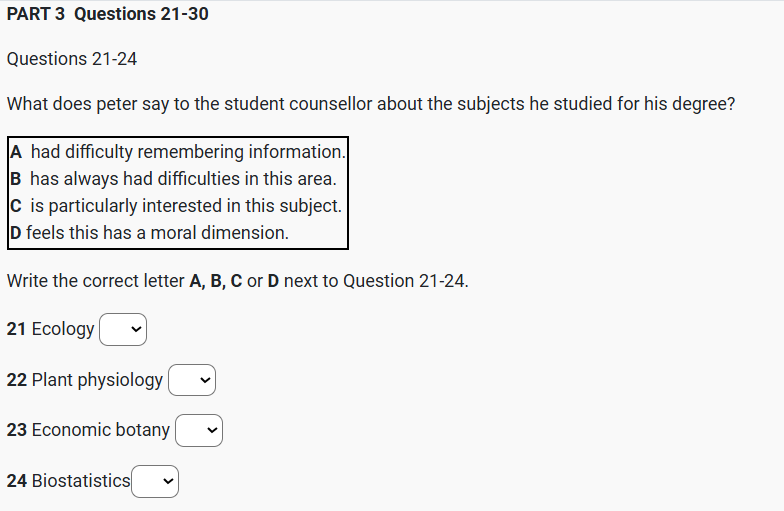
You will hear a councellor talking to a student about postgraduate degree courses. Well done for completing your degree, Peter. Were you pleased with your results?
I was a little disappointed I didn’t get the highest grade overall, but I did well in my favourite subjects. I got a first class grade in those subjects and pleased with that.
What were they? That was ecology and economic botany. I wasn’t very good at biostatistics or plant physiology. Plant physiology? You know the structure of plants, how they cope with different environments.

I think it’s really interesting, but I just couldn’t remember all the terminology we had to learn. I think that’s why I got a lower grade. As for statistics, I’ve never been any good at maths. So what did you do best in and why? Anything that included practical work, getting out into nature and seeing plants growing in the wild.

I’ve been interested in them since I was a small child, though I didn’t know what ecology was until my final year at school.
When I started studying it, I was hooked. You also mentioned economic botany. Yes, the opposite of ecology in a way, but I’m really worried about the future of our planet and how we’re going to be able to feed all of the people, what with climate change and all.
I feel, as a botanist, I have a real mission to help some of the world’s poorest people. That’s great. And now you’re thinking of doing a postgraduate degree. Yes, and I was wondering if you have any suggestions. There’s a lot to choose from. You said in the questionnaire you filled out earlier
that you would like to stay in the local area for personal reasons. Well, I’ve looked up four possible postgraduate courses that may interest you.
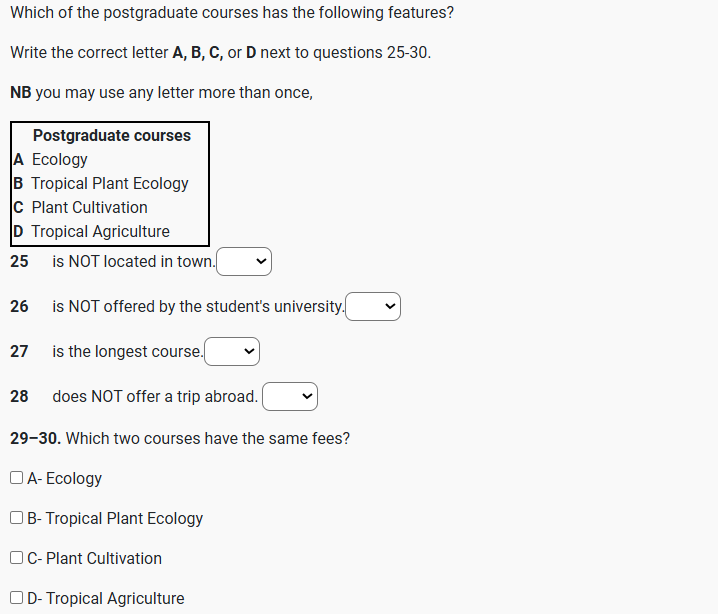
Ecology, Tropical Plant Ecology, Plant Cultivation and also Tropical Agriculture. Are they all offered by this university? The ecology courses are run here on campus,
while the Plant Cultivation course is run on our out of town campus.The Tropical Farming course is offered by the Farming Institute across town. And they’re all two semesters.

Yes, apart from the Tropical Farming course, which is one semester longer, as you undertake a longer study in a tropical location. Oh, that’s good. Is there a lot of field work in all the courses?
Yes.
Apart from the long study for the Tropical Farming course, the course in Tropical Plant Ecology has a month-long field trip abroad, while the others have two one-week excursions, with the Plant Cultivation course having an optional trip to study vineyards in France, as well as shorter one or two day trips. I imagine that’s reflected in the cost. Right.
The Tropical Farming course is, as you might expect, almost twice the cost of the course is based domestically, while the Tropical Ecology course is one and a half times as expensive. Hmm, thanks. I’ll give all of that some thought. So, what are your plans when you have completed your post-grad? I’m not sure yet. I suppose, ultimately, I’d like to work for the United Nations. Something like the Food and Agricultural Organization. That would be my ideal, but there are so many really good charities, NGOs and research institutes out there. Sounds good. Well, good luck. Thanks. See you later.


Learn From Experienced Teacher Best IELTS.

Small Batch Size, Flexible Time.

phone icon
8439000086
8439000087
7055710003
7055710004
IELTS Simulation 323 GMS Road, Near Ballupur Chowk, Dehradun, India
Chat on WhatsApp
email: info at ieltsband7.com
IELTS LISTENING- Different Types of Locks and How They Work S67T2

 IELTS listening Different Types of Locks and How They Work listening practice test has 10 questions belongs to the Security Systems & Engineering subject..

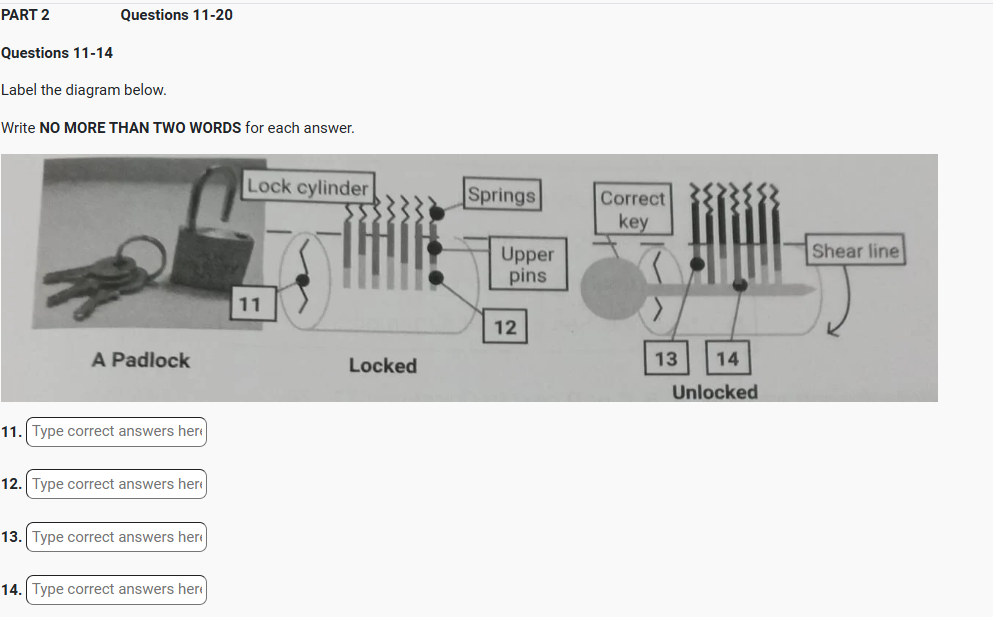
You will hear a lock expert talking about different types of locks. Safe under lock and key means security, and there are locks everywhere, securing different things in different ways. One of the most common types of lock is the cylinder lock, which is used in padlocks as well as doors. This was invented in the 19th century by Linus Yale Junior, so it’s often called a Yale lock. This is how a Yale lock works. When the correct key is inserted into the keyhole, which is shaped to match the blade of the key, the cylinder inside can be turned, so unlocking the door or padlock.

When locked, a series of pins projecting from the locked casing stop the cylinder from moving. There are two separate pins, upper pins and lower pins. The pins are forced from above into holes in the cylinder by a series of springs.

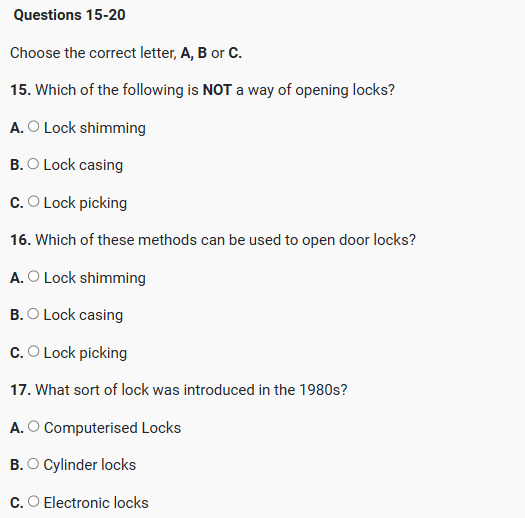
The key profile is cut into a series of high teeth and lower notches and the lower pins correspond to these, so when the key is inserted the upper pins are forced up into alignment over the shear line. allowing the cylinder to be turned. However, if a key is lost, the lock can still be opened. One method is picking the lock. In this, two tools are used, one to put tension on the cylinder, the other to lift each of the lower pins one at a time. A second is shimming, used with padlocks, in which a thin strip of metal is inserted between the lock cylinder and the lock casing, separating the lower and upper pins and allowing the cylinder to be turned. If you do find yourself locked out, you can call on the services of a professional locksmith, such as myself. However, for the smith to legally continue with their work, you will have to show proof that you are entitled to remove the lock or enter the building or room.

This could include showing a photo ID and some proof of ownership or residence. Otherwise, the locksmith is obliged to call the police. As technology develops, the job of the locksmith is becoming increasingly complex. Vehicles, for example, saw the introduction of electronic locks in the 1980s, and later computerised locks. Previously, leaving a key inside a car and then locking the vehicle was one of the most common causes of people being locked out. Now the problems are either to do with electric keys known as fobs, running out of battery power, or with the computer program which allows them to work. However, whether a car uses a new electronic key or a traditional one, losing them remains the most frequent cause of lockouts. The earliest electronic keys known as VATS keys for Vehicle Anti-Theft System used a traditional key with an additional electronic component set to a particular electrical resistance specific to any one vehicle which needed to be matched to start its motor.

Logsmiths have equipment to measure the required resistance and produce the corresponding key. If a computerized key is lost, which does not have a traditional keyblade, and a push button is used to start the vehicle, the owner must contact the dealer or qualified locksmith, giving the car’s VIN, or vehicle identification number, to reprogram the car’s onboard computer. Such expertise comes at a cost. As keys become more complex, security has increased, but so have the penalties for losing them.


Best Results Easily Get Required Score IELTS Exam.

phone icon
8439000086
8439000087
7055710003
7055710004
IELTS Simulation 323 GMS Road, Near Ballupur Chowk, Dehradun, India
Chat on WhatsApp
email: info at ieltsband7.com
IELTS LISTENING-Finding a Restaurant in Town S67T1

 IELTS listening Finding a Restaurant in Town listening practice test has 10 questions belongs to the Restaurants and Food subject..

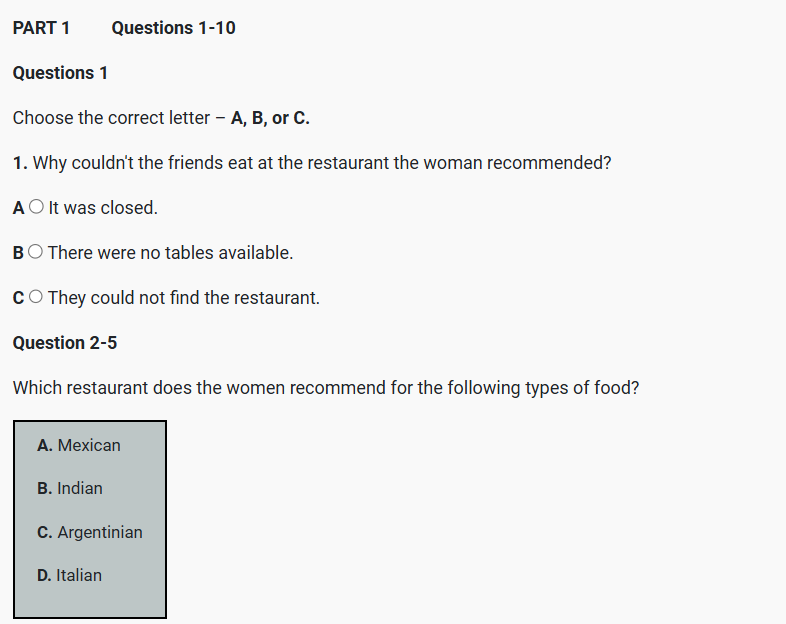
You will hear a woman talking on the phone to her friend about nearby restaurants. Hi, we’re still in town. It’s a fantastic place with so much to see. There was a brilliant craft show at the castle. Unfortunately, we missed the train as we got caught up in a long traffic jam, so we thought we’d grab something to eat while we wait for the next one. I’m glad you liked the place.

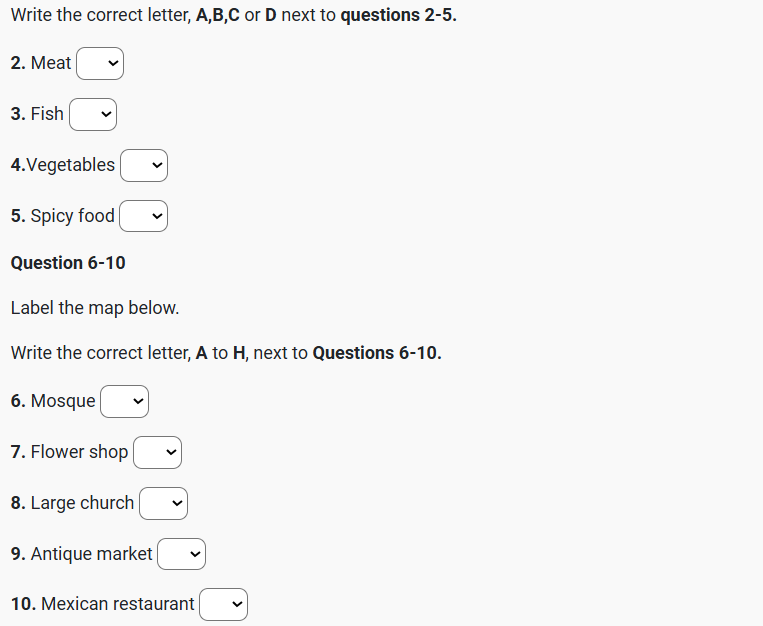
The craft fair sounds good. Actually, I’m still at work. Something came up. So I’ll be back late anyway. We tried that Indian restaurant you recommended, but it’s fully booked. Can you recommend anything else? That’s a shame. It’s the best vegetarian restaurant in town. I’ve been going there for ages. They have a matar paneer to die for.

Still, there’s so much there. It depends on what you like. There’s a great Italian seafood restaurant nearby. I would particularly recommend the tuna. It’s always really fresh and tasty. But if you still want spicy food, there’s also a Mexican taco place.

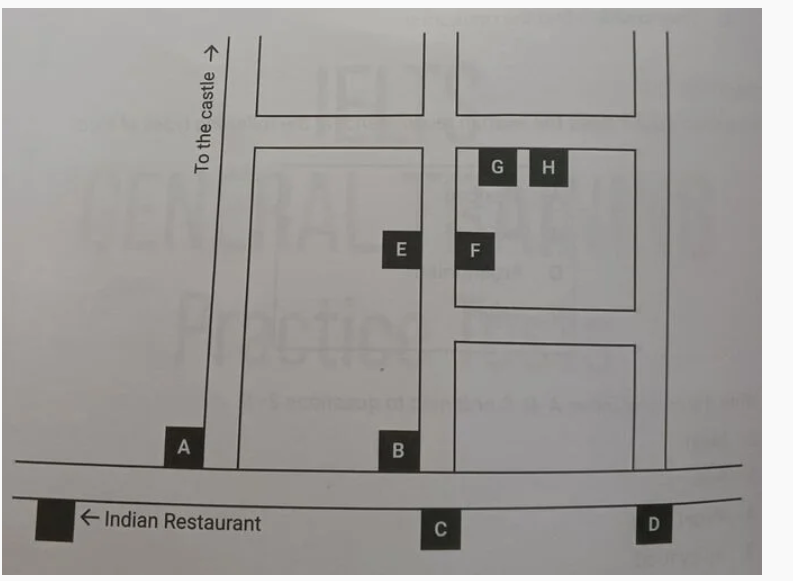
You know I don’t eat meat, but I think there’s also an Argentinian steakhouse not far from where you are. I know the manager, he’s actually from Argentina, but came over when he was about eight, so now he has a really thick local accent. The Mexican sounds good. I think we all love tacos. How do we get there? That’s not too difficult. First, stand with the Indian restaurant behind you and cross the road. Then turn right and take the second road on the left opposite the mosque. Isn’t that the road to the castle?

No, it’s the next street you want. There’s a flower shop on the corner. Go up the road, past the large church on your left, and when you get to the crossroad, turn right. The Mexican restaurant is just a little way down the road after the antique market we went to on Wednesday. Great. I think I’ve got that.

I’ll call again if we get lost. No problem. Have a great time. I’ll see you when I get back. It looks like I’m going to be here at work for a few hours yet.


Boost Your Score: Practice IELTS Online with IELTS Simulator.

phone icon
8439000086
8439000087
7055710003
7055710004
IELTS Simulation 323 GMS Road, Near Ballupur Chowk, Dehradun, India
Chat on WhatsApp
email: info at ieltsband7.com