Unlock the Benefits of IELTS Listening

Access our library of Listening practice audio in MP3 format for on-the-go listening, and PDFs for offline study sessions. Download MP3 and download PDF file for offline practice. 

IELTS LISTENING – Name of agent Flagstone S49T2

 IELTS listening Name of agent Flagstone listening practice test has 10 questions belongs to the Everyday Life.

MRS SMITH: Hello, Mrs Sutton. Come in. How are you settling in next door? Have all your things from Canada arrived yet? I thought I saw a removals van outside your house yesterday afternoon.

MRS SUTTON: Yes. They came yesterday. We spent all day yesterday arranging them. It’s beginning to feel a bit more like home now.

MRS SMITH: That’s good. Look, come in, and sit down. Are you alright? You look a bit worried.

⬇️  Download Free PDF

MRS SUTTON: Well, I am a bit. I’m sorry to bother you so early, Mrs Smith, but I wonder if you could help me. Could you tell me how I can get hold of a doctor? Our Q11 daughter Anna, isn’t very well this morning and I may have to call somebody out. She keeps being sick and I am beginning to get a bit worried. I just don’t know how the health system works here in England. All I know is that it’s very different from ours back in Canada.

MRS SMITH: Well, I don’t know really where to start. Let me think. Well, the first thing you have to do is find a family doctor – sometimes we call them general practitioners as well – and register with him or her. If you live here, you’ve got to be on a doctor’s list. If you’re not, things can be a bit difficult. Nobody will come out to you if you’re not registered. Anyway, they work in things called Q12 practices. Sort of small groups of family doctors all working together in the same building. Now what you’ve got to do this morning is register with one of them.

There are two practices near here, so we’re quite well off for doctors in this part of Manchester. There’s the Dean End Health Centre about ten minutes’ walk away and there’s another practice in South Hay. That’s about five minutes away going towards the town centre. We’re registered at the Dean End one, but they’re both OK. There are Q13 about six doctors in our practice and Q14 four in the other. So ours is quite big in comparison. And the building and everything’s a bit more modern. South Hay is a bit old-fashioned but the doctors are OK. Their only problem is that they Q15 don’t have a proper appointment system. Sometimes you have to wait for ages there to see someone. Anyway, you go to the receptionist in whichever health centre and ask her to register you with a doctor there. You have to fill in a form, but it doesn’t take long. Ours is called Dr Jones and we’ve been going to him for years – ever since we moved here fifteen years ago. I wouldn’t say he’s brilliant but I suppose he’s alright really. We’re used to him now. They say he’s very good with Q16 elderly people, but he does tend to get a bit impatient with children. Listen, the one who’s supposed to be really good with small children is Dr Shaw. I’ve heard lots of people say that. She’s young and she’s got small children of her own. So you could try registering with her. And if her list is full, I heard somebody say the other day that there’s a really nice young doctor at South Hay, a Dr Williams. He holds special clinics for people with Q17 back trouble. But that’s not really your problem, is it?

MRS SMITH: If you want a doctor to visit you at home, you have to ask for a home visit. You’re supposed to do that before 10.30 in the morning, but obviously, if it’s an emergency, you can phone at any time, night or day. It might not be your doctor that comes, though. It’s quite often one of the other doctors in the practice. It doesn’t really seem to make much difference.
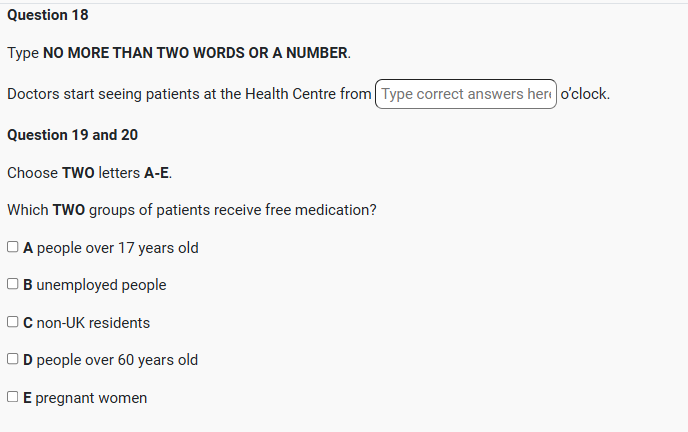
Otherwise, you make an appointment to see your doctor at the health centre. You usually get seen the same day. Not always of course, but usually, as I say. They hold surgeries between Q18 9 and 11.30 every weekday, and from 4 to 6.30 Monday to Thursday. Saturdays are only for emergencies.

When the doctor sees you, he gives you a prescription. He writes what medication you need on it and you take it to a chemist’s shop. There’s one opposite the centre. If it’s for a child under 16, you don’t have to pay. So if it’s for Anna. There’s no problem. The same thing goes if you’re Q19 unemployed or retired, or if you’re Q20 pregnant. Just as well because it’s not cheap. You pay the same price for each item the doctor has prescribed. At the moment it’s something like £5 per item. So you pay for the medication but the consultation with the doctor doesn’t cost you anything. It’s completely free as long as you’re a resident here. You’re going to be here for three years, aren’t you? So there shouldn’t be any question of you paying anything to see the doctor. So that’s one less problem to worry about.

Look, Mrs Sutton. If you want, I’ll sit with your daughter for half an hour if you want to go down to the health centre to register. It’s no trouble really, don’t worry.

MRS SUTTON: Are you sure you wouldn’t mind? That would really help me a lot. I’ll ask them if they can send someone round later to see Anna. I think I’ll try the Dean End Centre.

MRS SMITH: Good idea. Don’t worry about Anna.

MRS SUTTON: Right. I’ll be back as soon as I can.


Boost Your Score: Practice IELTS Online with IELTS Simulator.

phone icon
8439000086
8439000087
7055710003
7055710004
IELTS Simulation 323 GMS Road, Near Ballupur Chowk, Dehradun, India

Chat on WhatsApp
email: info at ieltsband7.com

IELTS LISTENING – Flagstone S49T1

IELTS listening Flagstone listening practice test has 10 questions belong to the Housing & Renting. 

JANICE: Hello… Flagstone.

JON: Oh! hello; is that Flagstone Properties?

JANICE: Yes that’s right. Flagstone here. How can I help you?

JON: Hello. I’m ringing just to make enquiries about renting a house. My name’s Jon Anderson.

⬇️  Download Free PDF

JANICE: Yes, Mr Anderson. What sort of thing were you looking for?

JON: Two-bedroomed house with garden.

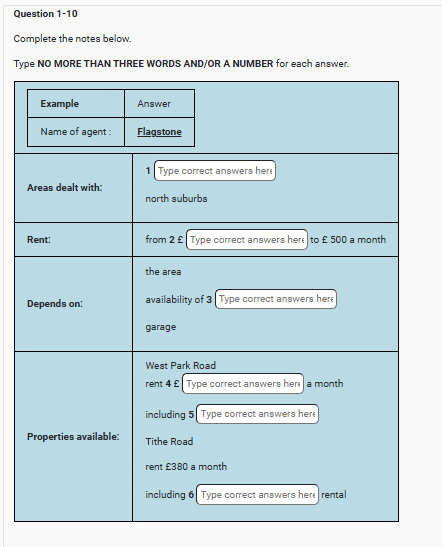
JANICE: Well… yes, sir, that shouldn’t be any problem. Just to let you know that our main areas, the main areas we deal with, are Q1 the city centre itself.

JON: City centre… uh-huh.

JANICE: And the north suburbs.

JON: Oh well… we were most interested in the Northern areas actually.

JANICE: Right… yes… What sort of price were you thinking of?

JON: Well… could you give me some idea?

JANICE: Certainly. It really ranges from £Q2 250 per month.

JON: Only £250?

JANICE: Yes, to about £500 depending on a number of different factors.

JON: What does it depend on?

JANICE: Well, obviously the quality of the area. And then whether there’s Q3 a garden.

JON: Well, as I said, we’d want a garden.

JANICE: And a garage pushes up the price.

JON: Right… well, we wouldn’t necessarily need one. I think about £350 a month would be our limit.

JANICE: OK. Well… would you like to have a look at a couple of properties, sir?

JON: Yes, that’d be great.

JANICE: Looking at our files… I think we’ve got two which might suit you.

JON: Hang on. I’ll just get a pen. Right.

JANICE: OK. Well, there’s one on West Park Road which is £Q4 325 a month.

JON: Are the bills included?

JANICE: Well, that one just includes Q5 the water bill.

JON: OK, right.

JANICE: And the second house is in Tithe Road. I’ll just spell that for you … OK?

JON: Yep.

JANICE: T-I-T-H-E Road.

JON: Got that. And how much is that one?

JANICE: That’s £380.

JON: 380. Is that including water?

JANICE: No, I’m afraid not, but it does include Q6 the telephone rental.

JON: Oh well, that’s not too bad then. So, …

JANICE: So, when would you be available to see them?

JON: Well, I’ll be in town next week … say … Thursday?

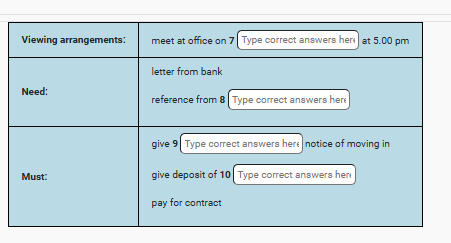
JANICE: No, I’m sorry we don’t have any availability for Thursday. How about Q7 Wednesday afternoon?

JON: OK. That’s fine. Would 5.00 be OK?

JANICE: Yes, fine. 5.00 o’clock it is. Just come to the Flagstone Offices.

JON: Oh, before I forget. What sort of things do I need to get done… to rent with you?

JANICE: Well, the most important thing is a letter from your bank.

JON: NO problem…

JANICE: And then a reference letter from Q8 your employer.

JON: Yes, that’s OK.

JANICE: Great, and then we would need you to give Q9 2 weeks’ notice of moving in.

JON: Right… 2 weeks’ notice. And what about a deposit?

JANICE: That’s Q10 one months rent, whatever the amount is.

JON: OK. One month. Is that it?

JANICE: No, sorry, one more… you will have to pay for the contract.

JON: Oh yes. I’d forgotten about that. OK, fine. So I’ll start arranging those, and I’ll…

JANICE:… I’ll see you next week.

JON: Yes. Thanks very much. Bye.

JANICE: Goodbye.


Best Results Easily Get Required Score IELTS Exam Dates Available, Small Batch Size with Flexible Time, Professional.

phone icon
8439000086
8439000087
7055710003
7055710004
IELTS Simulation 323 GMS Road, Near Ballupur Chowk, Dehradun, India
Chat on WhatsApp
email: info at ieltsband7.com

IELTS LISTENING – Wildlife In City Gardens S48T4

 IELTS listening Wildlife In City Gardens listening practice test has 10 questions belong to the Academic & Environment & Wildlife .
Good morning. Today I’d like to present the findings of our Year 2 project on wildlife found in gardens throughout our city. I’ll start by saying something about the background to the project, then talk a little bit about our research techniques, and then indicate some of our interim findings.
 

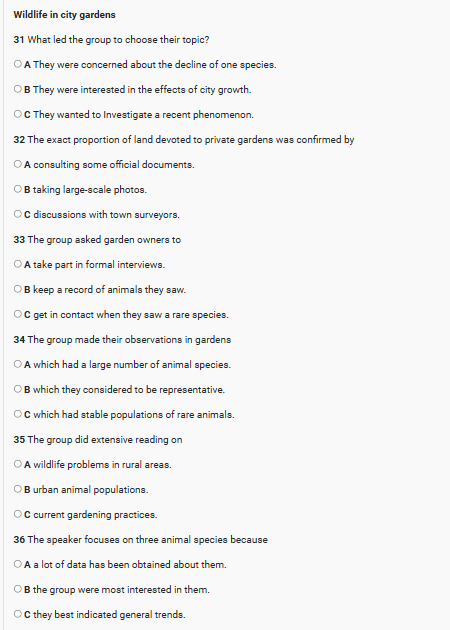
First of all, how did we choose our topic? Well, there are four of us in the group, and one day while we were Q31 discussing a possible focus, two of the group mentioned that they had seen yet more sparrow-hawks-one of Britain’s most interesting birds of prey – in their own city centre gardens and wondered why they were turning up in these gardens in great numbers.
 

⬇️  Download Free PDF

We were all very engaged by the idea of why wild animals would choose to inhabit a city garden. Why is it so popular with wildlife when the countryside itself is becoming less so?
 
The first thing we did was to establish what proportion of the urban land is taken up by private gardens. We estimated that it was about one fifth, and this was endorsed by looking at large-scale usage maps in the town land survey office – 24% to be precise.
 
Our own informal discussions with neighbours and friends led us to believe that many garden owners had interesting experiences to relate regarding wild animal sightings so we decided to Q33 survey garden owners from different areas of the city. Just over 100 of them completed a survey once every two weeks for twelve months – ticking off species they had seen from a pro forma list – and adding the names of any rarer ones.
 
Meanwhile, we were doing our own observations in selected gardens throughout the city. We deliberately chose smaller ones because they were by far the most typical in the city. The whole point of the project was to look at the norm not the exception. Alongside this primary research on urban gardens, we were studying a lot of books about the decline of wild animals in the countryside and thinking of possible causes for this.
 
So what did we find? Well, so much that I just won’t have time to tell you about here. If you’re interested in reading our more comprehensive findings, we’ve produced detailed graphic representations on the college website and of course any of the group would be happy to talk to you about them. Just email us.
 
What we’ve decided to present today is information about just three species – because we felt these gave a Q36 good indication of the processes at work in rural and urban settings as a whole.
 

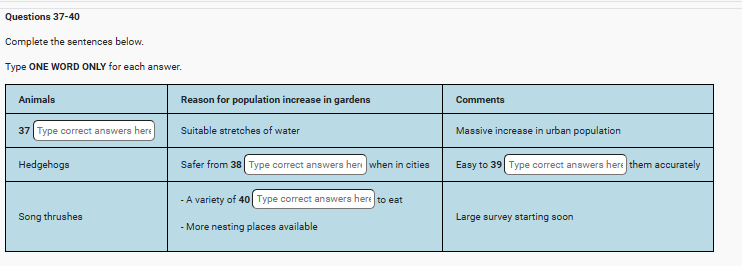
The first species to generate a lot of interesting information was Q37 frogs. And there was a clear pattern here – they proliferate where there is suitable water. Garden ponds are on the increase, rural ponds are disappearing, leading to massive migration to the towns.
 
Hedgehogs are also finding it easier to live in urban areas – this time because their Q38 predators are not finding it quite so attractive to Q35 leave their rural environment, so hedgehogs have a better survival rate in cities. We had lots of sightings, so all in all we had no difficulties with our efforts to Q39 count their numbers precisely.
 
Our final species is the finest of bird singers, the song thrush. On the decline in the countryside, they are experiencing a resurgence in urban gardens because these days gardeners are buying lots of different plants which means there’s an extensive range of Q40 seeds around, which is what they feed on.
 
Another factor is the provision of nesting places – which is actually better in gardens than the countryside. Hard to believe it, but it’s true. Incidentally, we discovered that a massive new survey on song thrushes is about to be launched, so you should keep an eye open for that.
Now, I’d be happy to answer any questions you may have…

Boost Your Score: Practice IELTS Online with IELTS Simulator.

phone icon
8439000086
8439000087
7055710003
7055710004
IELTS Simulation 323 GMS Road, Near Ballupur Chowk, Dehradun, India
Chat on WhatsApp
email: info at ieltsband7.com

IELTS LISTENING – Kira – The Exchange Student S48T3

 IELTS listening Kira – The Exchange Student listening practice test has 10 questions belong to the University Life.
PAUL: Hello, Kira, how are you?
 
KIRA: Fine thanks, Paul, how are you?
 
PAUL: Well, thanks. It’s good to see you. It must be twelve months since you did our course?

⬇️  Download Free PDF

PAUL: What course did you enroll in?
 
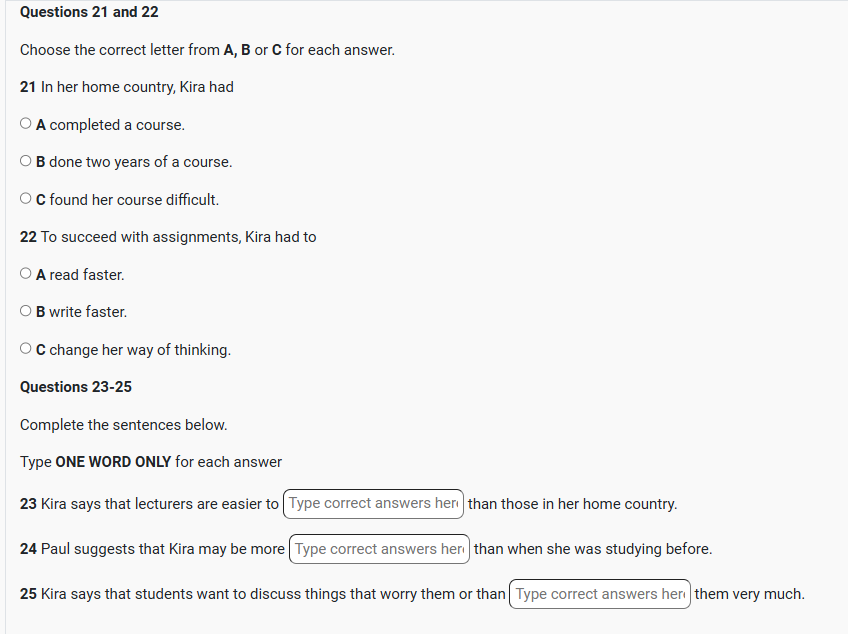
KIRA: Actually, I went straight into third-year Pharmacy. They credited me with two years, which probably made it more difficult for me.
 
PAUL: On the other hand, you were lucky to be granted credits. Is that why you chose the course?

KIRA: Yes. And, as I’d Q21 already finished a course in it in my country. I thought it would be easier if I studied something I already knew.
 
PAUL: I didn’t realise you went into third year. I thought you started in first year. No wonder it was so hard! And what do you think is one of the big differences between studying at a university here and studying in your country?
 
KIRA: Well, I’ve found it very difficult to write assignments, because I wasn’t familiar with that aspect of the system here. The main problem is that the lecturers expect you to be critical. That made me feel really terrible. I thought “How can I possibly do it? How can I comment on someone else’s research when they probably spent five years doing it?”
 
KIRA: I think a lot of people who come from overseas countries have similar problems. But after a while it became easier for me. People expect you to have problems with the process of reading and writing but, in fact, it is more a question of altering your viewpoint towards academic study.
 
PAUL: How was the content of the lectures? Was it easy for you?
 
KIRA: I didn’t really have many problems understanding lectures. The content was very similar to what I’d studied before.
 
PAUL: And what about the lecturers themselves? Are they essentially the same as lecturers in your country?
 
KIRA: Well actually, no. Here, they’re much easier to Q23 approach. After every lecture you can go and ask them something you didn’t understand. Or you can make an appointment and talk to them about anything in the course.
 
PAUL: Maybe you found them different because you’re a more Q24 mature student now, whereas when you were studying in your country you were younger and not so assertive.
 
KIRA: No, I don’t think that’s the difference. Most of the students here do it. In my faculty, they all seem to make appointments – usually to talk about something in the course that’s worrying them, but sometimes just about something that might really Q25 interest them, something they might want to specialise in. The lecturers must set aside certain times every week when they’re available for students.
 
PAUL: That’s good to hear.
 
PAUL: And how was your timetable? Was it a very busy year?

KIRA: Very, very busy. They make you work very hard. Apart from lectures, we had practical sessions in a lot of subjects. We did these in Q26 small groups. I had to go and work four hours every week in a community pharmacy. Actually, I enjoyed this very much – meeting new people all the time. Then in second semester, we had to get experience in hospital dispensaries, so Q27 every second day we went to one of the big hospitals and worked there. And on top of all that we had our assignments, which took me a lot of time. Oh, I nearly forgot, between first and second semesters, we had to work full-time for Q28 two weeks in a hospital.
 
PAUL: That does sound a very heavy year. So are you pleased now that you did it? Do you feel some sense of achievement?
 
KIRA: Yeah, I do feel much more Q29 confident, which I suppose is the most important thing.
 
PAUL: And have you got any recommendations for people who are studying from overseas?
 
KIRA: Well, I suppose they need very good English. It would be much better if they spent more time learning English before they enter the university, because you can be in big trouble if you don’t understand what people are saying and you haven’t got time to translate.
 
PAUL: Anything else?
 
KIRA: Well, as I said before, the biggest problem for me was a lack of familiarity with the Q30 education system here.
 
PAUL: It sounds as if it was a real challenge. Congratulations, Kira.
 
KIRA: Thanks, Paul.

Boost Your Score: Practice IELTS Online with IELTS Simulator.

phone icon
8439000086
8439000087
7055710003
7055710004
IELTS Simulation 323 GMS Road, Near Ballupur Chowk, Dehradun, India
Chat on WhatsApp
email: info at ieltsband7.com