Unlock the Benefits of IELTS Listening

Access our library of Listening practice audio in MP3 format for on-the-go listening, and PDFs for offline study sessions. Download MP3 and download PDF file for offline practice. 

IELTS LISTENING – Flight to Toronto S44T1

IELTS SIMULATOR ONLINE ACADEMIC LISTENING - Flight to Toronto S44AT1 FREE COMPUTER DELIVERED ONLINE IELTS SIMULATION
IELTS listening Flight to Toronto listening practice test has 10 questions belongs to the very day Social & Transactional Conversation. 

Customer: Good morning. I’d like to book a flight to Toronto, please.

Agent: Certainly. Flying from Sydney?

Customer: Yes. On Thursday, please.

Agent: Q1 Thursday the 16th? Right. … There are three flights that day. Do you prefer flying with any particular airline?

🎧Attempt Free Listening Test…

⬇️  Download Free PDF

Customer: I’ve heard that Air Canada is good but expensive. Is there a big difference in prices between the airlines? I’ll be flying Q2 business class.

Agent: Yes, there is. Air Canada is the most expensive airline at $4,000 to $6,000 for business class depending on the date of return. Qantas is $3,000 to $6,000 and Pacific, the budget airline, charges between $2,000 and $3,500.

Customer: Wow! That’s quite a difference in prices! I’m returning on from Wednesday 22nd, so could you check the return prices for me?

Agent: Sure. Let me just enter the return date into the computer. … OK. … Air Canada has tickets for $4,600. Qantas has them for $4,200. Pacific has tickets for $ Q3 3200. Those prices all include Q4 taxes and surcharges.

Customer: OK. Before I make a decision, I would like to know the departure and arrival times – in both directions.

Agent: Of course. Let’s look at Air Canada first. … Leaves Sydney at 10 a.m. and arrives in Toronto at 10 a.m. local time. There s a stopover in Vancouver. The Qantas flight leaves Sydney at Q5 1:45 and arrives at 10:15 a.m. There’s also a stopover in Q6 Vancouver, but it’s shorter than the Air Canada one. Pacific flies via Los Angeles and leaves at Q7 6:15. arriving at 11:55 p.m.

Customer: Oh, that doesn’t sound very convenient– flying by Pacific, I mean.

Agent: Well, budget airlines do offer cheaper tickets, but they are often not so advantageous in other ways.

Customer: How about the return flights?

Agent: Let me check. … The Air Canada flight leaves Toronto at 4:00 and arrives at 6:00 local time. The Qantas flight leaves at 9 a.m. and arrives at 11 a.m. local time in Sydney. Pacific … The Pacific flight leaves Toronto at Q8 10:25 and arrives at 06:10 local time in Sydney. Again, not very convenient timing.

Customer: No, it isn’t. Are the stopovers the same as on the outward journey?

Agent: Yes, they are.

Customer: Well, I have a business appointment on Wednesday 22nd in the morning, so, unfortunately, I can’t take the Qantas flight. The Pacific flight times are too inconvenient, so I’ll take the Air Canada flight, even though it’s more expensive.

Agent: Right. I’ll book that for you, shall I? Do you have your passport with you?

Customer: Yes, I do. … Here you are.

Agent: Thank you. I’ll just enter your details. … OK, could you just check this printout? Make sure that I’ve spell your name correctly and have written your passport number correctly, too…. Will you be paying by credit card?

Customer: Yes, I have a company credit card…. Here you are. … Oh, Q9 my name is Reece with a ‘c’, not a ‘s’.

Agent: Oh, I’m sorry! I’ll correct that. R, double E, C, E.

Customer: And my given names are Mary-Anne. Mary hyphen Anne – with an ‘e’ – oh, you’ve got that. Sorry.

Agent: OK. Mary-Anne joined together with a hyphen. Is the passport number OK?

Customer: Yes. Could you give me an official invoice, please? I need it for my company.

Agent: Certainly. Shall I use the company name as it appears on the credit card – Q10 ABC stocks?

Customer: Yes.

Agent: OK. Thank you. Could you sign here? … And here? … Thank you. I’ll just print out your ticket.

Customer: Thank you.

🎧Attempt Free Listening Test…

Small Batch Size, Flexible Time and Professional IELTS Teacher Best IELTS coaching classes IDP certified British Council trained and CELTA certified experienced trainer.

phone icon
8439000086
8439000087
7055710003
7055710004
IELTS Simulation 323 GMS Road, Near Ballupur Chowk, Dehradun, India

Chat on WhatsApp
email: info at ieltsband7.com

IELTS LISTENING – Rural Development S43T4

IELTS SIMULATOR ONLINE ACADEMIC LISTENING - Rural Development S43AT4 FREE COMPUTER DELIVERED ONLINE IELTS SIMULATION
IELTS listening Rural Development listening practice test has 10 questions belongs to the Academic &  Lecture. 

LECTURER:

I hope that this first session, which I’ve called An Introduction to British Agriculture, will provide a helpful background to the farm visits you’ll be doing next week.

I think I should start by emphasising that agriculture still accounts for a very important part of this country’s economy. We are used to hearing the UK’s society and economy described as being ‘industrial’ or even ‘post-industrial’, but we mustn’t let this blind us to the fact that agriculture and its supporting industries still account for around 20% of our Gross National Product.

🎧Attempt Free Listening Test…

⬇️  Download Free PDF


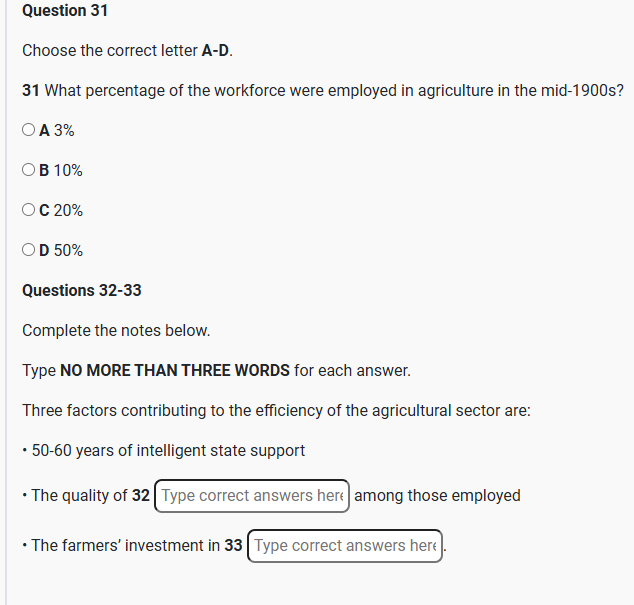
This figure is especially impressive, I think when you bear in mind how very small a percentage of the UK workforce is employed in agriculture. This is not a recent development – you would have to go back to 1750 or so to find a majority of the workforce in this country working in agriculture: Q31 By the middle of the next century, in 1850 that is, it had fallen sharply to 10%, and then to 3% by the middle of the twentieth century.

And now just 2% of the workforces contribute 20% of GNP. How is this efficiency achieved? Well, my own view is that it owes a great deal to a history, over the last 50 or 60 years, of intelligent support by the state, mainly taking the form of helping farmers to plan ahead. Then the two other factors I should mention, both very important, are the high level of Q32 training amongst the agricultural workforce. And secondly, the recognition by farmers of the value of investing in Q33 technology.

Now, although the UK is a fairly small country, the geology and climate vary a good deal from region to region. For our purposes today we can divide the country broadly into three – I’ve marked them on the map here (indicates map).

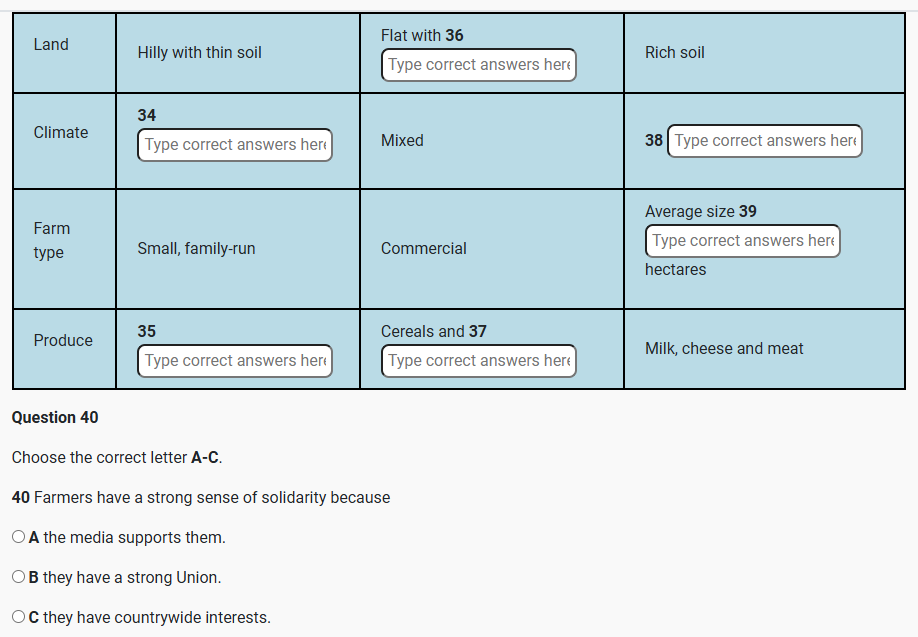
The region you’ll get to know best, of course, is the north, where we are at present. The land here is generally hilly, and the soils thin. The climate up here, and you’ve already had evidence of this, is generally Q34 cool and wet. As you will see next week, the typical farm here in the North is a small, family-run concern, producing mainly Q35 wool and timber for the market.

If we contrast that with the Eastern region, over here (indicating on map), the east is flatter and more low-lying, with Q36 fertile soils and a mixed climate. Average farm size is much bigger in the east, and farms are likely to be managed strictly on commercial lines. As for crops, well, the east is the UK’s great cereal-producing region. However, increasingly significant areas are now also given over to Q37 high-quality vegetables for supply direct to the supermarkets.

The third broad region is the west, where it’s a different story again. Q38 The climate is warmer than in the north and much wetter than in the east. The resulting rich soils in the west provide excellent pasture, and the farms there are quite large, typically around Q39 800 hectares. The main products are milk, cheese, and meat.

So, clearly, there are marked differences between regions. But this does not prevent quite a strong sense of solidarity amongst the farming community as a whole, right across the country. This solidarity comes in part from the need to present a united front in dealing with other powerful interest groups, such as government or the media. It also owes something to the close cooperation between all the agricultural training colleges, through which the great majority of farmers pass at the beginning of their careers. And a Q40 third factor making for solidarity is the national structure of the Farmers’ Union, of which virtually all farmers are members.

Finally, in this short talk, I would like to say a little about the challenges facing farmers in the next…

🎧Attempt Free Listening Test…

Boost Your Score: Practice IELTS Online with IELTS Simulator.

phone icon
8439000086
8439000087
7055710003
7055710004
IELTS Simulation 323 GMS Road, Near Ballupur Chowk, Dehradun, India
Chat on WhatsApp
email: info at ieltsband7.com

IELTS LISTENING – Assignment Discussion S43T3

IELTS SIMULATOR ONLINE ACADEMIC LISTENING - Assignment Discussion S43AT3 FREE COMPUTER DELIVERED ONLINE IELTS SIMULATION.
IELTS listening Assignment Discussion listening practice test has 10 questions belongs to the Educational & Academic Discussion. 

LYNNE: That essay we have to write … the one on how children learn through the media … how are you planning to write it?

ROBIN: Well, I’ve given it some thought and I think that the best way to approach it is to divide the essay into two parts. First of all, we’d have to look at some examples of each type of media…

🎧Attempt Free Listening Test…

⬇️  Download Free PDF


LYNNE: Yes, what they are … then we could describe how we can use each medium so that children can learn something from each one.

ROBIN: Exactly. Maybe we could draw up a table and look at examples of each medium in turn. Let’s see, the different forms of media would be … the print media …

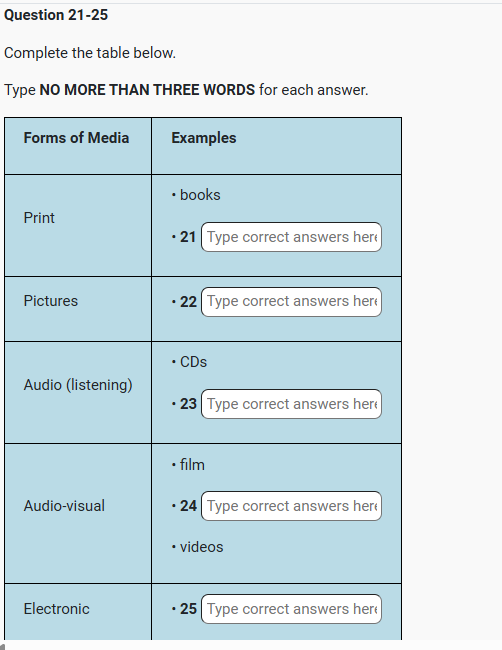
LYNNE: Here you’d have things like books and Q21 newspapers, that sort of thing …

ROBIN: Urn, and included in these are the pictorial forms of print media, like Q22 maps

LYNNE: Yes, maps are really just formal pictures, aren’t they? And then there are what we call the audio forms of media … where children can listen. CDs and Q23 radios are probably the best examples because a lot of children have access to these especially radios.

ROBIN: And this would lead into the audio-visual media, which can be seen as well as heard . . . film, Q24 television . . . and we mustn’t forget videos.

LYNNE: Yes, but there’s a final category as well … computers, that make up the so-called electronic media. In the United Kingdom and Australia, they say that one in three families has a Q25 computer now.

ROBIN: Yes, I believe it. Well, that’s a good list to start with … we’re really getting somewhere with this essay now … so let’s move on to when each type of medium could be used. I guess we could start by trying to identify the best situation for each type of media.

LYNNE: What do you mean?

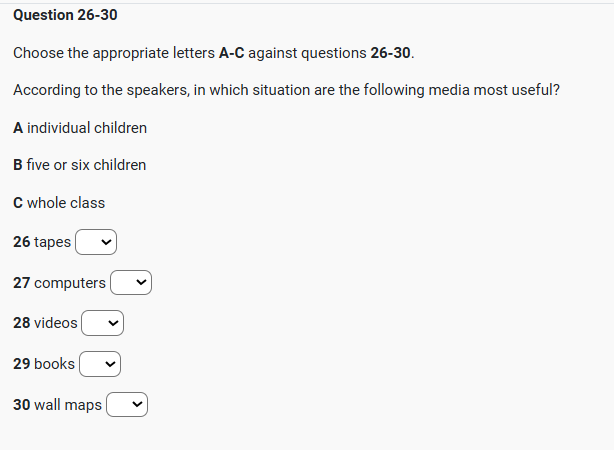
ROBIN: I’m talking about whether each medium should be used with different-sized groups. For example, we could look at pictures, and ask whether they’re more useful for an individual child, a few children together, or a full class – in this case, I’d say pictures are best with individual children because they give them an Example opportunity to let their imaginations run wild.

LYNNE: Yes, I see …

ROBIN: Q26 Let’s take tapes next. Although tapes look ideal for individual children, I feel they’re best suited to small group work. This way, children don’t feel isolated, because they can get help from their friends. Q27 Computers are the same … I think they’re better with small numbers of children and they’re hardly ever useful with a whole class. Q28 Videos, however, are ideal for use with everyone present in the class, especially when children have individual activity sheets to help them focus their minds on what’s in the video.

LYNNE: And what about books, what would you recommend for them? Q29 Books are ideal for children to use by themselves. I know they’re used with groups in schools, but I wouldn’t recommend it. Other pictorial Q30 media like maps, though, are different … I’d always plan group work around those … give the children a chance to interact and to share ideas.

ROBIN: I agree… teachers often just leave maps on the wall for children to look at when they have some free time, but kids really enjoy using them for problem-solving.

LYNNE: Yes, different people have different ideas I suppose…

ROBIN: Yes, and different teachers recommend different tools for different age groups…

🎧Attempt Free Listening Test…

Boost Your Score: Practice IELTS Online with IELTS Simulator.

phone icon
8439000086
8439000087
7055710003
7055710004
IELTS Simulation 323 GMS Road, Near Ballupur Chowk, Dehradun, India
Chat on WhatsApp
email: info at ieltsband7.com

IELTS LISTENING – Welcome to Smith House S43T2

IELTS SIMULATOR ONLINE ACADEMIC LISTENING - Welcome to Smith House S43AT2 FREE COMPUTER DELIVERED ONLINE IELTS SIMULATION
IELTS listening Welcome to Smith House listening practice test has 10 questions belongs to the Campus. 

COLLEGE PRESIDENT

Well, good morning, everyone, it’s good to see you all here. Welcome to Smith House. Q11 Smith House as you may or may not know, is one of the oldest residential colleges of the university. As you can see, the building you’re in now which contains this main lounge, the dining room, the recreation room, the kitchen and the offices was part of the original old house, built in the 1840s to be used by the family of George Smith.

🎧Attempt Free Listening Test…

⬇️  Download Free PDF

That’s of course how the house and college got their names. The original house was converted into, a residential college for the university in 1940 and since then has continued to be added on to and modernised.

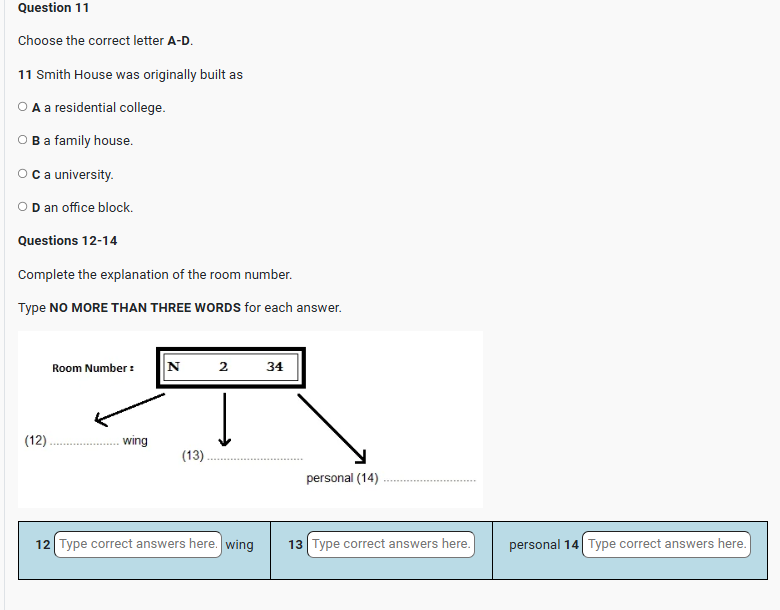
You’ll notice when you receive your room allocation in a few minutes that your room number either begins with the letter N, S, or W like this one here. The first letter refers to the three wings of the college which come away from this main building. Of course, the letters represent the three directions – in this case – Q12 north, south and west. Q13 Each wing has two floors, and so the next number you see is either one, or in this case two, and this indicates which floor your room is on. The number after that is your Q14 individual room number. So it’s quite simple to find any room by going to the right wing, then floor, and then room number.

You’ll also notice, when you receive your orientation pack shortly, that there are two keys. One is the key to your room and only you have that key – and the other is a key to the front door which you’ve just come through here from the street. Q15 This door is closed and locked at 8 pm every night and opened again at 7 am. You’ll need your key if you’re coming back to the college between those times. We ask all students to always enter and leave the college through the front door. You will notice at the end of each corridor that there is another door but these are Q16 fire doors and are kept locked from the outside. They should only be opened from the inside in case of emergency.

In your fees, you’ve paid a laundry fee which covers the cleaning of bed linen and towels. All bed linen and towels are clearly embossed with the name Smith House so it’s easily identifiable. Q17 If you want your other laundry to be done by the college this can be arranged for a small extra fee.

There are only a few rules here at Smith House and we have these rules so that we can all live comfortably together. The most important rule is that there must be no noise after 9 pm. Q18 There is also no smoking in the rooms or anywhere inside the college but smoking is permitted on the balconies.

All meals are served in the dining room. Meal times are listed in your orientation pack. Q19 Please read these carefully as meal times cannot be changed and if you arrive late I’m sorry to say you’ll just go hungry.

Q20 If you’re unsure about things, each floor has an elected ‘floor senior’ who is usually a student in their third or fourth year of study who’s been at Smith House for a while. The floor seniors will introduce themselves later today and answer any questions you have. But for now, I’m going to hand you over to Marney who is going to give you the orientation packs and keys. Thanks, Marney.

🎧Attempt Free Listening Test…

Best Results Easily Get Required Score IELTS Exam Dates Available, Small Batch Size with Flexible Time, Professional. Easily Get Required Score I am interested in IELTS Pass with Confidence, Dehradun Small Batch Size with Flexible Time, professional faculty.

phone icon
8439000086
8439000087
7055710003
7055710004
IELTS Simulation 323 GMS Road, Near Ballupur Chowk, Dehradun, India
Chat on WhatsApp
email: info at ieltsband7.com