Unlock the Benefits of IELTS Listening

Access our library of Listening practice audio in MP3 format for on-the-go listening, and PDFs for offline study sessions. Download MP3 and download PDF file for offline practice. 

IELTS LISTENING – SUBJECT OF DRAWING S3T3

IELTS SIMULATOR ONLINE IELTS LISTENING - SUBJECT OF DRAWING S3T3 FREE COMPUTER DELIVERED ONLINE IELTS SIMULATION.............

IELTS Listening SUBJECT OF DRAWING listening practice test has 10 questions belongs to the Arts / Education subject..

JEREMY: Hello, Helen. Sorry, I’m late.

HELEN: Hi, Jeremy, no problem. Well, we’d better work out where we are on our project, I suppose.

JEREMY: Yeah. I’ve looked at the drawings you’ve done for my story, ‘The Forest’, and I think they’re brilliant – they really create the atmosphere I had in mind when I was writing it.

HELEN: I’m glad you like them.

JEREMY: There are just a few suggestions I’d like to make.

🎧Attempt free listening test…

⬇️  Download free PDF

HELEN: Go ahead.

JEREMY: Now, I’m not sure about the drawing of the Q21 cave – it’s got trees all around it. which is great, but the drawing’s a bit too static, isn’t it? I think it needs some action.

HELEN: Yes, there’s nothing happening. Perhaps l should add the boy – Malcolm, isn’t it? He would be walking up to it.

JEREMY: Yes. let’s have Malcolm in the drawing. And what about putting in a Q22 tiger – the one that he makes friends with a bit later? Maybe it could be sitting under a tree washing itself.

HELEN: And the tiger stops in the middle of what it’s doing when it sees Malcolm walking past.

JEREMY: That’s a good idea.

HELEN: OK, I’ll have a go at that.

JEREMY: Then there’s the drawing of the crowd of men and women Q23 dancing. They’re just outside the forest, and there’s a lot going on.

HELEN : That’s right, you wanted them to be watching a carnival procession, but I thought it would be too crowded. Do you think it works like this?

JEREMY: Yes, I like what you’ve done. The only thing is, could you add Malcolm to it, without changing what’s already there?

HELEN: What about having him sitting on the tree trunk on the right of the picture?

JEREMY: Yes, that would be fine.

HELEN: And do you want him watching the other people?

JEREMY: No, he’s been left out of all the fun. so I’d like him to be Q24 crying – that’ll contrast nicely with the next picture, where he’s laughing at the clowns in the carnival.

HELEN: Right, I’ll do that.

JEREMY: And then the drawing of the people ice skating in the forest.

HELEN: I wasn’t too happy with that one. Because they’re supposed to be skating on Q25 grass, aren’t they?

JEREMY: That’s right, and it’s frozen over. At the moment it doesn’t look quite right.

HELEN: Mm, I see what you mean. I’ll have another go at that.

JEREMY: And I like the wool hats they’re wearing. Maybe you could give each of them a Q26 scarf, as well.

HELEN: Yeah, that’s easy enough. They can be streaming out behind the people to suggest they’re skating really fast.

JEREMY: Mm, great. Well, that’s all on the drawings.

HELEN: Right. So you’ve finished writing your story and I just need to finish illustrating it, and my story and your drawings are done.

HELEN: So the next thing is to decide what exactly we need to write about in the report that goes with the stories, and how we’re going to divide the work.

JEREMY: Right, Helen.

HELEN: What do you think about including a section on how we planned the project as a whole, Jeremy? That’s probably quite important.

JEREMY: Yeah. Well, Q27 you’ve had most of the good ideas so far. How do you feel about drafting something, then we can go through it together and discuss it?

HELEN: OK, that seems reasonable. And I could include something on how we came up with the ideas for our two stories, couldn’t I?

JEREMY: Q28 Well I’ve started writing something about that, so why don’t you do the same and we can include the two things?

HELEN: Right. So what about our interpretation of the stories? Do we need to write about what we think they show, like the value of helping other people, all that sort of thing?

JEREMY: That’s going to come up later, isn’t it? Q29 I think everyone in the class is going to read each other’s stories and come up with their own interpretations, which we’re going to discuss.

HELEN: Oh, I missed that. So it isn’t going to be part of the report at all?

JEREMY: No. But we need to write about the illustrations because they’re an essential element of children’s experience of reading the stories. It’s probably easiest for you to write that section, as you know more about drawing than I do.

HELEN: Maybe, but I find it quite hard to write about. Q30 I’d be happier if you did it.

JEREMY: OK. So when do you think …

🎧Attempt free listening test…

Boost Your Score: Practice IELTS Online with IELTS Simulator.

phone icon
8439000086
8439000087
7055710003
7055710004
IELTS Simulation 323 GMS Road, Near Ballupur Chowk, Dehradun, India

Chat on WhatsApp
email: info at ieltsband7.com


IELTS LISTENING – THE TAYLOR CONCERT HALL S2T4

IELTS SIMULATOR ONLINE IELTS LISTENING EASY DEMO - THE TAYLOR CONCERT HALL S2T4 FREE COMPUTER DELIVERED ONLINE IELTS SIMULATION 
 IELTS LISTENING THE TAYLOR CONCERT HALL listening practice test has 10 questions belongs to the Architecture / Entertainment subject..

We’ve been discussing the factors the architect has to consider when designing domestic buildings. I’m going to move on now to consider the design of public buildings, and I’ll illustrate this by referring to the new Taylor Concert Hall

🎧Attempt free listening test…

⬇️  Download free PDF

So, as with a domestic building, when designing a public building, an architect needs to consider the function of the building -for example, is it to be used primarily for entertainment, or for education, or for administration? The second thing the architect needs to think about is the context of the building, this includes its physical location. obviously. but it also includes the Q31 social meaning of the building, and how it relates to the people it’s built for. And finally, for important public buildings, the architect may also be looking for a central symbolic idea on which to base the design, a sort of metaphor for the building and the way in which it is used.

Let’s look at the new Taylor Concert Hall in relation to these ideas. The location chosen was a site in a run-down district that has been ignored in previous redevelopment plans. It was occupied by a Q32 factory that had been empty for some years. The whole area was some distance from the high-rise office blocks of the central business district and shopping center, but it was only one kilometer from the ring road. The site itself was bordered to the north by a Q33 canal which had once been used by boats bringing in raw materials when the area was used for manufacturing.

The architect chosen for the project was Tom Harrison. He found the main design challenge was the location of the site in an area that had no neighbouring buildings of any importance. To reflect the fact that the significance of the building in this quite run-down location was as yet unknown, he decided to create a building centered around the idea of a mystery -something whose meaning still has to be discovered.

So how was this reflected in the design of the building? Well, Harrison decided to create pedestrian access to the building and to make use of the presence of water on the site. As people approach the entrance, they, therefore, have to cross over a Q34 bridge. He wanted to give people a feeling of suspense as they see the building first from a distance, and then close-up, and the initial impression he wanted to create from the shape of the building as a whole was that of a Q35 box. The first side that people see, the southern wall, is just a high, flat wall uninterrupted by any windows. This might sound off-putting, but it supports Harrison’s concept of the building -that the person approaching is intrigued and wonders what will be inside. And this flat wall also has another purpose. At night-time. projectors are switched on and it functions as a huge Q36 screen. onto which images are projected.

The auditorium itself seats 1500 people. The floor’s supported by ten massive pads. These are constructed from Q37 rubber, and so are able to absorb any vibrations from outside and prevent them from affecting the auditorium. The walls are made of several layers of honey-colored wood, all sourced from local beech trees. In order to improve the acoustic properties of the auditorium and to amplify the sound, they are not straight. they are Q38 curved. The acoustics are also adjustable according to the size of orchestra and the type of music being played. In order to achieve this, there are nine movable panels in the ceiling above the orchestra which are all individually motorized, and the walls also have Q39 curtains which can be opened or closed to change the acoustics.

The reaction of the public to the new building has generally been positive. However, the evaluation of some critics has been less enthusiastic. In spite of Harrison’s efforts to use local materials. they criticize the style of the design as being Q40 international rather than local, and say it doesn’t reflect features of the landscape or society for which it is built.

 
🎧Attempt free listening test…

Boost Your Score: Practice IELTS Online with IELTS Simulator.

phone icon
8439000086
8439000087
7055710003
7055710004
IELTS Simulation 323 GMS Road, Near Ballupur Chowk, Dehradun, India
Chat on WhatsApp
email: info at ieltsband7.com


IELTS LISTENING – HIRING A PUBLIC ROOM S1T1

HIRING A PUBLIC ROOM

IELTS LISTENING Listening HIRING A PUBLIC ROOM listening practice test has 10 questions belongs to the Facilities & Services subject..

WOMAN : Oh, hello. I wanted to enquire about hiring a room in the Village Hall, for the evening of September the first.

🎧Attempt free listening test…

⬇️  Download free PDF


OFFICIAL : Let me just see … Yes, we have both rooms available that evening. There’s our Main Hall – that’s got seating for 200 people. Or there’s the Charlton Room …

WOMAN: Sorry?

OFFICIAL : The Q1 Charlton Room – C-H-A-R L-T-O-N. That’s got seating for up to one hundred.

WOMAN : Well, we’re organising a dinner to raise money for a charity, and we’re hoping for at least 150 people, so I think we’ll go for the Main Hall. How much would that cost?

OFFICIAL: Let’s see. You wanted it for the evening of September 1st?

WOMAN : Yes, that’s a Saturday.

OFFICIAL : So from six pm to midnight that’d be £Q2 115 – that’s the weekend price, it’s £75 on weekdays.

WOMAN : That’s all right.

OFFICIAL : And I have to tell you there’s also a deposit of £250, which is returnable of course as Iona as there’s no damage. But we do insist that this is paid in Q3 cash , we don’t take cards for that. You can pay the actual rent of the room however you like though – cash, credit card, cheque …

WOMAN : Oh, well I suppose that’s OK. So does the charge include use of tables and chairs and so on?

OFFICIAL : Oh, yes.

WOMAN : And what about Q4 parking ?

OFFICIAL : Yeah, that’s all included. The only thing that isn’t included is … you said you were organising a dinner?

WOMAN : Yeah.

OFFICIAL : Well, you’ll have to pay extra for the kitchen if you want to use that, it’s £25. It’s got very good facilities – good quality cookers and fridges and so on.

WOMAN : OK, well I suppose that’s all right. We can cover the cost in our entry charges.

OFFICIAL : Right. So I’ll make a note of that. Now there are just one or two things you need to think about before the event. For example, you’ll have to see about getting a licence if you’re planning to have any Q5 music during the meal.

WOMAN : Oh, really?

OFFICIAL : It’s quite straightforward, I’ll give you the details later on. And about a week or ten days before your event you’ll need to contact the caretaker, that’s Mr Evans, to make the arrangements for Q6 entry – he’ll sort that out with you.

WOMAN : And do I give him the payment as well?

OFFICIAL : No, you do that directly with me.

WOMAN : Right. Now is there anything I need to know about what happens during the event?

OFFICIAL : Well, as you’ll be aware, of course the building is no smoking throughout.

WOMAN : Of course.

OFFICIAL : Now, are you having a band?

WOMAN : Yes.

OFFICIAL : Well, they’ll have a lot of equipment, so rather than using the front door they should park their van round the back and use the Q7 stage door there. You can open that from inside but  don’t forget to lock it at the end.

WOMAN : OK.

OFFICIAL : And talking of bands, I’m sure l don’t need to tel! you this, but you must make sure that no one fiddles about with the black box by the fire door – that’s a system that cuts in when the  volume reaches a certain level. It’s a legal requirement.

WOMAN : Sure. Anyway, we want people to be able to talk to one another so we don’t want anything too loud. Oh, that reminds me, well be having speeches – are there any microphones available?

OFFICIAL : Yeah. Just let the caretaker know, he’ll get those for you. Right, now when the event is over we do ask that the premises are left in good condition. So there’s a locked cupboard and you’ll be informed of the Q8 code you need to open that. It’s got all the cleaning equipment, brushes and detergent and so on.

WOMAN : Right. So what do we need to do after everyone’s gone? Sweep the Q9 floors I suppose?

OFFICIAL : Well, actually they have to be washed, not just swept. Then you’ll be provided with black plastic bags, so all the rubbish must be collected up and left outside the door.

WOMAN : Of course. Well make sure everything’s left tidy. Oh. and I forgot to ask. I presume we can have Q10 decorations in the room?

OFFICIAL : Yes, but You must take them down afterwards.

WOMAN : Sure.

OFFICIAL : And the chairs and tables should be stacked up neatly at the back of the room

WOMAN : I’ll make sure I’ve got a few people to help me.

🎧Attempt free listening test…

Best Results Easily Get Required Score IELTS Exam Dates Available, Small Batch Size with Flexible Time, Professional.

phone icon
8439000086
8439000087
7055710003
7055710004
IELTS Simulation 323 GMS Road, Near Ballupur Chowk, Dehradun, India
Chat on WhatsApp
email: info at ieltsband7.com


IELTS LISTENING – Rocky Bay Field Trip S2T3


IELTS SIMULATOR ONLINE ACADEMIC IELTS LISTENING EASY DEMO - Rocky Bay Field Trip S2AT3 FREE COMPUTER DELIVERED ONLINE IELTS SIMULATION

IELTS LISTENING Rocky Bay field trip listening practice test has 8 questions belongs to the Research & Environment subject.

HELEN: I’ve brought my notes on our Biology Field Trip to Rocky Bay, Colin, so we can work on our report on the research we did together.

COLIN: OK. I’ve got mine too. Let’s look at the aims of the trip first.

HELEN: Right. What did you have?

 
🎧Attempt free listening test…

⬇️  Download free PDF

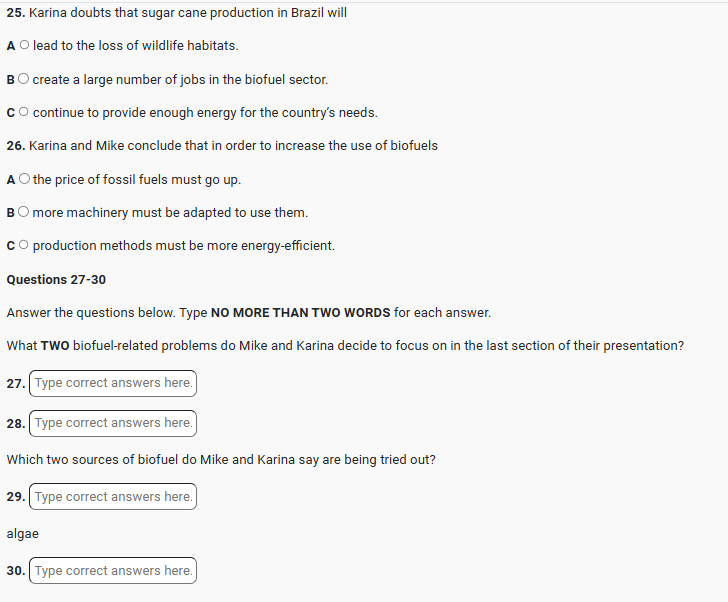
COLIN: I just put something about getting experience of the different sorts of procedures used on a field trip. But Q21 we need something about what causes different organisms to choose particular habitats.

HELEN: I agree. And something about finding out how to protect organisms in danger of dying out?

COLIN: In our aims? But we weren’t really looking at that.

HELEN: I suppose not. OK, now there’s the list of equipment we all had to bring on the field trip. What did they tell us to bring a ruler for?

COLIN: It was something about measuring the slope of the shore, but of course, we didn’t need it because we were measuring wind direction, and we’d brought the compass for that …

But not the piece of Q22 string to hold up in the air! Didn’t Mr. Blake make a fuss about us leaving that behind?

COLIN: Yeah. He does go on. Anyway, it was easy to get one from another of the students.

Now, the next section’s the procedure. I sent you the draft of that.

COLIN: Yeah. It was clear, but Q23 I don’t think we need all these details of what time we left and what time we got back, and how we divided up the different research tasks.

OK. I’ll look at that again.

COLIN: Then we have to describe our method of investigation in detail. So let’s begin with how we measured wave speed. I was surprised how Q24 straightforward that was.

I’d expected us to have some sort of high-tech device, not just stand there and count the number of waves per minute. Not very precise, but I suppose it was good enough. But the way we measured the amount of salt was interesting.

COLIN: In the water from the rock pools?

Yeah, oh, I wanted to check the chemicals we used in the lab when we analysed those samples – was it potassium chromate and silver nitrate?

COLIN: That’s right.

HELEN: OK. And we need the map of the seashore. You just left that to me. And I had to do t while the tide was low, well that was OK, but Q25 the place I started it from was down on the beach, then I realized I should have gone up higher to get better visibility. so I had to start all over again. But at least I’d got the squared paper or I’d have had problems drawing it all to scale.

HELEN: Yes. It looks good. We could get a map of the region off the internet and see if we need to make any changes.

I had a look but I couldn’t find anything. But you took some pictures, didn’t you?

COLIN: Yeah. I’ll email you them if you want.

HELEN: OK. Q26 I’ll make my amendments using those, then I can scan it into our report. Great. Now when we get to our findings I thought we could divide them up into the different zones we identified on the shore and the problems organisms face in each zone. So for the highest area …

COLIN: … the splash zone?

HELEN: Yeah, we found mostly those tiny shellfish that have strong hard shells that act as protection.

COLIN: But not from other organisms that might eat them, predators?

HELEN: No, that’s not the main danger for them. But the shells prevent them from Q27 drying out because they’re in the open air for most of the time.

COLIN: Right. And since they’re exposed, they need to be able to find some sort of shelter or cover themselves up, so they don’t get Q28 too hot. Then in the middle and lower zones, nearer the sea, we need to discuss the effects of wave action …

HELEN: Yes, and how organisms develop structures to prevent themselves from being swept away or even destroyed by being smashed against the rocks.

COLIN: I haven’t done anything on the geological changes. I don’t know what to put for that.

HELEN: No, we weren’t concentrating on that. Maybe we need to find some websites.

COLIN: Good idea. I’ve got the lecture notes from Mr. Blake’s geology course, but they’re too general. But we could ask him which books on our Reading List might be most helpful.

HELEN: Right. OK, now I did a draft of the section of sources of possible error in our research, but I don’t know if you agree. For example, the size of the sample, and whether it’s big enough to make any general conclusions from. But I thought actually we did have quite a big sample.

COLIN: We did. And our general method of observation seemed quite reliable. But we might not be all that accurate as far as the actual numbers go.

HELEN: Yeah, we might have Q29 missed some organisms – if they were hiding under a rock, for example. I wasn’t sure about the way we described their habitats. I decided it was probably OK.

COLIN: Yeah, and the descriptions we gave of the smaller organisms, they weren’t very detailed, but they were adequate in this context. Q30 I’m not sure we identified all the species correctly though.

HELEN: OK, we’d better mention that. Now, how …

 
🎧Attempt free listening test…

Easily Get Required Score I am interested in IELTS Pass with Confidence, Dehradun Small Batch Size with Flexible Time, professional faculty.

phone icon
8439000086
8439000087
7055710003
7055710004
IELTS Simulation 323 GMS Road, Near Ballupur Chowk, Dehradun, India
Chat on WhatsApp
email: info at ieltsband7.com